What is the atom's central core called where protons (P) and neutrons (N) are located?
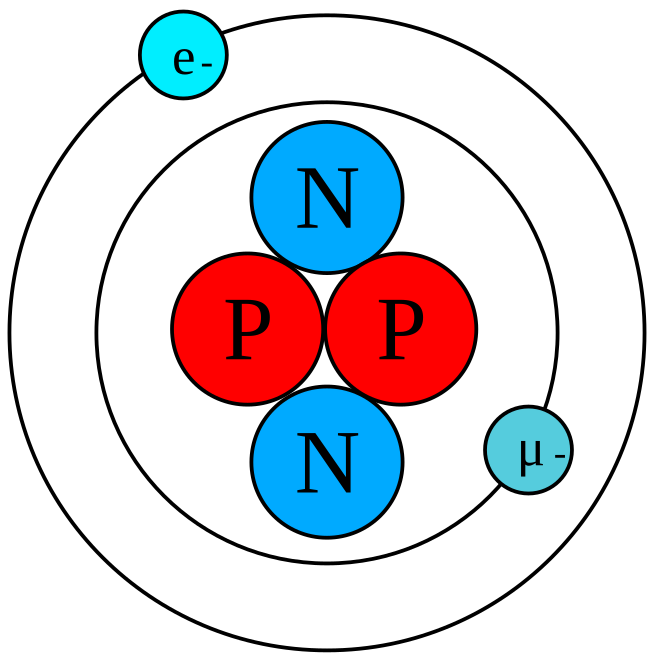
What is the atom's central core called where protons (P) and neutrons (N) are located?
What is the atom's central core called where protons (P) and neutrons (N) are located?
What subatomic particle has a negative charge?
Which particle in an atom's nucleus has a positive charge?
Which subatomic particle contributes to the mass of the atom but has no charge?
Match the scientist with their contribution to atomic theory
| Draggable item | arrow_right_alt | Corresponding Item |
|---|---|---|
Bohr | arrow_right_alt | Alpha particle scattering experiment |
Democritus | arrow_right_alt | Discovered the electron |
J.J. Thomson | arrow_right_alt | Energy levels of electrons |
Rutherford | arrow_right_alt | Everything was made of tiny particles |
Match the key atomic feature with its corresponding discovery
| Draggable item | arrow_right_alt | Corresponding Item |
|---|---|---|
Energy levels | arrow_right_alt | Gold foil experiment |
Discovered electrons | arrow_right_alt | Hydrogen spectrum analysis |
Atomic nucleus | arrow_right_alt | Cathode ray experiment |
What happens when an electron goes from high to low energy?
What determines the color of light an atom emits?
What occurs when an electron moves to a higher energy level?
Heated gaseous atoms of elements emit light in unique colored patterns as electrons drop from excited energy states to ground energy states. Heated hydrogen atoms have only four colored lines: red, green, blue, and violet. What prediction did Niels Bohr make about electrons based on this information?
An electron in an atom can gain energy by being heated and move to a higher energy orbital. When the electron returns to its ground state the energy is released as–