Log in
Sign up for FREE
arrow_back
Library

Space Rocks Quiz (9/18/2023)

star
star
star
star
star
Last updated over 2 years ago
10 questions
Required
10
Required
10
Required
10
Required
10
Required
10
Required
10
Required
10
Required
10
Required
10
Required
10
Question 1
1.

Question 2
2.

Question 3
3.

Question 4
4.

Question 5
5.

Question 6
6.

Question 7
7.

Question 8
8.

Question 9
9.

Question 10
10.

How many stars are in our solar system?
10 billion
0
1
100 million
The curved path of a celestial object or spacecraft around a star, planet, or moon is
a/an .
comet
moon
orbit
model
A is an instrument that aids in the observation of objects far away.
teleprompt
microscope
digital analyzer
telescope
The is at the center of our solar system.
Earth
Sun
Asteroid Belt
Moon
Which of the following is a wide region of small, rocky bodies that is located between the orbits of Mars and Jupiter?
the Oort cloud
the Kuiper Belt
the asteroid belt
the rings of Saturn
Terry was learning about an object in the Solar System that is made of frozen gases, ice, dust, and solid rock. Which of these objects was she learning about?
a comet
an asteroid
a star
a meteor
A meteorite is DIFFERENT from a comet mainly because it:
has a tail of ice and dust.
has a nucleus made of snow and rock.
enters the Earth’s atmosphere.
is found in orbit between Mars and Jupiter.
The bars of light in the picture are particles and debris that produce a streak of light as they burn up in Earth's atmosphere. They are sometimes called shooting stars. These are called:
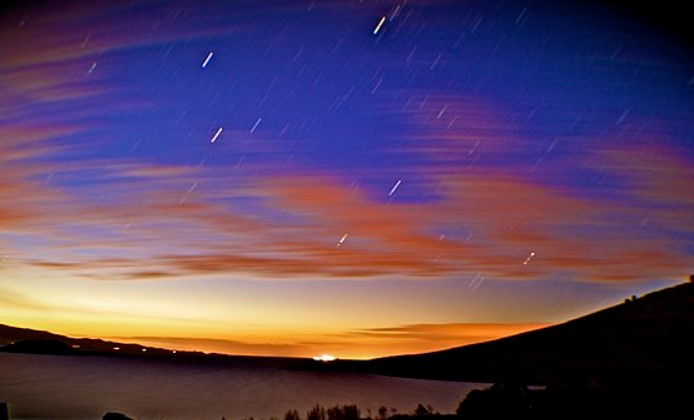
interplanetary dust.
asteroids.
meteors.
comets.
Comets and meteoroids are small solar system bodies that orbit the Sun. There is one distinctive feature of a comet that sets it apart from a meteoroid. What is it?
visible coma - fuzzy outline and tail
the naming process for both comets and meteoroids is the same
variances in the rock composition in both comets and meteoroids
elliptical orbits around the Sun
~ A rock ~ Found in a belt ~ Originates between Mars and Jupiter ~ Vary greatly in size; dust-like to hundreds of miles across The prompt above is describing what celestial body?
dark matter
meteor
asteroid
comet