Log in
Sign up for FREE
arrow_back
Library

Unit 1 Mid Unit Test Re-take

star
star
star
star
star
Last updated 25 days ago
13 questions
Required
3
Required
3
2
1
1
1
1
1
1
Required
2
1
1
2
Question 1
1.

334 J/g Heat of fusion (melting or freezing) Hfus
2260 J/g Heat of vaporization (evaporating or condensing) Hvap
2.1 J/g˚C Heat capacity (c) of ice
4.18 J/g˚C Heat capacity (c) of liquid water
1.9 J/g˚C Heat capactiy (c) of steam

Calculate the heat when 25 g of water at 100˚C is converted to steam at 135˚C.

TYPE NUMBERS ONLY. Round to the WHOLE number (ex. 1234)

Question 2
2.

The specific heat of aluminum is 0.380 J/g°C. Calculate the heat when 479 g of aluminum is cooled from 37.2°C to 22.5 °C.

In the typing box, type the NUMBERS only! Round to the WHOLE number (Ex. 1234)

Question 3
3.

The specific heats of 4 substances are shown below. If 500 J of energy is applied to each substance,

After 10 minutes, rank the substance from greatest to least temperature change.

Specific Heat of Metals
Iron-0.460 J/g°C
Gold-0.129 J/g°C
Silicon- 0.711 J/g°C
Aluminum- 0.380 J/g°C

  1. Silicon
  2. Aluminum
  3. Gold
  4. Iron
Question 4
4.

What causes a substance to have high thermal energy but low temperature?

Question 5
5.

During a change in state from gas to liquid what is happening to the energy of the substance?

Question 6
6.

Which of the following are examples of thermal energy transfer through conduction? Select all that apply.
(Pick 2)

Question 7
7.

Which of the following are examples of thermal energy transfer through convection? Select all that apply.

(Pick 2)

Question 8
8.

Which of the following are examples of thermal energy transfer through radiation? Select all that apply.

(Pick 2)

Question 9
9.

Which of the following objects has the greatest amount of thermal energy?

Question 10
10.

There are three liquids that Mrs. Garcia tests in a lab. She lights a fire underneath all the liquids and takes the temperature in minute increments. Based on her lab data, rank the liquids from lowest to highest specific heat! Note-*not actual lab data.
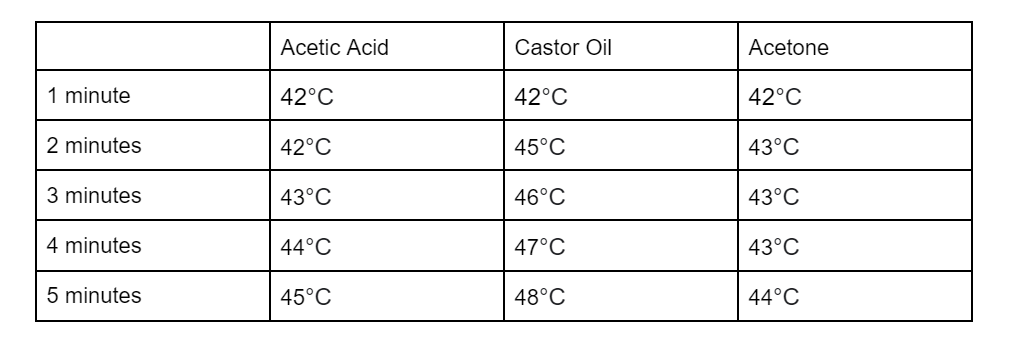
  1. Castor Oil
  2. Acetic Acid
  3. Acetone
Question 11
11.

To compare the specific heats of Samples A and B, Ms. Phong heats up 5 grams of Sample A and 5 grams of Sample B to 250°C and places them in two identical bomb calorimeters with the initial temperature of 100 g of water at 20°C.

The Final Temperature of Sample A + Water = 50°C
The Final Temperature of Sample B + Water = 50°C

What can you conclude about the specific heats of sample A and sample B?

Question 12
12.

A 100 g sample of water at 100°C is mixed with a 1000 g sample of water at 25°C. What will the final temperature be closest to?

Question 13
13.

Mr. Cortez went on another camping trip. He wants to freeze the leftover ramen so he can save it for later.
The initial temperature of his leftover ramen is 90°C. He wants to freeze his ramen at -10°C.


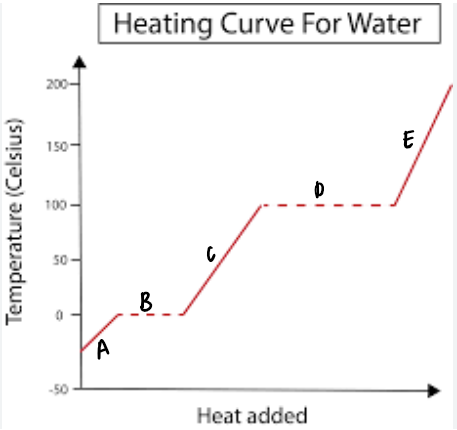
Which parts of the heating curve will you be looking at?