1.6 The U.S. Tax System 9/19/23

Last updated 10 months ago
36 questions
Note from the author:
OBJECTIVES & STANDARDS
Math Objectives
  • Use piecewise-linear equations without graphing in a realistic context
  • Calculate using percentages
  • Deconstruct a larger problem into smaller, constituent problems to solve
Common Core Math Standards
  • Link to all CCSS Math
  • CCSS.PRACTICE.MP2
  • CCSS.PRACTICE.MP4
  • CCSS.HSA.SSE.A.1
  • CCSS.HSA.CED.A.1
  • CCSS.HSA.REI.A.1
  • CCSS.HSF.BF.A.1
Personal Finance Objectives
  • Differentiate between deductions and credits on a U.S. tax return
  • Compare and contrast the many different deductions available
  • Differentiate between earned and unearned income and their tax implications
  • Examine tax breaks that apply specifically to students and recent graduates
National Standards for Personal Financial Education
Earning Income
  • 1d: Examine the benefits of participating in employer sponsored retirement savings plans and healthcare savings plans
  • 6a: Calculate the amount of taxes a person is likely to pay when given information or data about the person’s sources of income and amount of spending
  • 7c: Differentiate between gross, net, and taxable income
  • 8a: Explain the difference between earned and unearned income
  • 9b: Explain the difference between a tax credit and a tax deduction
DISTRIBUTION & PLANNING
Distribute to students
  • 1.6 The U.S. Tax System 9/19/23
OBJECTIVES & STANDARDS
Math Objectives
  • Use piecewise-linear equations without graphing in a realistic context
  • Calculate using percentages
  • Deconstruct a larger problem into smaller, constituent problems to solve
Common Core Math Standards
  • Link to all CCSS Math
  • CCSS.PRACTICE.MP2
  • CCSS.PRACTICE.MP4
  • CCSS.HSA.SSE.A.1
  • CCSS.HSA.CED.A.1
  • CCSS.HSA.REI.A.1
  • CCSS.HSF.BF.A.1
Personal Finance Objectives
  • Differentiate between deductions and credits on a U.S. tax return
  • Compare and contrast the many different deductions available
  • Differentiate between earned and unearned income and their tax implications
  • Examine tax breaks that apply specifically to students and recent graduates
National Standards for Personal Financial Education
Earning Income
  • 1d: Examine the benefits of participating in employer sponsored retirement savings plans and healthcare savings plans
  • 6a: Calculate the amount of taxes a person is likely to pay when given information or data about the person’s sources of income and amount of spending
  • 7c: Differentiate between gross, net, and taxable income
  • 8a: Explain the difference between earned and unearned income
  • 9b: Explain the difference between a tax credit and a tax deduction
DISTRIBUTION & PLANNING
Distribute to students
  • 1.6 The U.S. Tax System 9/19/23
Intro

QUESTION OF THE DAY: How much tax refund money went unclaimed by 1.5 million Americans who didn’t file their taxes? 📷5 min

Answer the question on the first slide in the space below. Then, compare your answer to the answer on the second slide. Finally, follow your teacher’s directions on how to answer the follow-up questions on the last slide.
1

How much tax refund money went unclaimed by 1.5 million Americans who didn’t file their taxes?

Learn It
VIDEO: Types of Income
There are two different types of income that go into your gross income. Watch this video to learn about the differences. Then, answer the following questions about earned and unearned income.
1

Choose whether each statement applies to earned income (E) or unearned income (U)

*Quizlet Has Answers/more practice
https://quizlet.com/374421902/taxes-earned-vs-unearned-income-flash-cards/

1

Which type of income do you expect to be the majority of most people’s income? Why?

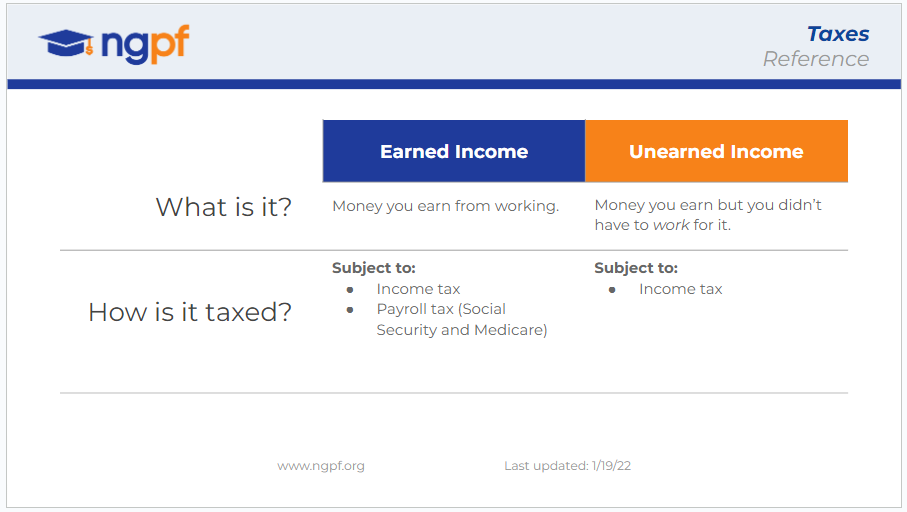
REFERENCE: Earned vs. Unearned Income
Examine this reference slide showing some differences in how earned and unearned income are taxed. Then, answer the following questions.

1

Which income is subject to Social Security and Medicare tax?

1

What is an advantage of having unearned instead of earned income?

ARTICLE: The difference between tax credits and deductions and why it matters
You may have heard of people taking certain action because of the “tax break” it will give them. These tax breaks are ways to reduce your tax liability, the total amount of money you owe in taxes, and they come in a lot of different varieties and go by a number of different names. Read this article and answer the questions to learn about these opportunities to reduce your tax liability.
1

What is the difference between a tax deduction and a tax credit?

1

Which reduces your tax liability more, a deduction or a credit?

1

Which would you prefer, a refundable or a non-refundable credit? Explain your answer.

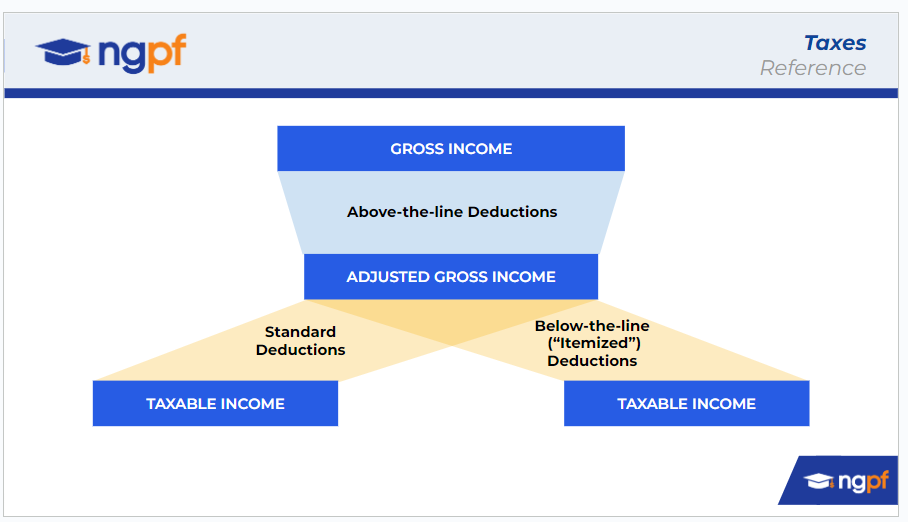
REFERENCE: Taxes Flowchart
This flowchart represents the different steps to calculate your taxable income from your gross income. Review this flowchart before learning about each of the steps below.
**Take Notes in your book!!**

1

Why are itemized and standard deductions shown on the same line?

1

“The line” referred to is your adjusted gross income (AGI). It is your income after applying above-the-line but before applying below-the-line deductions, and it is an important factor in determining eligibility for many different benefits. Assuming your gross income doesn’t change, would you want your AGI to be larger or smaller? Explain why.

ARTICLE: Increase Your Tax Refund With Above-the-Line Deductions
Above-the-line deductions, also called adjustments to income on the Form 1040, are one of the ways to reduce the amount of taxes you will owe. Read through this list of common above-the-line deductions. Then, answer the questions below.
1

Why is it important to know about these above-the-line deductions even if you’re not itemizing deductions on your taxes?

1

What are two of these deductions that might be important to you in the future and why?

1

Tax deductions are a way for the government to incentivize (or disincentivize) certain behaviors. Looking at all of these deductions, what might be some behaviors the government is trying to encourage?

ARTICLE: Itemized Deductions: What They Are and How They Can Slash Your Tax Bill
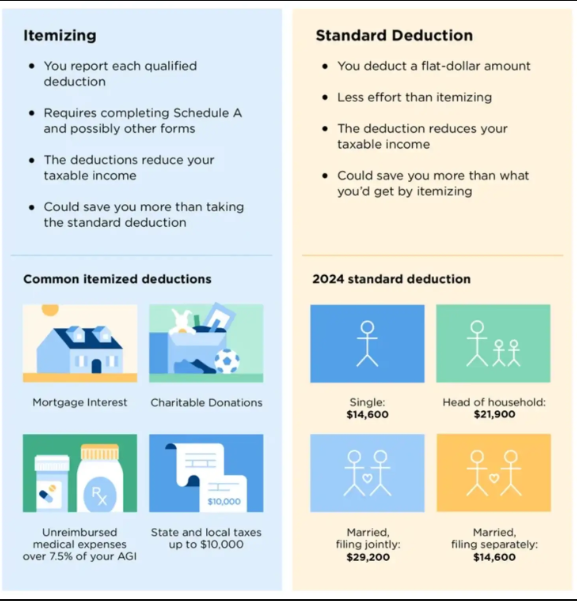
Below-the-line, or “itemized,” deductions are commonly cited as a great way to save money on your taxes. However, there is more to them than it may seem. Read just the first section of this article stopping at “What it means to take the standard deduction.” Next, review the infographic at the bottom of the article. Then, answer the questions below.

1

True or false: Itemizing deductions always results in the lowest tax liability possible. Explain your reasoning.

1

What is one disadvantage of itemizing your deductions?

1

Iman is choosing between taking the standard deduction or itemized deductions. Her below-the-line deductions add up to $9,800. What should she do?

3
Skim the list at the bottom of this article: Tax Deductions Guide, 20 Popular Breaks. Then, choose ONE deduction that interest you and write the following:
  1. The name of the deduction_______
  2. The amount of the deduction_______
  3. A brief explanation of what the deduction is for_______
ARTICLE: Tax Guide for Students and New Grads
Thinking ahead to what’s after high school, it is helpful to know there are certain tax benefits to investing in your education. Examine these education-based tax breaks, then answer the question below.
1

Samiya is a college sophomore who is filing her taxes and has to decide between taking the American Opportunity Credit or the Lifetime Learning Credit on her tax return. Assuming she fulfills all the requirements for both, which should she choose to get the maximum tax credit and how much will she receive?

1

Who would benefit most from knowing about these credits and why?

EDPUZZLE: How Tax Brackets Actually Work
Now that you’ve tallied all your deductions and figured out your taxable income, it’s time to actually calculate the taxes that you owe. Watch this video to learn more about how the graduated income tax bracket system works. Then, answer the questions either in EdPuzzle or below.
1

A tax deduction...
A. LOWERS a person's tax liability by LOWERING his/her taxable income

B. INCREASES a person's tax liability by LOWERING his/her taxable income

C. INCREASES a person's tax liability by INCREASING his/her taxable income
D. has no impact on the amount of taxes a person pays

1

Which statement BEST describes marginal tax rates?
  1. Your income is taxed at the highest rate that applies to your income amount (e.g. all of your income is taxed in the highest pocket)
  2. Your income is equally split among the tax brackets (e.g. divide your income by # of brackets and apply the rates of each tax bracket)
  3. Your income is always taxed at the lowest rate of that tax year (e.g. all of your income is placed and taxed in the first pocket)
  4. Your income may fall into more than one tax bracket, so more than one tax rate can apply (e.g. fill up the first pocket and then move to the next pocket)

1

Which of the following statements describes the CORE misconception addressed in this video?
  1. The standard deduction reduces your tax liability
  2. Portions of your income are taxed at different rates, called marginal tax rates
  3. When the government wants to increase tax rates, it is usually referring to the rates for the highest tax brackets
  4. The tax rate of the highest tax bracket your income falls into is applied to your whole income

Math Connection: Income Tax Brackets
ACTIVITY: MATH: Income Tax Brackets
Now that you know how to reduce your gross income to get your taxable income. This math activity will give you the opportunity to calculate your resulting tax liability. Follow your teacher’s directions to complete this activity on income tax brackets.

MATH: Income Tax Brackets

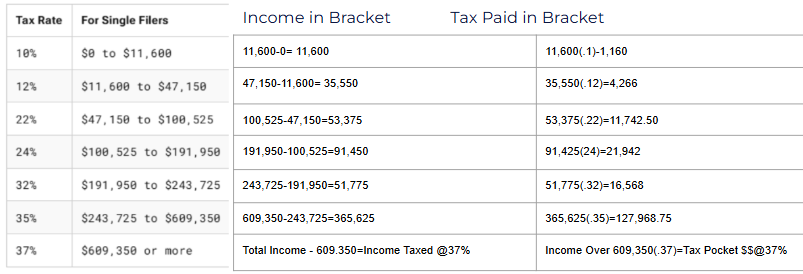
How exactly do tax brackets work? When we file our taxes, where does the number for total tax come from? In this activity, you will practice calculating your taxable income, reading a tax bracket table, and finding your total tax due based on how much you made in the calendar year.
NOTE: This is just the fundamentals of how taxes are calculated and does not include further details like tax credits, itemized deductions, and unearned income.

Part I: Interactive Examples
These two videos provide information on how to calculate an estimated tax due. Follow your teacher’s directions on which video(s) you should watch or skip ahead to the next section. *Videos linked in the google doc linked at the top of this text.*
NOTE: The videos above use tax figures from 2019.
Be sure to use the most recent tax filing year’s figures when completing this activity.
Part II: Practice Problems
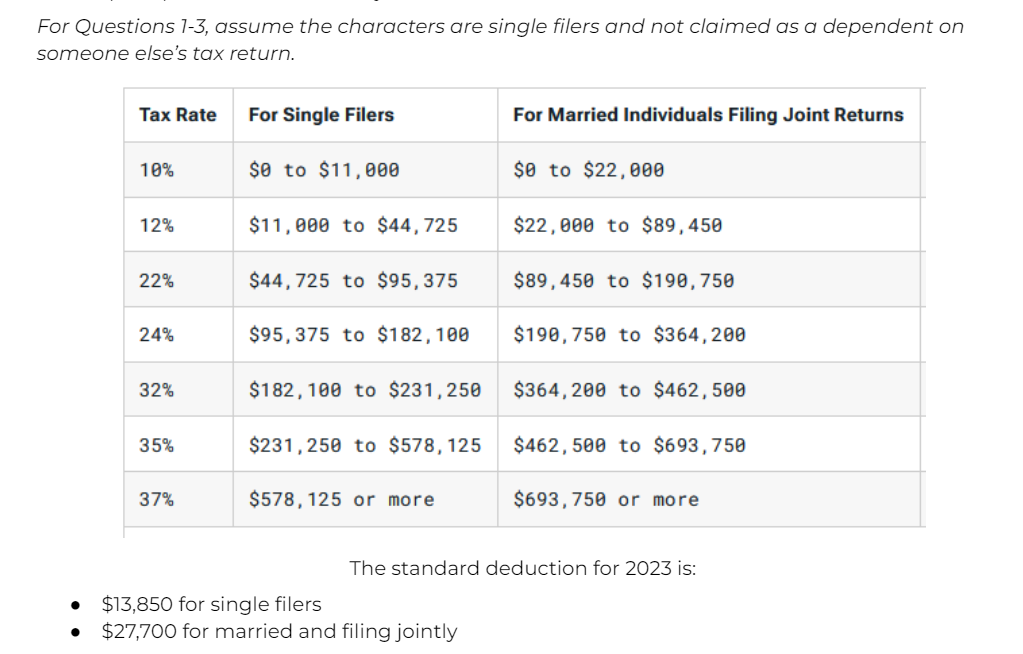
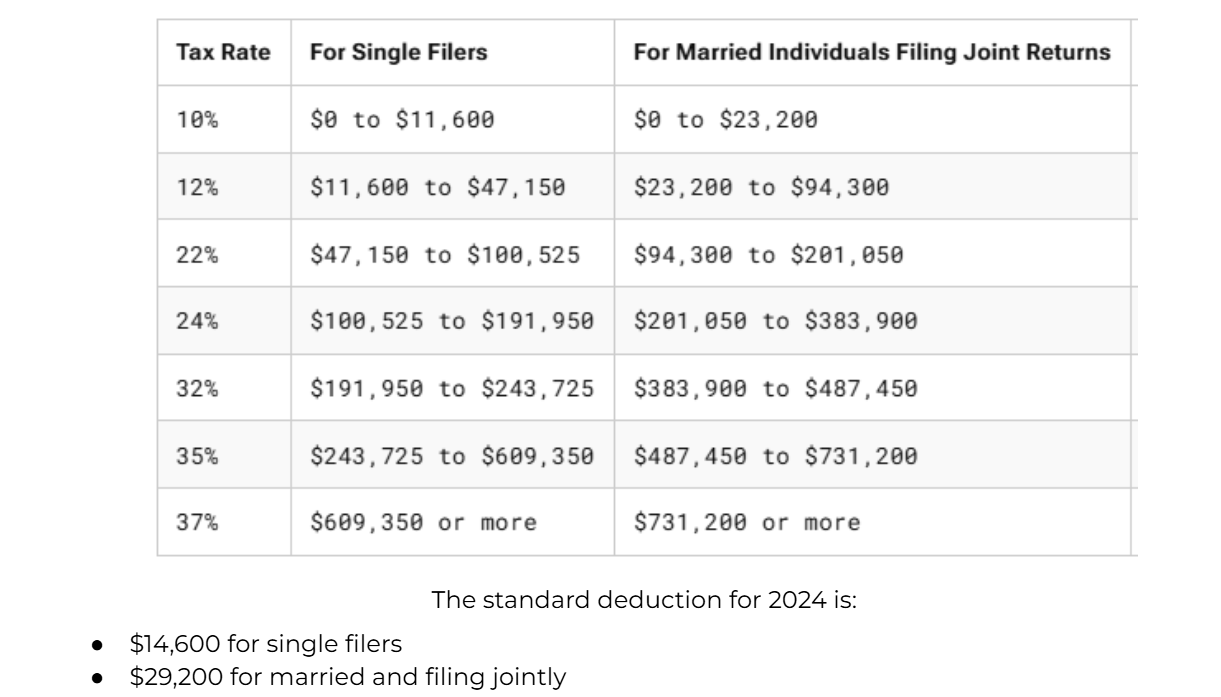
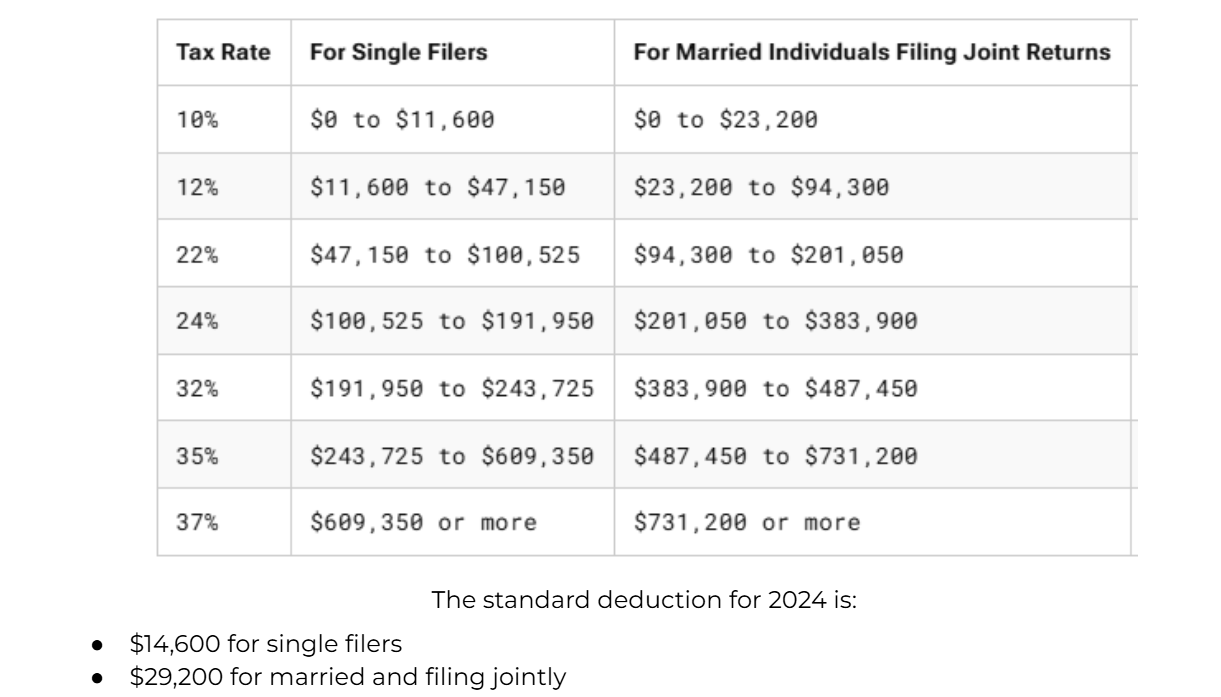
Use the tax bracket table below to calculate each person’s total tax for 2024 (NOTE: The videos in Part I were calculated for 2019). Complete the following practice problems by showing your work in the space provided. Then, write your final solution in the answer box.
For Questions 1-3, assume the characters are single filers and not claimed as a dependent on someone else’s tax return.

2023 Tax Brackets
2024 Tax Brackets
1

Look over the difference between the first box (2023) and the second box (2024). What do you notice?

1
Felix has a gross income of $18,000. What is his total tax due? _______
1
Sarina made $42,000 in the calendar year. How much does she owe in federal taxes?_______
1
Kennedy has a gross income of $105,000. What is her total tax due?_______
1
Alex and Tory are married and filing jointly. Their gross income is $150,000. How much do they owe in federal taxes?_______
When talking about taxes, it’s important to keep in mind the difference between marginal tax rate and effective tax rate.
  • Marginal tax rate: The highest tax bracket that your taxable income falls in.
  • Effective tax rate: The actual percentage of your taxable income that you end up paying in taxes.
3
Aiden has a gross income of $63,000 and takes the standard deduction. Their total taxes due are $6,628.
  1. What is their taxable income?_______
  2. What is their marginal tax rate?_______
  3. What is their effective tax rate? Round to the nearest hundredth of a percent._______
3
Liam has a gross income of $120,000 and takes the standard deduction.
  1. What are his total taxes due?_______
  2. What is his marginal tax rate?_______
  3. What is his effective tax rate? Round to the nearest hundredth of a percent._______
Part III: Reflection
1

Explain the difference between the common misconception that people might have about how tax brackets work and how they actually work.

1

Reflect on your process for calculating the total tax due. What is one mathematical strategy you can use to make the repeated calculations more efficient? Why would that be faster?

1

Why is the marginal tax rate always higher than the effective tax rate?

1

It’s helpful to know the background of how much you owe in federal taxes by calculating by hand. What is another way that people can look up how much they owe?

Exit Ticket *Also in book...Take NOTES in your book!!*
1

Which statement about deductions and credits is TRUE?
  1. A $1000 deduction will lower your tax bill from $1000 to $0
  2. A tax deduction lowers your tax liability more than a credit of the same amount
  3. You have to choose between taking deductions or credits, but not both
  4. You can get money back from a tax credit if your taxes owed are small enough

1

Last year, Ernesto made $15,500 from his part-time job with the USPS. He also made $500 in dividends from his investments, $3500 driving for Uber, and $15 in interest from his savings account. How much of his income would be subject to FICA taxes?
  1. $515
  2. $15,500
  3. $19,000
  4. $19,515

1

Tommy makes $30,000 working his first part-time job after college, which puts him in the 12% marginal tax bracket. How much will Tommy end up owing in taxes for the year?
  1. More than $3600
  2. Exactly $3600
  3. Less than $3600
  4. Tommy will owe $0 in taxes because he doesn’t make enough money

The End!! Make good choices :)