
0.5
Which statement is true about both the September equinox and the March equinox shown below?
Which statement is true about both the September equinox and the March equinox shown below?
Answer each statement accordingly.
Daylight hours are shorter for the hemisphere that is tilted toward the Sun during the solstice.
When it is summer in the United States, Earth is closest to the Sun.
Which statement is true about both the September equinox and the March equinox shown below?
A solstice is a day when ________________.
The seasons are caused by ___________.
A lunar eclipse can only occur during which type of moon phase?
Why don’t lunar eclipses occur every full moon?
Hours of daylight and nighttime are equal during a(n) .
Earth_________________on its axis and ________________around the Sun.
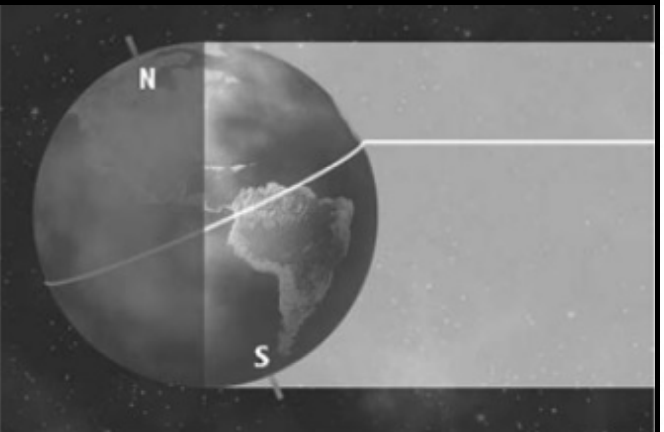
What season is shown for the northern hemisphere? Explain your answer.
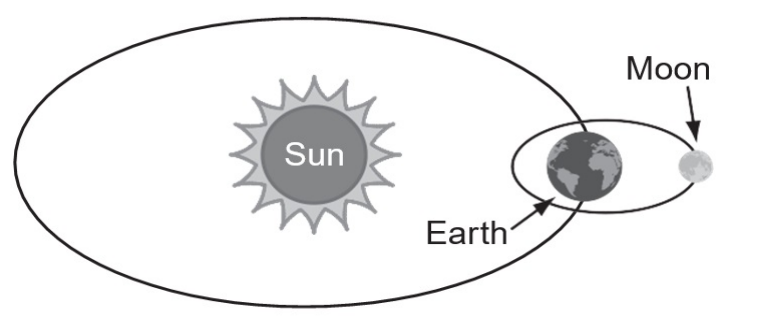
Molly researched the lunar eclipses that had been observed in her city. She found that all of them occurred during the full moon phase. She then drew a model to show the positions of the Sun, Earth, and the Moon during lunar eclipses. The diagram shows the model that Molly created.
Explain why the model shows that all lunar eclipses occur during the full moon phase.
Describe how the model could be changed to show why lunar eclipses do not occur every full moon.
Not only is the summer solstice the longest day of the year, it is also the day on which _____________.

What season is shown for the northern hemisphere? Explain your answer.
The phase of the Moon that comes right before the new moon is the ____.
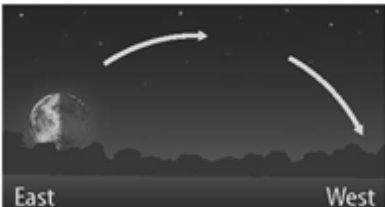
Which phase of the moon is shown in this picture of the sky at midnight?
Sequence the Moon's phases in order, beginning with the new moon phase.
The longest a total solar eclipse lasts is about how long?
Why don’t solar eclipses occur every new moon?

Lunar eclipses occur about every 2.5 years. Full moons occur once or twice each month.
Use the diagram of the Sun-Earth-Moon system to explain why lunar eclipses occur less often than full moons.