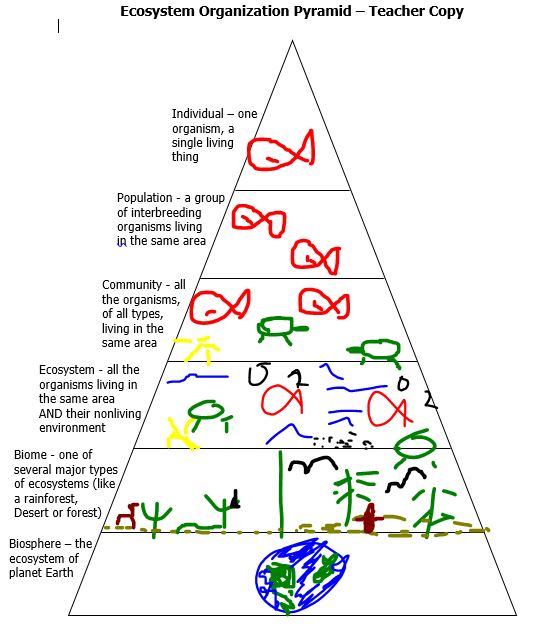
Watch the video below and fill out the sheet with the proper levels of ecosystem organization. Upload it in #1.
Watch the video below and fill out the sheet with the proper levels of ecosystem organization. Upload it in #1.
Fill out the chart below on your sheet or here. Include the definitions.
Tropical rainforests support a vast array of organisms, many of them still undiscovered by humans. However, the rainforest is quickly diminishing, both in size and biodiversity. Other ecosystems experience similar losses. Reasons include habitat destruction, pollution, disease, overharvesting, invasive species, and climate change.
Biodiversity refers to the number, variety, and populations of species within a particular geographic area.
A decrease in biodiversity refers mainly to a loss of species. A population decrease indicates the potential for a species’ disappearance from a community. A species that has disappeared from a particular community is said to be extirpated, or locally extinct. A species no longer found on Earth is extinct. Species whose populations have dwindled such that they might easily become extinct are termed endangered species.
Probably more biodiversity is lost to the degradation of habitat than to any other factor. As human populations grow, they consume more resources, clearing forests to build farms, damming waterways, crowding coastal areas with houses and hotels, and mining mountains and prairies for minerals. The resident organisms either continue to survive in the remaining natural areas or adapt to living among humans. Some species cannot thrive in the altered or fragmented habitats and eventually die out.
Pollution and disease contribute in several ways to the loss of biodiversity. A sudden chemical spill or waste discharge may devastate a pond or lake community, eliminating many species at once. A chronic low level of an environmental toxin often becomes dangerous as it accumulates in organisms over time. The concentration is magnified in the tissues of consumers of these organisms. A classic example of this biomagnification of a toxin is the decline of raptors and fish-eating seabirds in the 1960s due to their extensive feeding on fish that had already accumulated some of the pesticide DDT into their own tissues. Mercury is a toxin that bioaccumulates and is magnified in top predators such as tuna and swordfish. Disease agents, such as fungal parasites of plants, can devastate a species, particularly if the disease is introduced suddenly into a population without any inherited immunity. For example, a fungus from Asian chestnut trees introduced to the eastern U.S. in the early 1900s decimated the population of American chestnuts, a tree species of huge ecologic and economic importance in the Eastern U.S.
Overharvesting reduces biodiversity as species are removed from their habitat for human use or consumption. Overharvesting has reduced populations of whales and American bison and has eliminated the passenger pigeon. In many cases, direct losses indirectly affect other species, such as those that depend on the overharvested species as a food source. Overcollection of certain animals or plants whose parts are seen to have a medicinal or other traditional use often leads to a rapid decline in population. Populations as different as rhinoceroses and ginseng plants have been depleted for this reason. Ironically, the rarer such a species becomes, the more profitable it becomes to collect and sell on the black market.
Exotic species are organisms introduced deliberately or accidentally into a habitat to which they are not native. Some of these alien species are introduced and temporarily thrive before dying out, and some maintain small, localized populations. Others, called invasive species, expand their range with increasing ecological, economic, and environmental consequences. The kudzu vine, for example, was introduced to the U.S. in the late 1800s as an ornamental and later encouraged as an effective means of erosion control. Kudzu thrived too well in the Southeast, where it has covered many native plant communities under its vast tangles. Nonnative animals may also outcompete native species for food or habitat. The zebra mussel was accidentally introduced to the Great Lakes in the 1980s, probably through the release of ballast water from a European ship that had traveled up the St. Lawrence Seaway. The mussel multiplied and spread so rapidly that it brought many native mussel species to the brink of extinction. Not only does it outcompete the native mollusks for food, it grows upon their shells in such numbers that the native mollusks’ shells cannot open and close effectively and they are smothered. In the Great Lakes, the few native predators that eat the zebra mussels have not eaten them fast enough, and the mussel population continues to grow. Zebra mussels present a direct problem for people, too, because they attach not only to other mollusks, but also to the underwater machinery at dams and power stations. Ecologists do not know how the presence of the mussels will ultimately change the ecosystem. The mussels may bring about an increase in some species, just as they have caused a decline in others. Regardless, they have altered the biodiversity for the foreseeable future.
Recently, climate change has been recognized as a threat to biodiversity. The Fourth Assessment Report of the United Nations Intergovernmental Panel on Climate change, published in 2007, concluded that in the next century that climate change might be catastrophic for many ecosystems, noting that extinction becomes increasingly likely for a larger percentage of the Earth’s species as temperatures rise. Record temperature increases documented in the Arctic and Antarctic already are changing the scale and pattern of seasonal ice melts, altering the habitat available to polar species, possibly faster than they can adapt.
What are the 6 reasons that ecosystems are seeing diminishing size and biodiversity?
Degradation of habitats (also known as habitat destruction) is caused by what 5 factors?
What happens to the organisms whose habitat is destroyed?
How do environmental toxins become dangerous?
What are two examples of toxins contributing to the loss of biodiversity?
IDENTIFY the 3 species whose population has been reduced by overharvesting.
EXPLAIN how does this affect other species?
What makes an exotic species invasive?
IDENTIFY 2 examples of invasive species.
EXPLAIN how climate change is affecting the species such as the polar bears?