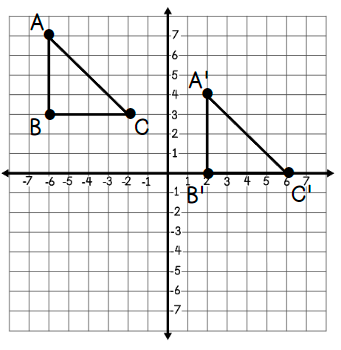
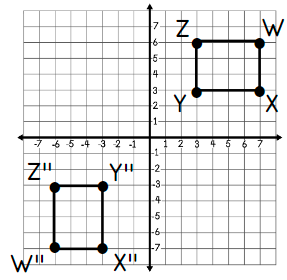
Which is a true statement about the transformation?
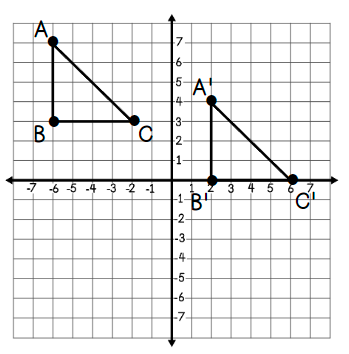
Which is a true statement about the transformation?
Which is a true statement about the transformation?
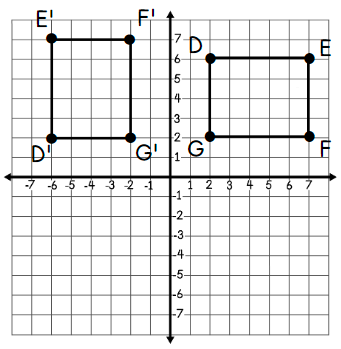
Which rule best represents the transformation?
Tyrell transformed a figure contained in quadrant IV by reflecting it over the y-axis and rotating it 180° clockwise. Which of the following is a true statement?
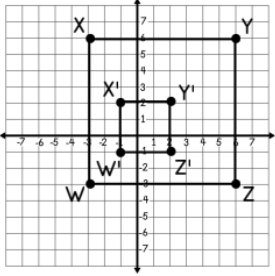
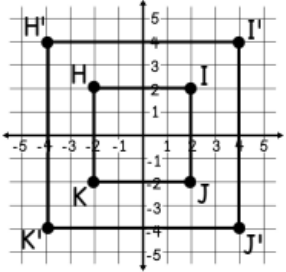
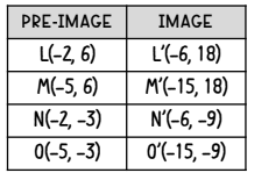
What is the scale factor of this dilation? (write as a fraction)
Which is the correct algebraic representation of the transformation below?
Ben transformed a figure from quadrant IV to quadrant I. The pre-image and image are congruent figures, but the orientation of the figure changed. Which could be the transformation Ben used?
Luke is going to reflect point R(6, 10) over the y-axis. What are the coordinates for R’?
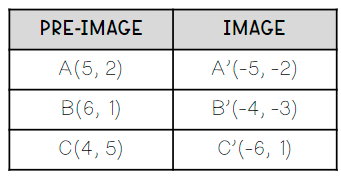
The table below shows the coordinates of a
figure that was transformed.
Which is a correct description of the transformation?
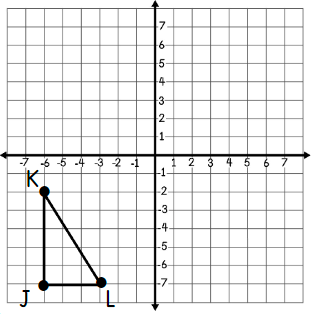
If JKL is rotated 180° clockwise, which describes the location of J’?
Which of the following is the correct algebraic representation for a translation 8 units right and 4 units down?
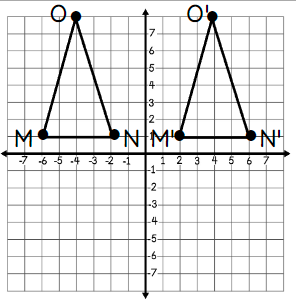
Which is a true statement about the transformation shown?
A triangle in quadrant II is going to be
reflected over the y-axis. Which of the
following is a true statement?
Triangle PQR has the following
coordinates. Where is Q’ after a translation 9
units right and 11 units up?
P(-9, -12) Q(-6, -13) R(-7, -4)
Which of the following is NOT a true statement about the dilation below?
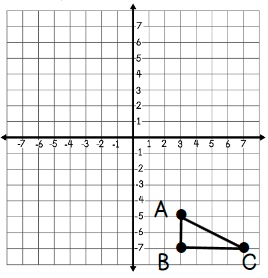
If ABC is translated 3 units up and then
reflected over the x-axis, which describes the location of B”?
A figure on a coordinate plane was transformed using the rule (x, y) → (-x, y). Which best describes the transformation?
Which correctly describes the sequence of transformations used to create the image on the graph?
Blake drew square ABCD. Then, he drew the image of it, square AʹBʹCʹDʹ, 2 centimeters to the right of the original figure. Line segment BC is 3 centimeters. How long is BC?
Which of the following is the correct algebraic representation for this transformation?
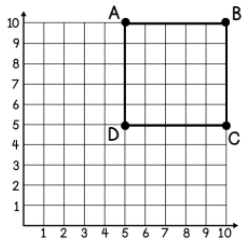
If you dilate rectangle ABCD by a factor of 4, what are the coordinates of D'?