Log in
Sign up for FREE
arrow_back
Library

Unit 1 Energy and Heat Test Retake

star
star
star
star
star
Last updated over 2 years ago
25 questions
2
2
2
2
2
2
2
2
2
2
2
2
2
2
2
2
2
2
2
2
2
2
2
2
2
6.PS3.1 Analyze the properties and compare sources of kinetic, elastic potential, gravitational potential, electric potential, chemical, and thermal energy.
Question 1
1.

Question 2
2.

Question 3
3.

Question 4
4.

Question 5
5.

Question 6
6.

6.PS3.2 Construct a scientific explanation of the transformations between potential and kinetic energy
Question 7
7.

Question 8
8.

Question 9
9.

Question 10
10.

Question 11
11.

Question 12
12.

6.PS3.3 Analyze and interpret data to show the relationship between kinetic energy and the mass of an object in motion and its speed.
Question 13
13.

Question 14
14.

Question 15
15.

Question 16
16.

Question 17
17.

6.PS3.4 Conduct an investigation to demonstrate the way that heat (thermal energy) moves among objects through radiation, conduction, or convection.
Question 18
18.

Question 19
19.

Question 20
20.

Question 21
21.

Question 22
22.

Question 23
23.

Question 24
24.

Question 25
25.

When an apple is hanging from a tree, it has
light energy
kinetic energy
elastic potential energy
gravitational potential energy
Mary eats a hamburger for lunch.  What type of energy does the hamburger have?
light energy
kinetic energy
electrical energy
chemical potential energy
When you wind a rubber band on a toy airplane, which of the following types of energy does the rubber band have?
kinetic energy
elastic potential energy
chemical potential energy
gravitational potential energy
4. Which of the following best shows kinetic energy?
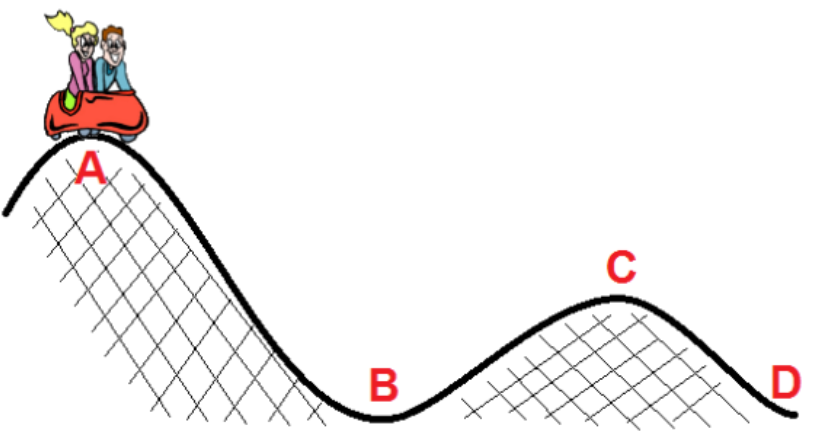
Look at the picture.  At what point will a roller coaster have the greatest potential energy?
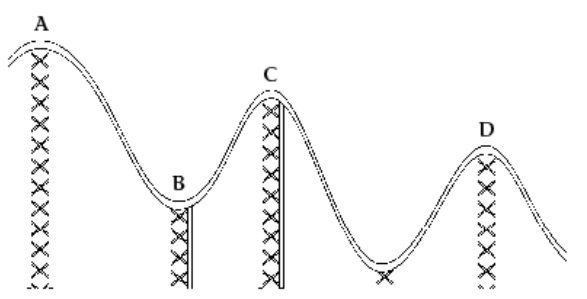
Point A
Point B
Point C
Point D
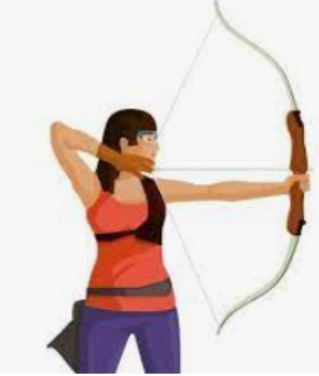
The energy of a bow changes when the string is pulled back.  Which change will occur in the bow after the string is released?

Elastic potential energy will decrease.
Elastic potential energy will increase.
Chemical potential energy will increase.
Gravitational potential energy will decrease.
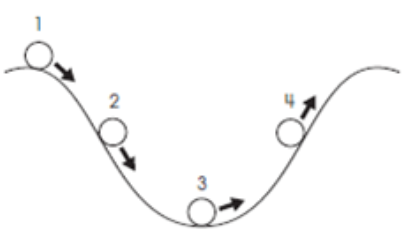
Students create an investigation of a ball rolling along a track.  The students release a ball from rest at position 1.  After the investigation the students discuss the transformation of energy that occurred.  Which student's explanation is correct?

A. Tony: "At point 1, the ball has the most kinetic and the least potential energy."
B. Kira: "At point 2, the ball's kinetic energy is changing into potential energy."
C. Sarah: "At point 3, the ball has the most kinetic and the least potential energy."
D. Tom: "At point 4, the ball's potential energy is changing into kinetic energy."
The image demonstrates both potential and kinetic energy.  Of the following choices, select the explanation for what happens as the apple falls.

As the apple falls its mass increases, and as a result its kinetic energy increases.
As the potential energy decreases in the apple, the kinetic energy of the apple increases.
The amount of kinetic and potential energy is equal in the bottom of the apple's fall.
As the kinetic energy increases, the potential energy increases.
Clyde and Marilyn are riding on a roller coaster.  During which section(s) of the track is their kinetic energy converted to potential energy?

from point A to point B and from point C to point D
from point B to point D only
from point A to point B only
from point B to point C only
What energy transformation occurs when an electric heater is plugged in and turned on?
electrical energy --> chemical energy
electrical energy --> thermal energy
chemical energy --> thermal energy
thermal energy --> electrical energy
Which BEST describes the energy transformation after a person eats a hot dog?
The kinetic energy of the hot dog is converted into potential energy.
The sound energy of the hot dog is converted into mechanical energy.
The chemical energy from the hot dog is converted into sound energy and thermal energy.
The chemical energy from the hot dog is converted into mechanical and thermal energy.
A monkey climbs up to the top of a tree.  What energy transformation occurs as the monkey is climbing to the top?
Both the gravitational potential energy and the kinetic energy increase.
Both the gravitational potential energy and the kinetic energy decrease.
The gravitational potential energy decreases and the kinetic energy increases.
The gravitational potential energy increases and the kinetic energy decreases.
Which of the following has the least amount of kinetic energy?
A 200g soccer ball moving at 10 m/s
A 200g soccer ball moving at 8 m/s
A 200g soccer ball moving at 20 m/s
A 200g soccer ball moving at 15 m/s
Car A has a mass of 1500 kg and is moving at 89 miles per hour.    Car B has a mass of 1500 kg and is moving at 58 miles per hour.   Which statement below best describes the kinetic energy of each car?
Car A has more energy than Car B because it is traveling faster than Car B.
Car A has more energy than Car B because it has a smaller mass than Car B.
Car B has more energy than Car A because it has a bigger mass than Car A.
Both cars have about the same energy because they have about the same mass.
A wrecking ball is swinging towards a building that needs to be knocked down. If you wanted to make the wrecking ball hit the building with more kinetic energy, what could you change?
Use a wrecking ball with a smaller mass.
Decrease the speed of the wrecking ball.
Use a wrecking ball with a bigger mass.
None of the above, the kinetic energy cannot be changed.
If two objects with different masses are moving in the same direction and at the same speed, what will happen to the kinetic energy?
The object with less mass will have greater kinetic energy.
The object with greater mass will have greater kinetic energy.
Both objects will have the same kinetic energy because they are traveling at the same speed.
We can’t tell which has greater kinetic energy from this information.
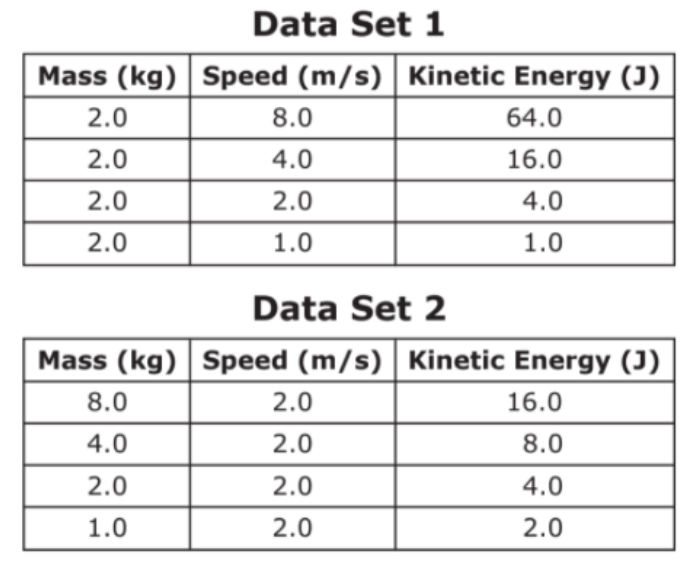
Students record the mass, speed, and kinetic energy of objects moving along a track. The students create these data tables. Which statement correctly relates the mass and speed of an object to its kinetic energy?

When both the mass and speed of an object doubles, the kinetic energy doubles with mass and more than doubles with speed.
When both the speed and the mass of an object doubles, its kinetic energy doubles.
When an object's mass doubles, its kinetic energy more than doubles.
When an object's speed doubles, its kinetic energy doubles.
A student is boiling water on a stove.  Which of the following correctly shows the movement of water in the pan as the water is heating?
A student gets sunburned while playing outside on a hot summer day.  What method of heat transfer occurred?
conduction
convection
radiation
reflection
One end of a metal rod is placed over a flame during an investigation.  A thermometer is touching the opposite end of the metal rod.  Which BEST describes what is happening during this investigation?
Radiant energy warms the thermometer.
Convection carries heat to the thermometer.
Mechanical energy from the flame carries heat to the thermometer.
Heat from the flame is conducted through the metal to the thermometer.
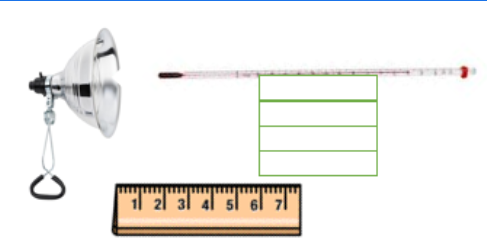
A student sets up an investigation to see if the temperature of the thermometer will increase if the thermometer is placed two inches away from a heat lamp.  The student checks the temperature every minute for ten minutes and sees an increase in temperature on the thermometer.  What form of heat transfer caused the temperature to increase in this investigation?

radiation
conduction
convection
reflection
Identify and explain the different types of  heat transfer occuring in the following scenario.

Chris went on a camping trip.  During the day it was so hot that he got sunburned.  When it was time to go to his campsite, he noticed smoke in the air.  His father had started a fire and he felt the heat as he walked by.  In the morning while his mother was cooking breakfast, he accidentally touched a hot pan and got burned.  Although this was the case, he still had fun on the trip.
Sunburn = radiation; smoke rising = convection; feeling heat from the fire = radiation; touching hot pan = convection
Sunburn = radiation; smoke rising = conduction; feeling heat from the fire = radiation; touching hot pan = conduction
Sunburn = radiation; smoke rising = convection; feeling heat from the fire = radiation; touching hot pan = conduction
Sunburn = conduction; smoke rising = convection; feeling heat from the fire = radiation; touching hot pan = convection
On a hot day, the upstairs rooms in a house are usually hotter than downstairs rooms. Why?
Cool air is less dense than hot air.
Warm air rises and cool air sinks.
Cool air rises and warm air sinks.
The upstairs rooms are closer to the Sun.
What happens if you put a warm metal spoon in a cold glass of iced tea?
The spoon cools and the tea will warm because thermal energy travels from the warm spoon to the cold tea.
The spoon will get cooler because the cold tea will conduct thermal energy to the warm spoon.
The tea and the spoon will both become cooler.
The two will remain the same temperature.
You are doing your homework at a desk that is underneath a lamp.  You start to feel hotter because of ____________________ from the lamp.
conduction
convection
radiation
reflection