Log in
Sign up for FREE
arrow_back
Library

Human Genome, Cell Theory, Cell Structure and Function, Cell Growth and Reproduction Test

star
star
star
star
star
Last updated almost 2 years ago
23 questions
Required
1
Required
1
Required
1
Required
1
Required
1
Required
1
Required
1
Required
1
Required
1
Required
1
Required
1
Required
1
Required
1
Required
1
Required
1
Required
1
Required
1
Required
1
Required
1
Required
1
Required
1
Required
1
Required
1
Question 1
1.

Question 2
2.

Question 3
3.

Question 4
4.

Question 5
5.

Question 6
6.

Question 7
7.

Use the information from question 5 to help answer this question.
The man with short eyelashes in Generation II marries a woman with long eyelashes. This woman reports that everyone in her family also has long eyelashes. Can the man and woman be sure that all of their children will have long eyelashes? Explain.

Question 8
8.

Question 9
9.

Question 10
10.

Question 11
11.

Question 12
12.

Please select the words that best complete the sentence.

Question 13
13.

Select the word or phrase that best completes the sentence.
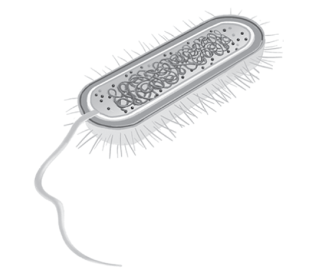
A model of a cell is shown.

Question 14
14.

Question 15
15.

Question 16
16.

Question 17
17.

Question 18
18.

Question 19
19.

Question 20
20.

Question 21
21.

What has been the most helpful thing we've done so far in class?

Question 22
22.

Assuming your current grade is higher than your Biology grade from during the school year, why do you think you're doing better now than you did in your regular class?

Question 23
23.

What do you like about the walks that we take?

A karyotype is a picture of a person's chromosomes arranged from largest to smallest. A karyotype is assembled from the cell of a human donor who has a genetic disorder. Which disorder can be determined by studying the karyotype?
a chromosomal disorder, such as Down syndrome
an X-linked genetic disorder, such as color blindness
a genetic disorder caused by a point mutation, such as sickle cell disease
a genetic disorder caused by a dominant allele, such as Huntington’s disease
Frieda is studying an example of a human karyotype. She makes the following claim about the karyotype.
“I can determine which sex chromosome was donated by the male parent, and which sex chromosome was donated by the female parent.”
Frieda’s claim is accurate under which of these conditions?
The karyotype was taken from a newborn baby.
The karyotype includes three copies of an autosome.
The karyotype was taken from a female.
The karyotype was taken from a male.
Steven develops a pedigree for earlobe attachment in a large family. Earlobes can be either free or attached. What information about earlobe attachment can Steven MOST LIKELY determine by analyzing the pedigree?
the dominant and recessive forms of the trait
the location of the gene for the trait on a chromosome
the percentage of each form of the trait in the human population
the type of mutation that caused the two forms of the trait
Horace is using a computer model to study the relationship between the genes and phenotype of an individual. In one experiment, Horace alters the nucleotide sequence in one of the model genes. In response, the computer shows that the eye color of the individual changes from brown to blue.
How did the change in the gene cause the change in phenotype?
by affecting the arrangement of glucose molecules in a carbohydrate
by directing the cell to produce a carbohydrate instead of a protein
by affecting the amino acid sequence of a protein
by altering the number of chromosomes in the cell
Refer to the passage and diagram to answer the next 3 questions.
A team of scientists is studying the inheritance of eyelash length in humans. Eyelash length is either long or short, and is controlled by a single autosomal gene.
The eyelash lengths of the members of one family are shown in the pedigree below. The pedigree labels the generations I, II, and III. The male and female in Generation I are the parents of the three males shown in Generation II, and are the grandparents of the three females shown in Generation III.
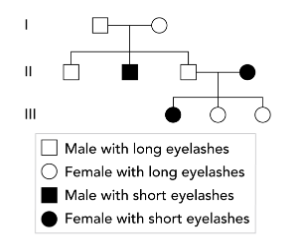
Three family members each have short eyelashes. These family members include one male and two females.
Which statement accurately compares the genotypes for eyelash length among the three family members?
The three family members each have a unique genotype for eyelash length.
Either two or three family members may have the same genotype for eyelash length, or each genotype may be unique.
The two females have the same genotype for eyelash length, while the male has a different genotype.
All three of the family members have the same genotype for eyelash length.
Use the information from question 5 to help answer this question.
Some of the family members must be heterozygous for the trait of eyelash length, meaning their genotypes include one allele for long eyelashes and one allele for short eyelashes. In which generation are these family members?
I., II., and III.
II. and III. only
I. and II. only
III. only
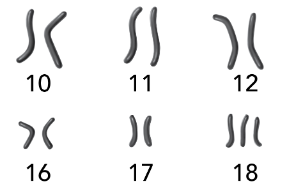
The diagram below shows a section of a karyotype. The karyotype was created from a cell sample that was obtained from a patient at a hospital.

Which conclusion about the patient do the karyotype data most strongly support?
The patient may or may not have a chromosomal disorder, depending on the full karyotype.
The patient has an abnormal number of autosomes that likely is causing severe symptoms.
The patient has an abnormal number of sex chromosomes that likely is causing severe symptoms.
The patient has no abnormalities or disorders that are due to the chromosomes shown in the karyotype.
Which of the following statements is part of the cell theory?
Cells are composed mostly of empty space.
Only animals are made up of cells.
Cells are generally large enough for the unaided eye to see.
All cells are produced from existing cells.
The cells of all organisms contain DNA. In cells of which of the following groups is the cellular DNA enclosed in a nucleus?
prokaryotes
viruses
eukaryotes
bacteria
A student is developing a model to show how most proteins are synthesized in cells. Which organelles would be LEAST useful for the student to include in the model?
Golgi apparatus
endoplasmic reticulum
ribosomes
chloroplasts
The instructions for making proteins are coded in the (cytoplasm / DNA / endoplasmic reticulum / nucleus) of a cell. In a eukaryotic cell, these instructions are located in the (cytoplasm / DNA / endoplasmic reticulum / nucleus).
The cell is (eukaryotic / prokaryotic / from an animal / from a plant) because it (contains DNA / does not contain DNA / contains a nucleus / does not contain a nucleus).
Which of the following structures are present in both plant and animal cells?
mitochondria
chloroplasts
cell walls
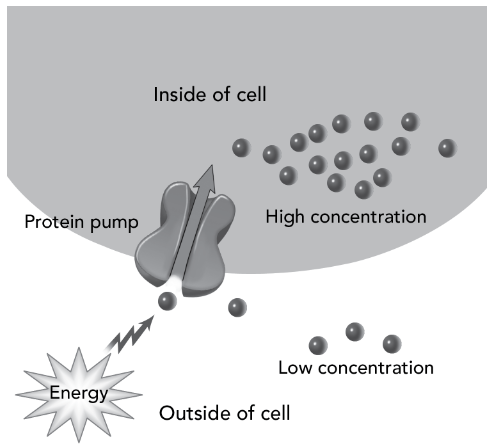
The illustration shows a model of the transport of solute particles from outside the cell to inside the cell.

What type of cell transport is modeled?
The model illustrates diffusion because solute particles are moving from an area of higher concentration to an area of lower concentration.
The model illustrates active transport because energy is required to move the solute particles from an area of lower concentration to an area of higher concentration.
The model illustrates facilitated diffusion because protein channels allow solute particles to cross the cell membrane.
The model illustrates osmosis because water molecules are moving from an area of higher concentration to an area of lower concentration.
Which describes active transport, but not passive transport?
moves particles across the cell membrane
moves particles from high concentration to low concentration
particles diffuse directly through the lipid bilayer
requires cellular energy
What useful purpose is served by cell division in a multicellular organism? Select all the correct answers.
to produce new cells during an organism’s growth
to ensure all cells get cancer
to replace damaged cells and tissues
What happens in Interphase?
The cell grows & replicates DNA
The cell splits in two
The cell starts to cleave
The chromosomes move to the middle
What are the three steps to the cell cycle?
Prophase, Mitosis, Telophase
Interphase, G1, S, G2
Interphase, Mitosis, Cytokinesis
Mitosis, Cytokinesis, Prophase
What is the difference between meiosis and mitosis?
mitosis creates 2 genetically identical cells while meiosis creates 4 genetically unique cells
mitosis only happens in sex cells
meiosis only happens in somatic (body) cells
meiosis creates 2 genetically identical cells while mitosis creates 4 genetically unique cells