Compare two different graph representations of account balance data
Analyze real-world data presented in a pie chart and bar graph.
Common Core Math Standards
Link to all CCSS Math
CCSS.PRACTICE.MP1
CCSS.PRACTICE.MP4
CCSS.HSF.IF.B.4
CCSS.HSF.IF.C.9
Personal Finance Objectives
Explain the purpose and benefits of a checking account
Read a bank statement
Analyze the consequences of not being in the banking system
National Standards for Personal Financial Education
Spending
9b: Develop a system for keeping track of spending, saving, and investing
Managing Credit
13a: Identify products and practices that are classified as alternative financial services
13b: Discuss the costs and benefits of using alternative financial services relative to traditional banking
DISTRIBUTION & PLANNING
Distribute to students
2.1 Student Activity Packet
OBJECTIVES & STANDARDS
Math Objectives
Compare two different graph representations of account balance data
Analyze real-world data presented in a pie chart and bar graph.
Common Core Math Standards
Link to all CCSS Math
CCSS.PRACTICE.MP1
CCSS.PRACTICE.MP4
CCSS.HSF.IF.B.4
CCSS.HSF.IF.C.9
Personal Finance Objectives
Explain the purpose and benefits of a checking account
Read a bank statement
Analyze the consequences of not being in the banking system
National Standards for Personal Financial Education
Spending
9b: Develop a system for keeping track of spending, saving, and investing
Managing Credit
13a: Identify products and practices that are classified as alternative financial services
13b: Discuss the costs and benefits of using alternative financial services relative to traditional banking
DISTRIBUTION & PLANNING
Distribute to students
2.1 Student Activity Packet
Intro (Warm-Up)
GRAPH: How Do People Pay for Stuff?
Study the graph to learn more about the different ways people pay for the things they buy.
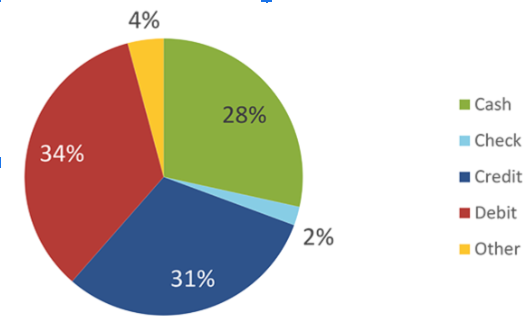
1 point
1
Question 1
1.
Which three payment methods are the most common?
1 point
1
Question 2
2.
What total percentage of purchases were paid for with either a credit card, debit card, or check?
1 point
1
Question 3
3.
Make a prediction - how do you think popular payment methods might change over time?
Learn It
ARTICLE: The Complete Guide to Checking Accounts
Read the first few paragraphs of this article, up through the section titled “Free Checking Accounts -- and How to Qualify for One.”
1 point
1
Question 4
4.
List some ways to get money OUT of your checking account.
1 point
1
Question 5
5.
List some ways to get money INTO your checking account.
Note: Two common methods not mentioned are mobile banking apps and direct deposit. You’ll learn more about these methods in later lessons.
1 point
1
Question 6
6.
Why do you think it is important to have a FREE checking account, if possible?
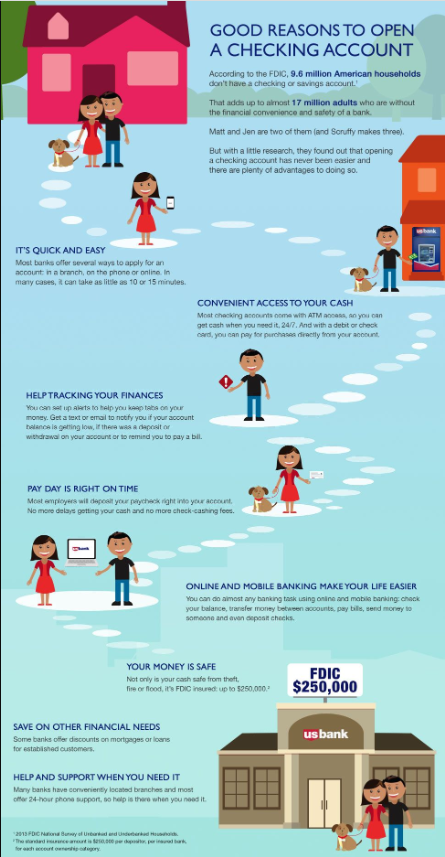
INFOGRAPHIC: Good Reasons to Open a Checking Account
Now that you know how a checking account works, review the infographic to learn more about the benefits of opening one.
1 point
1
Question 7
7.
Which reason to open an account is the most important to you, personally? Why?
1 point
1
Question 8
8.
Why might it be beneficial to get a text or email alert if your balance is low, there is a deposit or withdrawal, or a bill is due?
1 point
1
Question 9
9.
Why do you think it’s important to choose a bank account that is FDIC-insured?
Note: The Federal Deposit Insurance Corporation (FDIC) insures the money you deposit in certain bank accounts, so you will not lose your money if the bank fails.
VIDEO: How To Read Your Bank Statement And Why It's Important To Do So
With your checking account, you’ll receive a bank statement that you will want to review on a regular basis. Watch the video to familiarize yourself with what is included in a bank statement.
1 point
1
Question 10
10.
What is the purpose of a bank statement?
1 point
1
Question 11
11.
Why is it helpful to check each transaction on your statement?
1 point
1
Question 12
12.
How often do you think you would want to check your bank statement? Why?
ACTIVITY: FINE PRINT: Checking Account Statement
Now that you understand the importance of a bank statement, it’s time to practice analyzing one. Follow the directions on the worksheet to complete this activity.
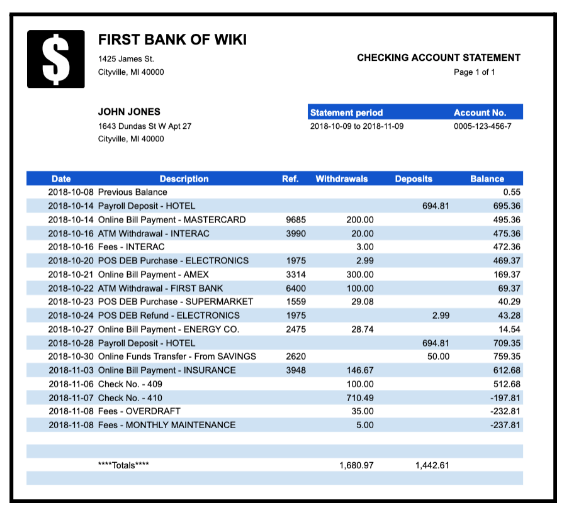
Part I: Read The Fine Print
Analyze this sample checking account statement and answer the questions that follow.
1 point
1
Question 13
13.
How frequently does John typically receive account statements from his bank?
Daily
Weekly
Monthly
Annually
1 point
1
Question 14
14.
How much did John Jones have in his account on the first day of the statement period?
-$72.47
$0.55
$694.81
$1,442.61
1 point
1
Question 15
15.
John has two ATM transactions but only one of them has a fee (Interac). Why?
Interac is an out-of-network ATM and First Bank charges customers if they use out-of-network ATMs.
First Bank charges customers for using their ATMs.
Banks charge fees if you take out less than $100 at an ATM machine.
The first ATM transaction is free but all additional ATM transactions have a fee.
1 point
1
Question 16
16.
Most employers will pay their employees by directly depositing their paycheck into their checking account. According to his checking account statement, John was paid ________________ every __________ .
$200.00, 3 weeks
$694.81, 2 weeks
$300.00, 1 month
$100.00, 2 weeks
1 point
1
Question 17
17.
What is the impact of the Online Funds Transfer - From Savings that appears on John's statement?
John's Savings account balance declined by $50 and his Checking account balance increased by $50
John's Savings account balance increased by $50 and his Checking account balance declined by $50
John's Savings account balance had no change and his Checking account balance declined by $50
John's Savings account balance increased by $50 and his Checking account balance had no change
1 point
1
Question 18
18.
Which statement is true regarding Check No. - 409?
This check likely came from John’s employer.
This check was written by John and paid to another person or business.
This check caused John to overdraw his checking account.
This check added $100 to John’s account.
1 point
1
Question 19
19.
Which transaction caused John to overdraw his account?
The Online Bill Payment for $146.67
Check No. 409 for $100
Check No. 410 for $710.49
The Overdraft Fee of $35
1 point
1
Question 20
20.
What was the result of John overdrawing his checking account?
John’s payment was greater than the balance he had available in his account so the bank will deposit $237.81 into John’s account so he can pay his bills.
John’s payment was greater than the balance he had available in his account so he was charged a $35 fee.
John’s payment was greater than the balance he had available in his account so he was charged a $5 monthly maintenance fee.
John’s payment was greater than the balance he had available in his account so the bank will transfer $35 from a linked account.
1 point
1
Question 21
21.
Which fees was John charged on his checking account during this statement period?
Online Transfer Fee, Overdraft Fee, Per Check Fee
Per Check Fee, ATM Fee, Overdraft Fee, Maintenance Fee
Online Transfer Fee, ATM Fee, Maintenance Fee
ATM Fee, Overdraft Fee, Maintenance Fee
1 point
1
Question 22
22.
What is the mathematical formula that you would use to describe the financial activity on a bank statement?
Use what you learned from analyzing the checking account statement to answer this question.
Why is it important to review your checking account statement? What fees might this help you avoid? Explain your answer.
Math Connection - Representing Data
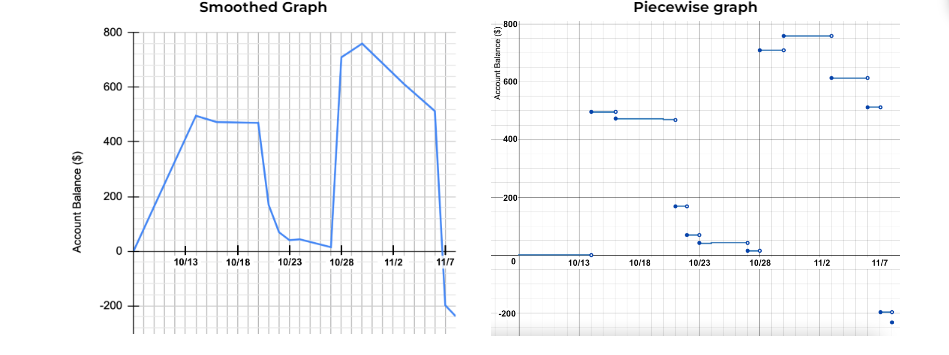
GRAPHS: John’s Account Balance
Now that you’ve learned to read a bank statement, let’s consider other ways of representing your account balance. These two graphs present the data on John’s account balance from the Fine Print above.
1 point
1
Question 24
24.
Describe the overall pattern of John’s account balance throughout the month.
1 point
1
Question 25
25.
Which graph do you think is the most useful for seeing overall patterns in John’s account balance? Why?
1 point
1
Question 26
26.
What was John’s approximate balance on 11/02, according to each graph?
Smoothed graph: _______ ______________
Piecewise graph: _______ ______________
1 point
1
Question 27
27.
Which graph do you think is the most accurate representation of John’s checking account balance? Why?
1 point
1
Question 28
28.
How else might you represent the data from John’s checking account?
Learn It
VIDEO: Spent: Looking for Change
You’ve learned how a checking account can help you protect your money, track your finances, and conveniently access funds. But what happens if you don’t have one? Watch this excerpt from a documentary to learn more.
1 point
1
Question 29
29.
Why do many people choose to use check-cashing services?
1 point
1
Question 30
30.
What are some of the disadvantages of being unbanked?
1 point
1
Question 31
31.
How might the shift towards digital banking impact people who are unbanked?
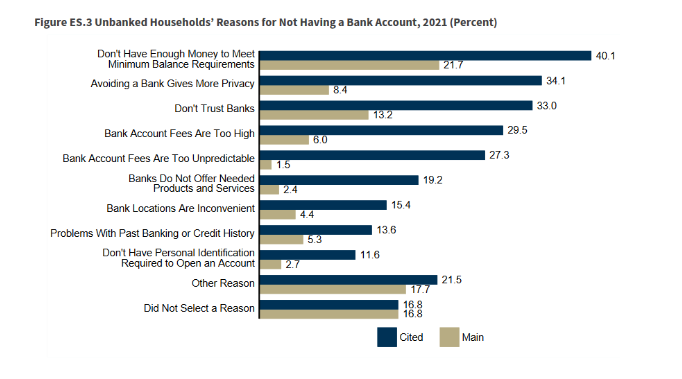
GRAPH: Why Are Many Americans Unbanked?
Being unbanked is expensive, yet millions of Americans do not have bank accounts and regularly rely on alternative financial services, like check cashers. Analyze this graph to learn more about the reasons why people are unbanked.
1 point
1
Question 32
32.
What were the three most commonly cited reasons to not have a bank account?
1 point
1
Question 33
33.
What percentage of respondents said their main reason was not having enough money to meet minimum balance requirements?
1 point
1
Question 34
34.
Why do you think “bank fees are too unpredictable” is frequently cited as a reason not to have a bank account, but only 1.5% of respondents said it was the main reason?
Exit Ticket
1 point
1
Question 35
35.
All of the following are benefits of checking accounts, EXCEPT...
Your account balance is insured up to $250,000
You can track your spending and use account alerts
You can use your account for online and mobile banking
You will never pay any account fees or ATM fees
1 point
1
Question 36
36.
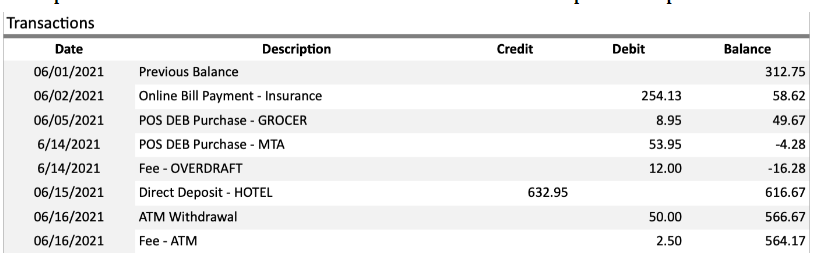
An excerpt from Andre’s bank statement is shown below. How much did he spend on his purchase from the MTA?
1 point
1
Question 37
37.
Which of the following is true about check cashers?