8th Grade: 1.2 Similarity End of Topic Assessment- ORIGINAL
star
star
star
star
star
Last updated about 1 year ago
11 questions
***IMPORTANT***
When entering answers, only enter spaces between words. If you are entering an answer for an algebraic rule, ordered pairs/coordinates, or any numbers enter your response with no spaces.
Use parentheses where appropriate!
Examples:
Rule: (2x,2y)
Ordered Pairs/Coordinates: (-1,2)
There are no spaces between any characters.
Vocabulary Section
Required
3 points
3
Question 1
1.
Match each word with it's proper defintion.
Draggable item
arrow_right_alt
Corresponding Item
Reduction
arrow_right_alt
A fixed point from which a dilation is generated
Center of Dilation
arrow_right_alt
When the scale factor is greater than 1, the image created is larger than the pre-image
Enlargement
arrow_right_alt
When the scale factor is less than 1, the image created is smaller than the pre-image
Required
3 points
3
Question 2
2.
Match each word with it's proper defintion.
Draggable item
arrow_right_alt
Corresponding Item
Scale Factor
arrow_right_alt
Transformations that produce figures that are the same shape as the original figure, but not the necessarily the same size
Similar
arrow_right_alt
The ratio of the distance of the new figure from the center of dilation to the distance of the original figure from the center of dilation. Written as a fraction of the new figure compared to the original figure.
Dilation
arrow_right_alt
When two figures ratios of corresponding side lengths are equal
Multiple Choice Section
Required
2 points
2
Question 3
3.
Which transformation does NOT preserve congruence?
Required
2 points
2
Question 4
4.
A polygon is graphed on a coordinate plane with (x, y) representing the location of a point on the polygon. The polygon is transformed using the rule (x, y) → (ax, ay).
Which statement must be true?
Required
2 points
2
Question 5
5.
Quadrilateral ABCD is dilated with the origin as the center of dilation to create quadrilateral A′B′C′D′.
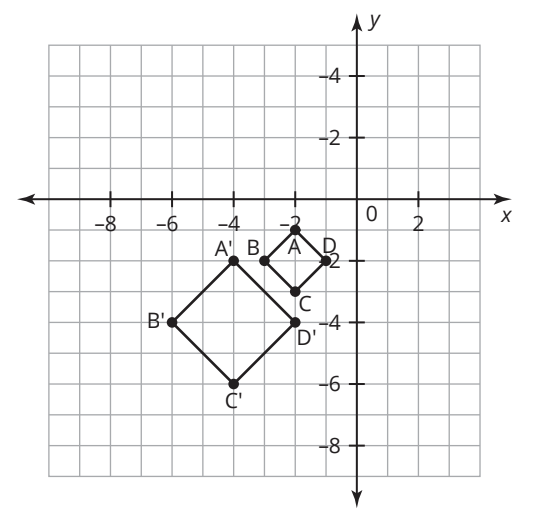
Which rule best represents this transformation?
New Item Types Section
Required
2 points
2
Question 6
6.
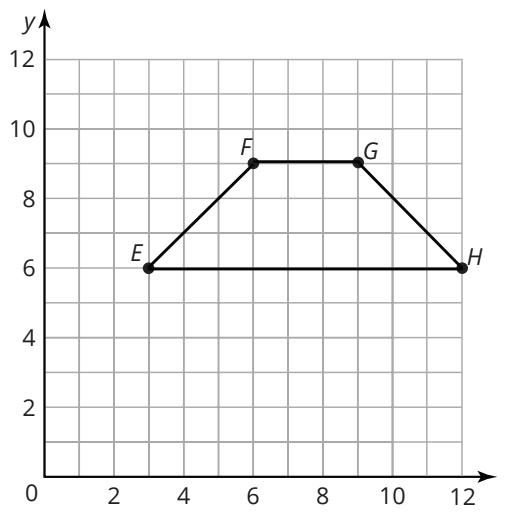
The perimeter of trapezoid E’F’G’H’ is __________ times the perimeter of trapezoid EFGH.
The area of trapezoid E'F'G'H' is __________ times the area of trapezoid EFGH.
Required
2 points
2
Question 7
7.
Rectangle QRST has coordinates Q(−8, 5), R(−8, 7), S(−5, 7), and T(−5, 5).
Dilate the rectangle by a scale factor of 4 with a center of dilation at the origin.
Write a rule to describe this transformation and use the rule to determine the coordinates of point R′.
(X,Y) -->_______
R' _______
Required
6 points
6
Question 8
8.
Select all scale factors that are a reduction.
Choose THREE answers.
Required
2 points
2
Question 9
9.
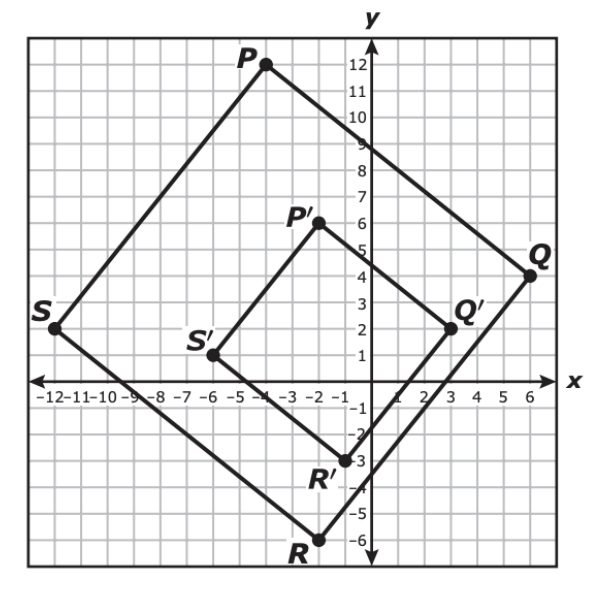
Quadrilateral PQRS is dilated with the origin as the center of dilation to create quadrilateral P′Q′R′S′.
What scale factor was used to dilate quadrilateral PQRS?
Bonus Section
0 points
0
Question 10
10.
A trapezoidal door mat is similar in shape to a trapezoidal rug. Each dimension of the door mat is one-third the size of the rug.
By what factor is the area affected?
0 points
0
Question 11
11.
Quadrilateral KMPT is dilated by a scale factor of 3/4 to create quadrilateral K’M’P’T’. The perimeter of quadrilateral KMPT is 60 units.
What is the perimeter, in units, of quadrilateral K’M’P’T’?