Log in
Sign up for FREE
arrow_back
Library

Paired Passages: "To a Daughter with Artistic Talent" & "from Big Fish"

star
star
star
star
star
Last updated 3 months ago
11 questions
Read the next two selections and answer the questions that follow.
Required
1
Required
1
Required
1
Required
1
Required
1
Required
1
Required
1
Required
1
Required
1
Required
1
Required
1

To a Daughter with Artistic Talent

by Peter Meinke

I know why, getting up in the cold dawn
you paint cold yellow houses
and silver trees. Look at those green birds,
almost real, and that lonely child looking
at those houses and trees.
You paint (the best way) without reasoning,
to see what you feel, and green birds
are what a child sees.

Some gifts are not given: you
are delivered to them,
bound by chains of nerves and genes
stronger than iron or steel, although
unseen. You have painted every day
for as long as I can remember
and will be painting still
when you read this, some cold
and distant December when the child
is old and the trees no longer silver
but black fingers scratching a grey sky.

And you never know why (I was lying
before when I said I knew).
You never know the force that drives you wild
to paint that sky, that bird flying,
and is never satisfied today
but maybe tomorrow
when the sky is a surreal sea
in which you drown . . .

I tell you this with love and pride
and sorrow, my artist child
(while the birds change from green to blue to brown).

“To a Daughter with Artistic Talent” from Liquid Paper: New and Selected Poems by Peter Meinke, ©1991. All rights are controlled by the University of Pittsburgh Press, Pittsburgh, PA 15260. Used by permission of the University of Pittsburgh Press.
Question 1
1.

Question 2
2.

Question 3
3.

Question 4
4.

Question 5
5.
Use Big Fish to answer question

Paragraph 20 reveals that the father views his childhood home of Ashland as __________
Question 6
6.

Question 7
7.

Question 8
8.

Question 9
9.

Question 10
10.

Question 11
11.

Use both passages to answer questions 1-4.

Which sentence best states a difference between the attitude of the speaker in the poem and the attitude of the narrator in the story?
The speaker in the poem worries that his daughter gets carried away by her imagination, while the narrator in the story admires the way his father uses his imagination.
The speaker in the poem believes that his daughter paints to express her true feelings, while the narrator in the story believes that his father tells stories to escape reality.
The speaker in the poem thinks his daughter paints to bring them closer together, while the narrator in the story thinks his father tells stories to distance himself from others.
The speaker in the poem believes that painting is good for his daughter’s health, while the narrator in the story worries that his father’s stories are a symptom of illness.
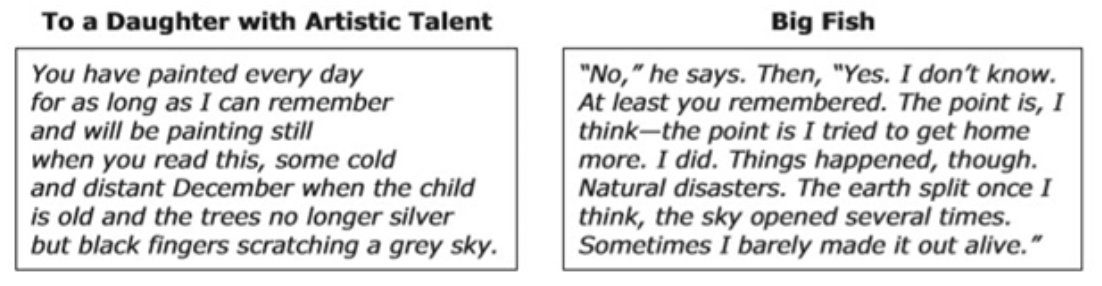
Read these quotations. From To a Daughter with Artistic Talent lines 13-19 and Big Fish line 14.
inner turmoil
stubbornness
guilt
e
Use both passages to answer questions 1-4.
Both the daughter’s paintings in “To a Daughter with Artistic Talent” and the father’s stories in the excerpt from Big Fish —
depict a world that seems more fanciful than realistic
contain imagery drawn from well-known fairy tales
are difficult for others to understand
portray heroic characters
Use both passages to answer questions 1-4.

What is a difference in how the two selections portray fathers?
While the father in “To a Daughter with Artistic Talent” is optimistic, the father in the excerpt from Big Fish is cynical.
While the father in “To a Daughter with Artistic Talent” seems caring, the father in the excerpt from Big Fish seems self-centered.
While the father in “To a Daughter with Artistic Talent” is open-minded, the father in the excerpt from Big Fish is judgmental.
While the father in “To a Daughter with Artistic Talent” seems defensive, the father in the excerpt from Big Fish seems relaxed.
CLEAR ALL
Use Big Fish to answer question

In paragraphs 3 through 5, the phrases “Let me guess” and “no doubt” give the son’s dialogue a tone that is —
naive
hypercritical
indignant
sarcastic
Select TWO correct responses and use Big Fish to answer question

What does paragraph 16 reveal about the son?
He blames himself for his father’s long absences.
He thinks his father never gave them the opportunity to be close.
He is too willing to forgive his father for lying.
He is unwilling to share what he knows with his father.
He is resentful towards his father.
Use to A Daughter With Artistic Talent to answer question

Read lines 26 and 27 from the poem.
when the sky is a surreal sea
in which you drown . . .
This image can best be interpreted as meaning that —
a child sees the sky as a magical ocean full of mysterious creatures
the speaker hopes to save his daughter from a terrible future
artists experience a sea of wild and unpredictable emotions
there is a danger that artists may get lost in their own creations
Use to A Daughter With Artistic Talent to answer question

Which sentence describes a shift in the poem’s focus?
In stanza 1, the speaker focuses on his daughter’s creative struggles, while in stanza 2, he imagines her eventual success as an artist.
In stanza 1, the speaker focuses on his daughter’s paintings, while in stanza 2, he describes his own artwork.
In stanza 1, the speaker focuses on his daughter’s art as an expression of childhood, while in stanza 2, he considers her future as a mature artist.
In stanza 1, the speaker focuses on his daughter’s early artistic success, while in stanza 2, he questions whether she should pursue a career as a painter.
Use to A Daughter With Artistic Talent to answer question

The final line of the poem suggests that —
the daughter will develop an interest in more practical pursuits as she matures
the speaker expects his daughter’s art to transform as she grows older
the daughter’s paintings will become more whimsical as she develops her technical skills
the speaker believes that his daughter will one day be a successful professional artist
Use to A Daughter With Artistic Talent to answer question

Lines 20 and 21 suggest that the speaker —
wants to be honest about how little he understands the creative impulse
does not want to mislead his daughter into believing that she has special talent
is now willing to risk hurting his daughter’s self-esteem by telling her the truth about her work
wants to admit his confusion about the sometimes-stifling life choices that creative people make