7th Grade: 1.2 Similarity End of Topic Assessment- Melle

Last updated about 2 years ago
13 questions

***IMPORTANT***

When entering answers, only enter spaces between words. If you are entering an answer for an algebraic rule, ordered pairs/coordinates, or any numbers enter your response with no spaces.

Use parentheses where appropriate!

Examples:

Rule: (2x,2y)

Ordered Pairs/Coordinates: (-1,2)

There are no spaces between any characters.

Vocabulary Section
Required
3

Match each word with it's proper defintion.

Draggable itemCorresponding Item
Reduction
A fixed point from which a dilation is generated
Center of Dilation
When the scale factor is greater than 1, the image created is larger than the pre-image
Enlargement
When the scale factor is less than 1, the image created is smaller than the pre-image
Required
3

Match each word with it's proper defintion.

Draggable itemCorresponding Item
Dilation
Transformations that produce figures that are the same shape as the original figure, but not the necessarily the same size
Scale Factor
The ratio of the distance of the new figure from the center of dilation to the distance of the original figure from the center of dilation. Written as a fraction of the new figure compared to the original figure.
Similar
When two figures ratios of corresponding side lengths are equal
Multiple Choice Section
Required
2

A transformation is applied to a figure to create a new figure on a coordinate grid. Which transformation does NOT preserve congruence?

Required
2

Which transformation does NOT preserve congruence?

Required
2

A trapezoidal door mat is similar in shape to a trapezoidal rug. Each dimension of the door mat is one-third the size of the rug.

Which statement is true?

Required
2

A polygon is graphed on a coordinate plane with (x, y) representing the location of a certain point on the polygon. The polygon is transformed using the rule (x, y) → (ax, ay).

Which statement must NOT be true?

Required
2

Quadrilateral ABCD is dilated with the origin as the center of dilation to create quadrilateral A′B′C′D′.
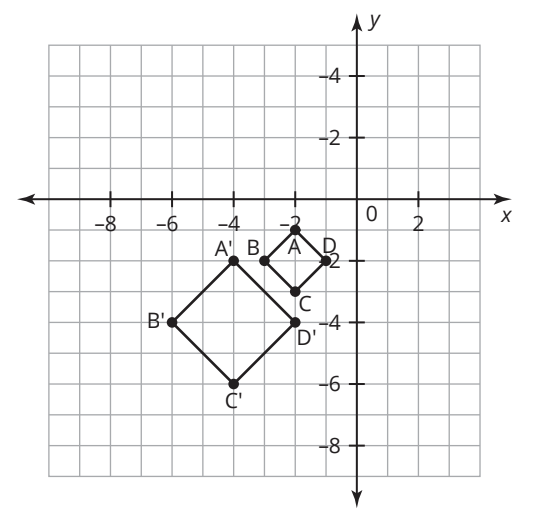

Which rule best represents this transformation?
Required
2

Quadrilateral KMPT is dilated by a scale factor of 0.75 to create quadrilateral K’M’P’T’. The perimeter of quadrilateral KMPT is 60 units. What is the perimeter, in units, of quadrilateral K’M’P’T’?

New Item Types Section
Required
2


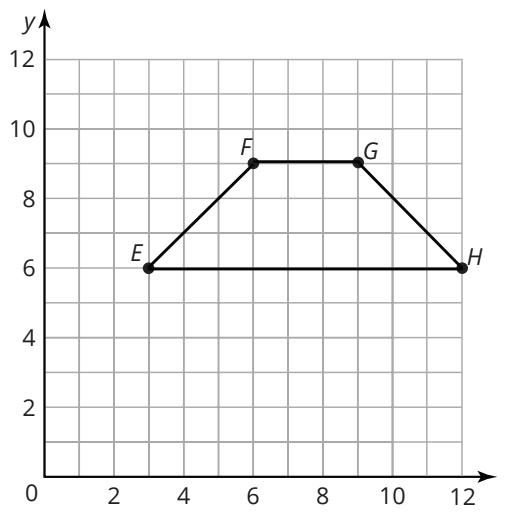
The perimeter of trapezoid E’F’G’H’ is __________ times the perimeter of trapezoid EFGH.

The area of trapezoid E'F'G'H' is __________ times the area of trapezoid EFGH.
Required
5
Rectangle QRST has coordinates Q(−8, 5), R(−8, 7), S(−5, 7), and T(−5, 5).

Dilate the rectangle by a scale factor of 4 with a center of dilation at the origin.

Write a rule to describe this transformation and use the rule to determine the coordinates of rectangle Q′R′S′T′.

Q' _______
R' _______
S' _______
T' _______
(X,Y) --> _______
Required
3

Select all scale factors that are a reduction.

Choose THREE answers.

Required
2

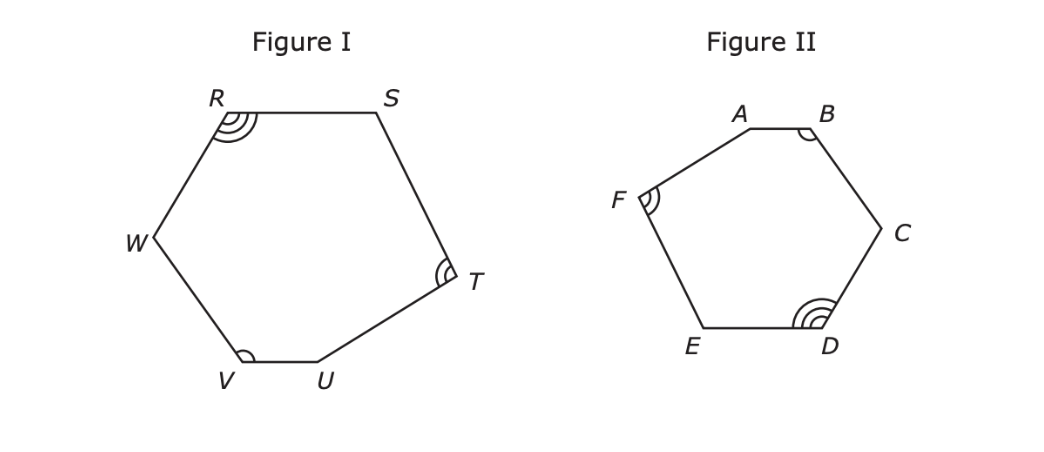
Figure I and Figure II are similar. Side RS in Figure I corresponds to which side in Figure 2?


Required
2

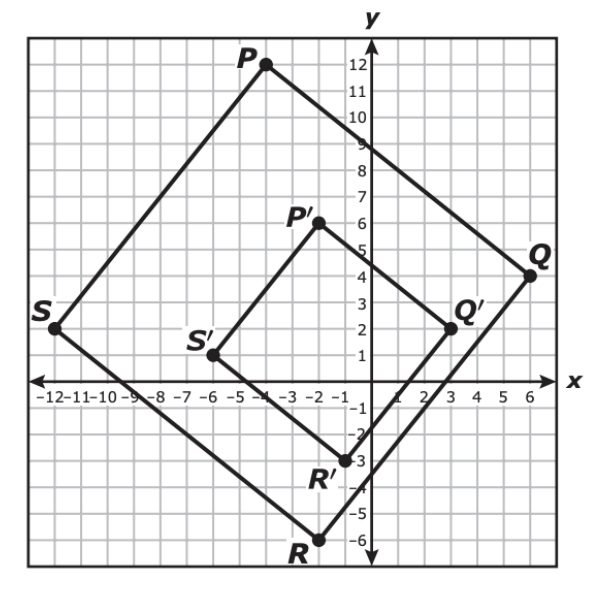
Quadrilateral PQRS is dilated with the origin as the center of dilation to create quadrilateral P′Q′R′S′. The coordinates of each vertex are integers. What scale factor was used to dilate quadrilateral PQRS?