Identify common checking account fees and how to avoid them
Explain how overdraft protection works and the impact of overdraft fees
Compare overdraft policies at major US banks
National Standards for Personal Financial Education
Spending
9c: Research financial technology options for financial record-keeping
Saving
3b: Compare and contrast the features of mobile payment accounts, cryptocurrency accounts, and checking/ savings accounts
DISTRIBUTION & PLANNING
Distribute to students
Student Activity Packet
OBJECTIVES & STANDARDS
Math Objectives
Calculate with percents using appropriate units
Common Core Math Standards
Link to all CCSS Math
CCSS.PRACTICE.MP6
CCSS.HSN.Q.A.1
Personal Finance Objectives
Identify common checking account fees and how to avoid them
Explain how overdraft protection works and the impact of overdraft fees
Compare overdraft policies at major US banks
National Standards for Personal Financial Education
Spending
9c: Research financial technology options for financial record-keeping
Saving
3b: Compare and contrast the features of mobile payment accounts, cryptocurrency accounts, and checking/ savings accounts
DISTRIBUTION & PLANNING
Distribute to students
Student Activity Packet
Intro (Warm-Up)
SIMULATION: Summer Spending
Your teacher will take you through a simulation of two months using a checking account. Please enter the amounts in your book on notes page 2.2 AND in the formative quesitons.
10 points
10
Question 1
1.
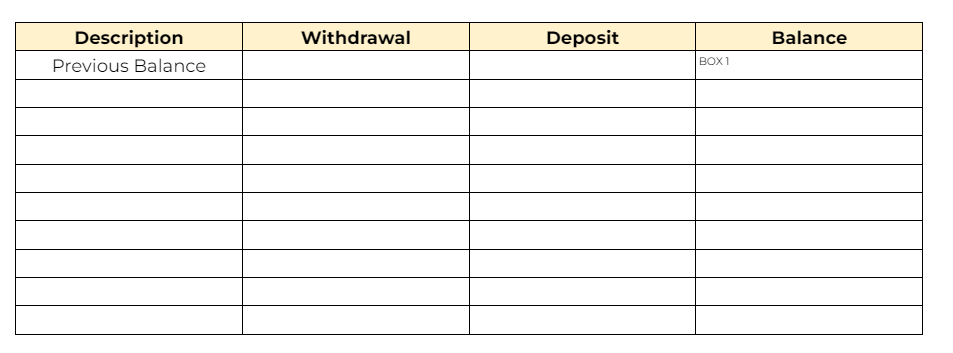
In Box 1, use your birth month multiplied by 100 (Ex: March = $300, October = $1000)_______
Your first transaction is a $100 transfer from your savings account. Because it was your 7th transfer, you also incurred a $25 transfer fee. Record both of these in the table to start. Then enter the simulation events as follows:
Simulation Events
Your car broke down and it was $300 to repair it.
You buy the new sneakers that just came out for $100. No fee with your debit card.
You purchased a $5 ice cream cone at the convenience store. You used the atm at the store to withdraw money to pay. There was a $5 fee for the ATM and a $5 fee from your bank for using an out-of network ATM.
It is the end of the month. You’re assessed a monthly service fee on your account of $15 if your daily balance was below $300.
You make no more purchases the following month to save money. At the end of the month, you’re assessed a monthly service fee on your account of $15 if your daily balance was below $300.
1 point
1
Question 2
2.
How did it feel when you were told you had a fee?
1 point
1
Question 3
3.
How does the amount spent on purchases compare to the amount spent in fees?
1 point
1
Question 4
4.
Do you feel like the fees were fair? Why or why not?
1 point
1
Question 5
5.
What is one thing you could do to spend less on fees?
Learn It
ARTICLE: 7 Common Bank Fees Explained
Read this article about common checking account fees. Then, answer the questions.
1 point
1
Question 6
6.
What fee or fees are the largest? Approximately how much are they?
1 point
1
Question 7
7.
Why might small ATM fees prove to be very expensive?
1 point
1
Question 8
8.
What fees do you think you are most likely to incur? Why?
VIDEO: Bank Overdraft Fees
One of the most common fees banks charge is the Overdraft fee. Watch this video to learn what this fee is and what you can do to avoid it. Then, answer the following questions.
1 point
1
Question 9
9.
What is misleading about the term “overdraft protection”?
1 point
1
Question 10
10.
True or False: Once you are signed up for overdraft protection, you cannot opt out.
1 point
1
Question 11
11.
What else did Sharon do to avoid future overdraft fees?
ARTICLE: 7 Mobile Banking Alerts Everyone Should Activate
In the previous video, you saw that Sharon had set up some alerts so that she could avoid expensive banking fees. Skim this article to find out what kinds of alerts you can set up so you can avoid fees as well. Then, answer the following questions.
3 points
3
Question 12
12.
In your own words, briefly describe the benefit of each type of alert below:
a. Low Balance
b. Direct Deposit
c. Unusual Activity
1 point
1
Question 13
13.
While all three of the alerts are highly recommended, which one do you think is most important? Why?
ANALYZE: Overdraft Fees
Use BankRate’s Overdraft Fees Vs. NSF Fees: How They Differ article to pair each overdraft protection with its description.
List of Overdraft Outcomes
Overdraft Coverage
NSF Fee
Overdraft Protection
1 point
1
Question 14
14.
Charged when checks or electronic payments cause your account to go below $0
This is only charged if no other account protections are in place
The average fee is around $25.
All transactions will be declined
_______
1 point
1
Question 15
15.
A service that automatically transfers money from a linked savings account when a transaction would cause your account balance to go below $0
Transactions are approved and money is transferred from your linked account
There is sometimes a fee but it will typically be smaller than other options
_______
1 point
1
Question 16
16.
Charged when any transaction causes your checking account balance to go below $0
Transaction to be approved and your account will go into negative territory
The average fee is around $30 per transaction
Many banks have a limit on the number of these transactions that you can be charged per day
You can opt out of this outcome
_______
Part II: Calculate the Fees
It’s never a good feeling to find out that you spent MORE money than you had available, then getting a fee added on top of that overspending! In this section, you will practice calculating the fees associated with overspending.
Joshua has a checking account at Grand Spire National Bank. Grand Spire has three options when an account goes below zero:
Option 1 - No Overdraft Service: The bank will decline any transaction that exceeds the available balance. This includes ATM, one time debit card and recurring debit transactions. A NSF Fee of $35 will be charged for each check or eCheck/ACH transaction (the digital equivalent of a check) that is declined.
Option 2 - Overdraft Coverage: All transactions that exceed an available balance will be accepted. A $35 fee will be charged for each transaction (including checks) that exceeds the available balance. You can be charged up to 3 overdraft fees per day.
Option 3 - Overdraft Protection: All transactions that exceed an available balance will be accepted. Money will be transferred in $50 increments from a linked Grand Spire savings account. A $10 transfer fee will be applied to each transfer.
Joshua’s Day
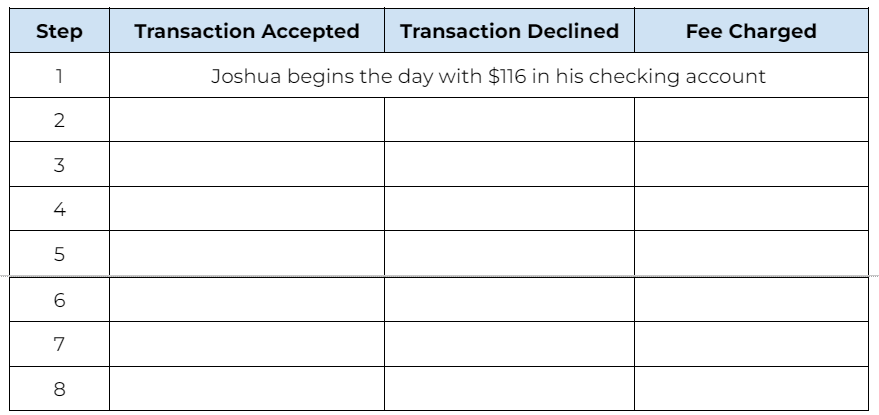
When the day begins, Joshua has $116 in his checking account $200 in his linked savings account
Before school he buys his cousin a round trip bus fare for $4 using his debit card
He then uses the card to get gas in his car for $43
Once the banks open, a check he gave the school for his senior yearbook clears, and $75 comes out of his account
Joshua’s Netflix account subscription is automatically charged to his debit card today, too, so another $10 leaves the account
After school he heads out with friends and uses his debit card to buy a $3 coffee
His $40 cell phone bill that is paid with an eCheck is withdrawn
Finally, he finishes out the day with some shopping to buy new soccer gear for $25 using his debit card at the store
0 points
0
Question 17
17.
Scenario 1: Joshua chooses Option 1 - No Overdraft Service
For each step in Joshua’s day, put a check mark ✔ in either the Transaction Accepted or Transaction Declined column. If he would be charged a fee, also write the fee amount and type in the Fee Charged column.
0 points
0
Question 18
18.
What are the total fees Joshua would have to pay in this scenario?
0 points
0
Question 19
19.
Including fees, what is Joshua’s ending balance?
0 points
0
Question 20
20.
At what step might Joshua start to suspect that he has overdrawn his account?
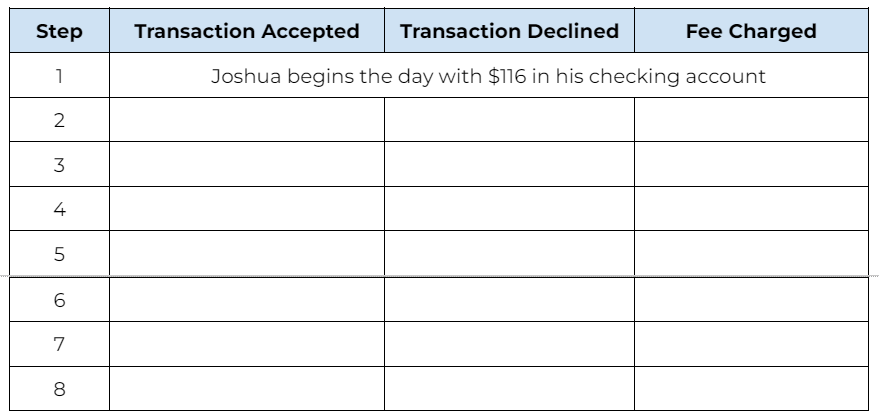
For each step in Joshua’s day, put a check mark ✔ in either the Transaction Accepted or Transaction Declined column. If he would be charged a fee, also write the fee amount and type in the Fee Charged column.
0 points
0
Question 22
22.
What are the total fees Joshua would have to pay in this scenario?
For each step in Joshua’s day, put a check mark ✔ in either the Transaction Accepted or Transaction Declined column. If he would be charged a fee, also write the fee amount and type in the Fee Charged column.
0 points
0
Question 25
25.
What are the total fees Joshua would have to pay in this scenario?
0 points
0
Question 26
26.
Including fees, what is Joshua’s ending balance?
0 points
0
Question 27
27.
Part III: Analyze the Bigger Picture
Now that you’ve seen the outcome of Joshua’s day using different overdraft options, take some time to reflect on overdraft outcomes and do some research into how major banks handle these situations.
Which overdraft option would be the best for Joshua if his goal is to minimize total fees? Are there any downsides to making this choice?
5 points
5
Question 28
28.
The top 5 consumer banks are Chase, Bank of America, Wells Fargo, Citibank and US Bank. Choose one of these banks and research their overdraft policies. In the space below, include information about this bank’s NSF fees, overdraft coverage fees, and overdraft protection fees. *Chose your own bank and fill in if it is not listed. **
1 point
1
Question 29
29.
If you were selecting a checking account and reviewing account agreements to see which is the best fit for you, which option do you think you would choose? Explain your thinking.
Math Connection - Percentages
1 point
1
Question 30
30.
Joshua made the following purchases in a day. What percentage of his purchases was for his soccer gear?_______ Screen shot Desmos for full credit!!
- Bus fare - $4 - Gas - $43 - Netflix subscription - $10
- Coffee - $3 - Dinner - $15 - Soccer Gear - $35
1 point
1
Question 31
31.
The average monthly maintenance fee is $13. What percentage of his balance would be spent on fees if Joshua had a starting balance in September of $116?_______ Screen Shot Desmos for full credit!
1 point
1
Question 32
32.
If he had to pay the maintenance fee a second time in October and had not deposited any more money, that $13 fee would be what percentage of Joshua’s October starting balance?_______ Screenshot Desmos for full credit!!
1 point
1
Question 33
33.
If 72% of households reported paying no banking fees whatsoever, that means 28% of households paid all the fees. Out of the total 131.3 million households in America, approximately how many paid banking fees in 2019?_______Households Screen shot Desmos for full credit!
1 point
1
Question 34
34.
Banks made around $31 billion in fees in 2019. If those households were responsible for the entire $31 billion, on average how much did each pay in fees?_______ Screen shot Desmos for Full Credit
1 point
1
Question 35
35.
When it comes to fears about banking, only 13% of Americans are cautious of incurring bank fees, according to a GOBankingRates survey. How many of the 131.3 million households in America are on the lookout for these hidden bank fees?_______ households Scren shot Desmos for full credit!!
Exit Ticket
1 point
1
Question 36
36.
What is an overdraft fee?
Fee for withdrawing more money than you have in the account
Fee for writing a check
Fee for going below your minimum balance requirement
Fee for making too many transfers from your account
1 point
1
Question 37
37.
Tori has $75 in her checking account and swipes her debit card for a $90 purchase at Target. She has overdraft protection. What most likely happens?
Her purchase is declined
Target calls the police to report her for fraud
Her purchase is approved, and she pays no fee
Her purchase is approved, but she pays an overdraft fee
1 point
1
Question 38
38.
Which is the correct order of average fee amounts from least to greatest?