Log in
Sign up for FREE
arrow_back
Library
6.ESS2.2 CFU-1
By Sharon Fletcher
star
star
star
star
star
Share
share
Last updated over 2 years ago
10 questions
Add this activity
1
1
1
1
1
1
1
1
1
1
Question 1
1.
Convection currents, which affect weather are created by
even cooling of the Earth.
the even heating of the Earth.
gravitational pull from the moon.
the uneven heating of the Earth.
Question 2
2.
Which of the following is one factor that drives the global wind systems on Earth?
movement of clouds
the even heating of the Earth
the gravitational pull of the moon
differences in air pressure on Earth
Question 3
3.
Why is the surface of the earth unevenly heated?
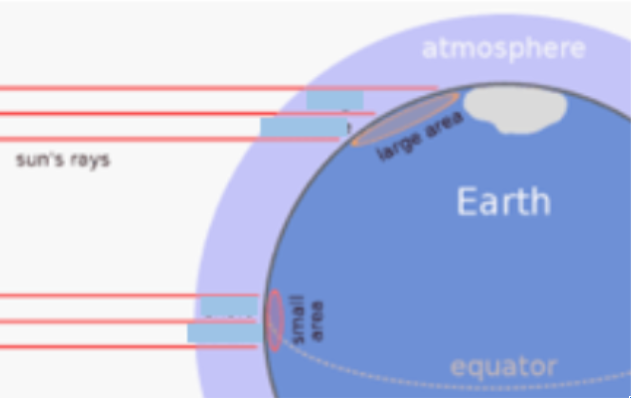
When the sun’s energy is transferred to the earth’s surface, it hits the area around the north and south poles most directly, while hitting the area around the equator at an angle.
When the sun’s energy is transferred to the earth’s surface, it hits the area around the equator most directly, while hitting the areas around the north and south poles at an angle.
The earth’s surface is evenly heated.
None of the above
Question 4
4.
Which answer choice correctly describes the movement of air on Earth?
Warm air rises from the equator and moves toward the poles because it is less dense.
Warm air rises from the equator and moves toward the poles because it is more dense.
Warm air rises from the north and south poles, then sinks toward the equator because it is less dense.
Warm air rises from the north and south poles, then sinks toward the equator because it is more dense.
Question 5
5.
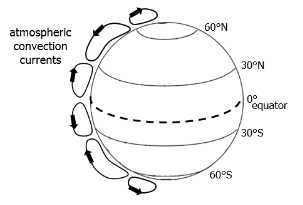
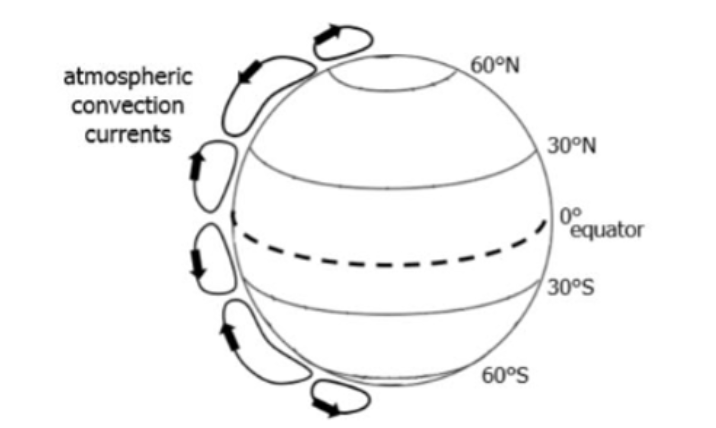
The model shows the patterns of atmospheric convection currents on Earth. What is one process that contributes to creating these currents?
even heating of Earth
movement of clouds
uneven heating of Earth
gravity from a nearby moon
Question 6
6.
What causes differences in air pressure around the Earth?
Warm air rises at the equator, and cold air sinks at the poles.
Warm air sinks at the equator, and cold air rises at the poles.
Warm air rises at the equator, and cold air rises at the poles.
Warm air sinks at the poles, and cold air rises at the equator.
Question 7
7.
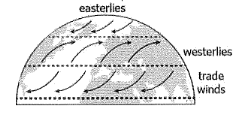
The diagram shows wind patterns in the Northern Hemisphere.
What do the circulation patterns of winds in the Southern Hemisphere look like?
Question 8
8.
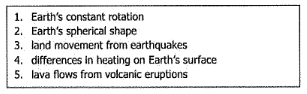
The list shows different properties.
Which properties cause the air in Earth's atmosphere to move in predictable patterns?
1, 2, and 3
1, 2, and 4
2, 3, and 4
3, 4, and 5
Question 9
9.
The model shows the patterns of atmospheric convection currents on Earth.
What is one process that contributes to creating these currents?
spinning of Earth's inner core
gravity from a nearby moon
movement of clouds
uneven heating of Earth's surfaces
Question 10
10.
The Coriolis effect is the curving of the path of a moving object. How does the Coriolis effect influence the wind?
It causes the air to move.
It changes the direction of the wind.
It causes winds to move in straight paths.
It changes the height at which wind travels.