1.1 Fractions & Tax Dollars 9.7.23

Last updated 10 months ago
34 questions
Note from the author:
OBJECTIVES & STANDARDS
Math Objectives
  • Define rational numbers
  • Express rational numbers as a fraction, decimal, and percent, and convert between the three
  • Multiply rational numbers to solve word problems
Common Core Math Standards
  • Link to all CCSS Math
  • CCSS.PRACTICE.MP2
  • CCSS.HSN.RN.B.3
  • CCSS.HSN.Q.A.1
Personal Finance Objectives
  • Understand how the federal government spends income tax dollars
  • Explain the similarities and difference between payroll taxes and self-employment taxes
  • Explain how sales tax is calculated, and how it differs between states and local areas
National Standards for Personal Financial Education
Earning Income
  • 6a: Calculate the amount of taxes a person is likely to pay when given information or data about the person’s sources of income and amount of spending
  • 6b: Identify which level(s) of government typically receive(s) the tax revenue for income taxes, payroll taxes, property taxes, and sales taxes
  • 6c: Describe the benefits they receive, or may receive in the future, from government-collected tax revenue
  • 11a: Evaluate the benefits and costs of gig employment, such as driving for a cab or delivery service
OBJECTIVES & STANDARDS
Math Objectives
  • Define rational numbers
  • Express rational numbers as a fraction, decimal, and percent, and convert between the three
  • Multiply rational numbers to solve word problems
Common Core Math Standards
  • Link to all CCSS Math
  • CCSS.PRACTICE.MP2
  • CCSS.HSN.RN.B.3
  • CCSS.HSN.Q.A.1
Personal Finance Objectives
  • Understand how the federal government spends income tax dollars
  • Explain the similarities and difference between payroll taxes and self-employment taxes
  • Explain how sales tax is calculated, and how it differs between states and local areas
National Standards for Personal Financial Education
Earning Income
  • 6a: Calculate the amount of taxes a person is likely to pay when given information or data about the person’s sources of income and amount of spending
  • 6b: Identify which level(s) of government typically receive(s) the tax revenue for income taxes, payroll taxes, property taxes, and sales taxes
  • 6c: Describe the benefits they receive, or may receive in the future, from government-collected tax revenue
  • 11a: Evaluate the benefits and costs of gig employment, such as driving for a cab or delivery service
Intro
ACTIVITY: MOVE: Your Tax Dollar in Action
Follow your teacher’s directions to participate in this activity that explores how the US spends its federal income tax revenue. After you’re done, you should be able to answer these questions.
1

In general, why does the US government collect taxes?

1

Opinion: Do you think the average American household would be better or worse off if they got to keep all their income rather than paying some in taxes? Why?

Learn It
Fractions, Decimals, and Percents
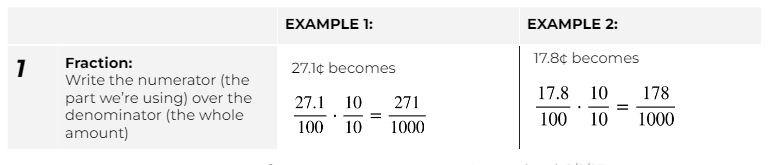
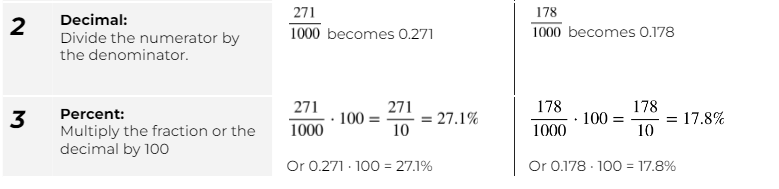
In the MOVE activity, each of the numbers is written as cents, which represent a portion of one dollar. We can translate each of the cents into a fraction, a decimal, or a percent.
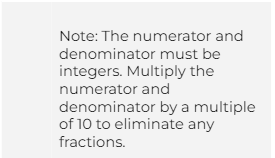
Here are two examples using the 27.1¢ and 17.8¢ devoted to the two largest federal tax spending categories.


1

Convert each of these into a fraction, a decimal rounded to the nearest thousandth, and a percent.

1

The fraction, decimal, and percent versions of a number represent the exact same quantity. How would you decide which way to express a given quantity?

VIDEO: What are Rational Numbers?
Fractions, decimals, and percents are all rational numbers. Watch this brief video to learn more about rational numbers.

Note that integers are also rational numbers, as they can be expressed as a fraction with 1 in the denominator. For example, -6 can be expressed as
1

In 2022, 40% of taxpayers owed no federal income taxes or received tax credits back from the government.
  1. Is 40% a rational number? Why or why not?
  2. What is an equivalent fraction that also represents 40%?

1
Also during 2022, 16.5% of households paid no federal income taxes AND no payroll taxes. Payroll taxes are specific taxes that contribute toward paying into the funds for Social Security and Medicare.
  1. What is one way you could write the percent as a fraction instead?_______
1

Which number is larger – the portion of Americans who paid no federal income tax or the portion of Americans who paid no federal income tax and no payroll taxes?

Practice It
1
The Tax Policy Center estimates that 40% of middle-income households will pay no federal income tax for tax year 2022.
Write this percent as a fraction._______
1
18 out of 26 students in the class have never filed taxes before.
Represent this value as a percent rounded to the nearest tenth._______
2
In 2022 the top 1% of taxpayers (in many cases, people with the highest incomes) paid nearly 26% of the total federal income taxes collected.
Write each percent as a fraction. 1%=_______ 26%=_______
2
1896 of the 6492 households in your zip code filed their taxes by February 15. By March 15, another 2429 had done so. What percent of households, rounded to the nearest tenth, have filed by March 15?._______ What percent have not filed? _______
1

You’re given the rational number ​᠎​​᠎​​᠎​​᠎​46/224. You can choose to add 10 to the numerator OR add 10 to the denominator. Which option will give you a larger final number?

1
$3.34 out of Annette’s $73 bill at the grocery store was sales tax. Write this as a rational number, remembering that numerator and denominator must be integers._______
1

Kirsten thinks 24% of federal tax dollars should fund education, and Jackson thinks $0.35 of every tax dollar should go toward education. Express each as a rational number. Who supports more education funding?

1
What’s one integer that could be used as the denominator of this fraction 1/[ ]to make its value less than 23%?_______
1

You’re given the rational number 362/451. You can choose to add 10 to the numerator OR subtract 10 from the denominator. Which option will give you a larger final number?

Learn It 2
Multiplying with Rational Numbers
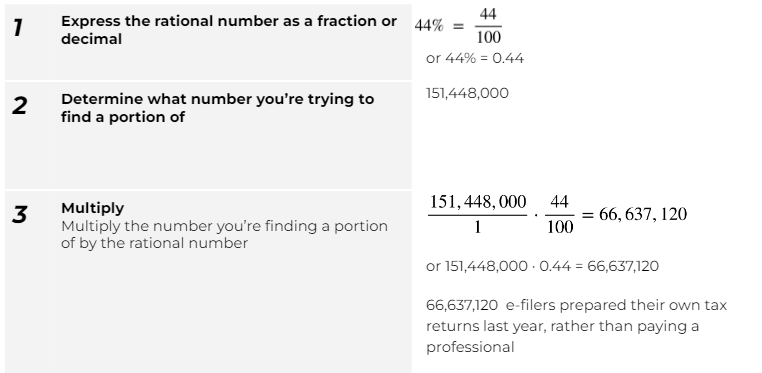
Thus far, we have focused on writing rational numbers as fractions, decimals, and percents and converting between one of those formats and another. Often, when talking about personal finance you are given a rational number (such as, 25% of her paycheck went to taxes) and you may want to use it to find out how much that rational number represents (for example, 25% of a $80 paycheck would be $20). You do so by multiplying.
  1. Review the completed example below.
Last year, 151,681,000 tax returns were e-filed (filed online rather than using a paper copy). 44% of e-filers filed their own taxes rather than paying a professional to do so. How many people are included in that 44%?


1
Follow your teacher’s directions to complete this second example, where the rational number is greater than 1.

Last year, Keisha paid $765 in taxes while working a part-time job and going to school. Now that she’s working full-time, she was shocked to find that her taxes jumped 612%! How much does Keisha pay in taxes now?$_______
APPLICATION: Calculating Taxes Using Rational Numbers NOTE: Round all answers to the nearest hundredth. Section

Level 1

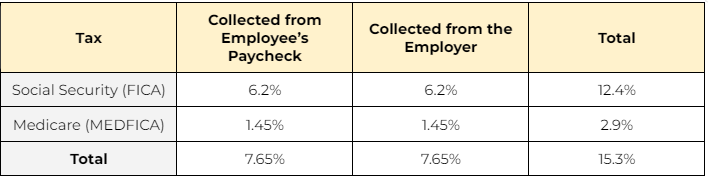
Payroll taxes are taxes paid on the wages and salaries earned by employees. The two most common federal payroll taxes support Social Security and Medicare and can be known as the Federal Insurance Contributions Act (FICA) and Medicare Federal Insurance Contributions Act (MEDFICA). Social Security and Medicare are both social insurance programs, providing support to eligible Americans.
NOTE: Commonly, when someone refers to “payroll taxes” or “FICA,” they mean the taxes that support both Social Security and Medicare, combined.
Here is how payroll taxes are collected:

Dynasti is an employee of Swifty Car Wash, Inc in their corporate legal department. Her annual salary is $114,800.
1

How much will Dynasti pay in Social Security taxes this year?

1

How much will Swifty Car Wash contribute to Medicare for Dynasti’s salary?

*Note that Swifty Car Wash has to contribute payroll taxes for every employee, according to their pay, not just Dynasti.
Nolan works part-time at a movie theater making his state’s minimum wage of $10.10 per hour. He receives a paycheck every 2 weeks.
1
If he works 20 hours over the course of the first two weeks in February, how much should he expect to have taken out of his paycheck for payroll taxes?_______
1

The second half of February is much busier with local schools closed for the entire week of Presidents Day, and Nolan’s boss schedules him for 27 hours instead. Other than payroll taxes, Nolan doesn’t have any other money withheld from his paycheck. How much can he expect his take-home pay to be? Note: Take-home pay is gross earnings minus any deductions.

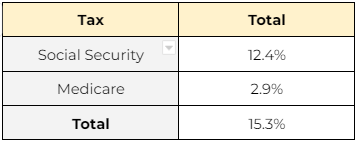
Payroll taxes are shared by traditional employees and their employers. Alternatively, if you are self-employed, which includes gig workers or those with a side-hustle, you have to pay the employer’s portion as well as the employee’s portion. These taxes are then called Self-Employment Contributions Act (SECA) taxes, which are taxed at the rates shown below.


In addition to full-time job at Swifty Car Wash, Dynasti also has a side-gig selling elaborate, expensive birthday cakes to customers within a 50-mile radius of her home. She’s using her profits to pay down law school loans more quickly.
1

In June, one of her busiest months, Dynasti sells 7 cakes, collecting a total of $795 from her customers. How much does she need to pay for her SECA taxes?

1

After reading more about self-employment taxes, Dynasti realizes she can deduct the cost of the ingredients she used to bake the cakes before she determines how much tax she owes! If ingredients for those 7 cakes cost a total of $82, how much does Dynasti actually owe for SECA?

Level 2

Unlike payroll, income, and self-employment taxes which are based on income, sales tax is based on the cost of goods purchased. The US does not have a universal federal sales tax; instead, individual states (and sometimes local governments) make the rules regarding sales tax in their jurisdictions. Not only do they set the rates, but they also set policy on what types of items are taxed and which are tax exempt.
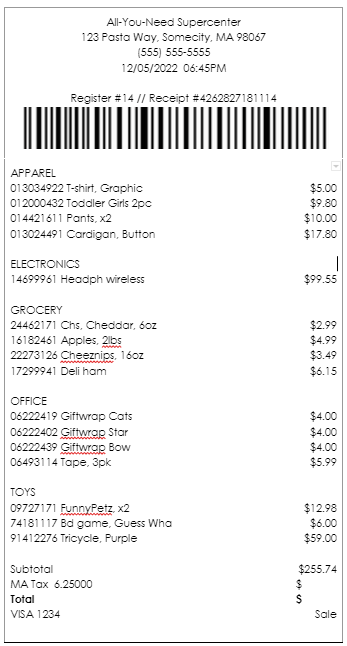
In the state of MA the state sales tax is 6.25%, there are no local sales taxes in the state, and the following categories are tax-exempt (no sales tax charged): Food for human consumption (non-restaurant), clothing under $175, periodicals, and admissions/tickets.

Glenn is doing some holiday shopping at his local retail superstore, and he picks up some general items for home, too. Here is his receipt:

1

How much should Glenn’s receipt list in the MA Tax line?

1

What will Glenn’s total bill be as a result of adding the appropriate sales tax?

1

What percent of Glenn’s total bill is sales tax?

1

In 2020, the median household income for Massachusetts was $84,385 per year, which amounts to $7,032 per month, or $3516 per paycheck if paid twice per month. If Glenn’s family has the median household income, what percent of his recent paycheck went toward sales tax on this purchase?

1

While the median income is nearly $85,000, a very large percent of MA households actually make closer to $35,000 per year, which amounts to $1458 per pay period. If that were Glenn’s recent paycheck, what percent of his pay would go to paying sales tax for this trip to All-You-Need?

1

While income taxes scale differently based on how much you earn, sales tax rates are charged to consumers regardless of how much income their household has. Explain how this sales tax system impacts the personal finances of households differently.

Level 3

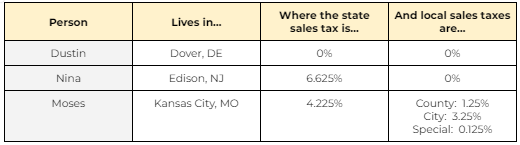
Five states in the country (Alaska, Delaware, Montana, New Hampshire, and Oregon) do not charge any sales tax on purchases, which means that residents of these states will pay less at the checkout counter than consumers will in other states. For these problems, you’ll need the following information:

Dustin buys a $325 lawn mower in Delaware. His cousin Nina buys the same model in New Jersey, where sales tax is 6.625%, calculated and then added onto the total cost of the item.
1

What will Nina’s total bill for the lawnmower be?

1

They’ve got a third cousin, Moses, who lives in Kansas City, Missouri. There, he’ll expect to pay a 4.225% state sales tax, a 1.25% county sales tax, a 3.25% city sales tax, and a 0.125% special sales tax. How much will he spend buying the lawnmower at his local hardware store?

1

Moses gets the idea that he should drive up to Delaware to buy the lawnmower there instead, so that he can save all the tax money! BUT, he realizes he’ll need to pay for roundtrip gas between his hometown in Kansas City, MO and Dustin’s hometown in Dover, DE, 1142 miles away. His vehicle gets roughly 23 miles per gallon on the highway, and a gallon of gas is currently $3.30. Is driving to Delaware for the lawnmower worthwhile? Show your work.

1

Given the idea by Moses, Nina’s wondering if she should travel from her home in Edison, NJ to Dustin’s house in Dover, DE to purchase the lawnmower there. They’re 144 miles from each other, and she’s got a hybrid vehicle that manages 54 miles per gallon. Is the roundtrip drive worth it in Nina’s case? Show your work.

1

When deciding whether it’s worthwhile to drive across state lines to avoid sales tax, what factors other than the cost of gas should Moses and Nina consider?

The End :)