OBJECTIVES & STANDARDS
Math Objectives
Write equations for piecewise functions
Read the graphs of piecewise functions
Identify whether functions are continuous or discontinuous
Common Core Math Standards
Link to all CCSS Math
Personal Finance Objectives
Represent stepped tax rates using piecewise functions
Use piecewise functions to deepen understanding of marginal and effective tax rates for income or payroll taxes
National Standards for Personal Financial Education
Earning Income
6a: Calculate the amount of taxes a person is likely to pay when given information or data about the person’s sources of income and amount of spending
7a: Investigate the federal and state tax rates applicable to different sources of income
DISTRIBUTION & PLANNING
Distribute to students
OBJECTIVES & STANDARDS
Math Objectives
Write equations for piecewise functions
Read the graphs of piecewise functions
Identify whether functions are continuous or discontinuous
Common Core Math Standards
Link to all CCSS Math
Personal Finance Objectives
Represent stepped tax rates using piecewise functions
Use piecewise functions to deepen understanding of marginal and effective tax rates for income or payroll taxes
National Standards for Personal Financial Education
Earning Income
6a: Calculate the amount of taxes a person is likely to pay when given information or data about the person’s sources of income and amount of spending
7a: Investigate the federal and state tax rates applicable to different sources of income
DISTRIBUTION & PLANNING
Distribute to students
ANALYZE: Which Graph Fits?
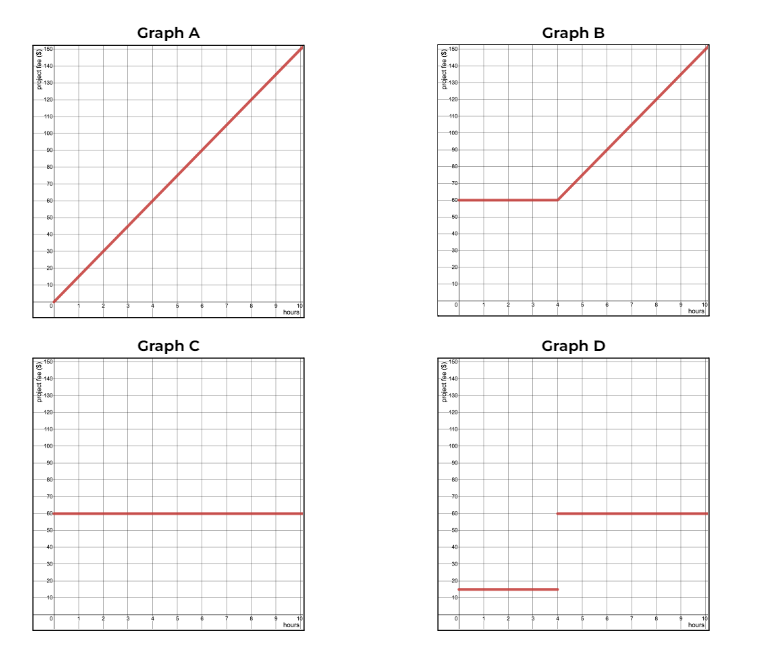
Tyrese is a freelance artist who charges a flat fee of $60 for any project that takes 4 hours or less. If a project takes him longer than 4 hours, he charges $15 per hour.
How much does Tyrese charge for a project that takes him 3 hours?
How much does Tyrese charge for a project that takes him 8 hours?
Which of the following graph accurately represents Tyrese’s pricing? How do you know?
Part I: Introducing Piecewise Functions
A piecewise function has multiple “pieces” that follow different rules, depending on the domain (x values).
In your own words, explain why Tyrese’s pricing was a piecewise function.
What other real-life situation(s) might be represented by a piecewise function?
Part II: Writing Equations for Piecewise Functions
We can use case notation to write an equation for piecewise functions. This tells us what rule to apply for each “case” or “piece” of the function.
Here is the equation for Tyrese’s project fees:
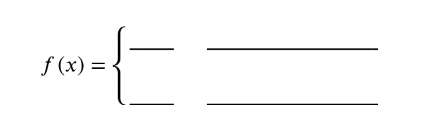
Tyrese’s business is booming, so he decides to increase his prices. Now, he charges $100 for any project that takes five hours or less. He charges $20 per hour for projects that take longer than 5 hours. Write the new equation for his pricing.
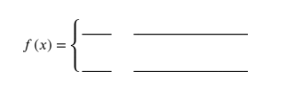
f(x)=
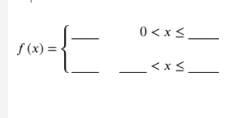
An airline charges for in-flight internet. It costs $7 for 1 hour or less of internet. It costs $19 for more than 1 hour, with a maximum of 24 hours total.
Equation: * Type in entire inequality for blanks 2 & 4*
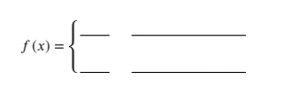
f(x)=
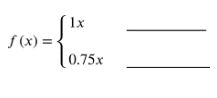
Bagels are $1 each if you buy 12 or fewer bagels. If you buy more than 12 bages, they cost $0.75 each.
Equation: type in inequality
1x
0.75x
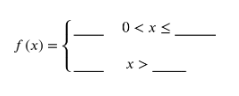
A parking lot charges $3 to park for anytime up to 2 hours. After 2 hours, they charge $1.50 per hour
Equation: *type in entire inequality for blanks 2 and 4*
f(x)=
Kaustabh is a DJ who charges $200 for any event under 2 hours. For events 2 hours or longer, he charges $100 per hour.
Equation:
f(x)=
Apples cost $3 per pound if you buy less than 5 pounds. If you buy 5 pounds or more, they cost $1.25 per pound.
Equation:
f(x)=
Sara earns $16 per hour working at Foods Co-op. If she works more than 40 hours a week, she earns time-and-a-half (ie. a 50% pay increase) for those overtime hours. Write an equation for her total weekly pay as a function of hours worked.
Equation:
f(x)=
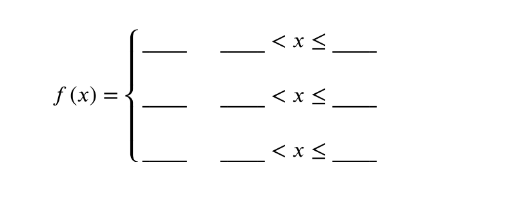
Fill in the blanks to write an equation that represents this situation.
f(x)=
What is f(4)?
What is f(1)?
For which x values does f(x) = 20?
What is the domain of this function?