Log in
Sign up for FREE
arrow_back
Library
SPE: RLA Assessment 9/29
By Elida Cruz
star
star
star
star
star
Share
share
Last updated over 2 years ago
10 questions
Add this activity
1
5.9.D.i
1
5.6.G
1
5.3.B
1
5.3.B
zoom_in
zoom_in
zoom_in
Question 1
1.
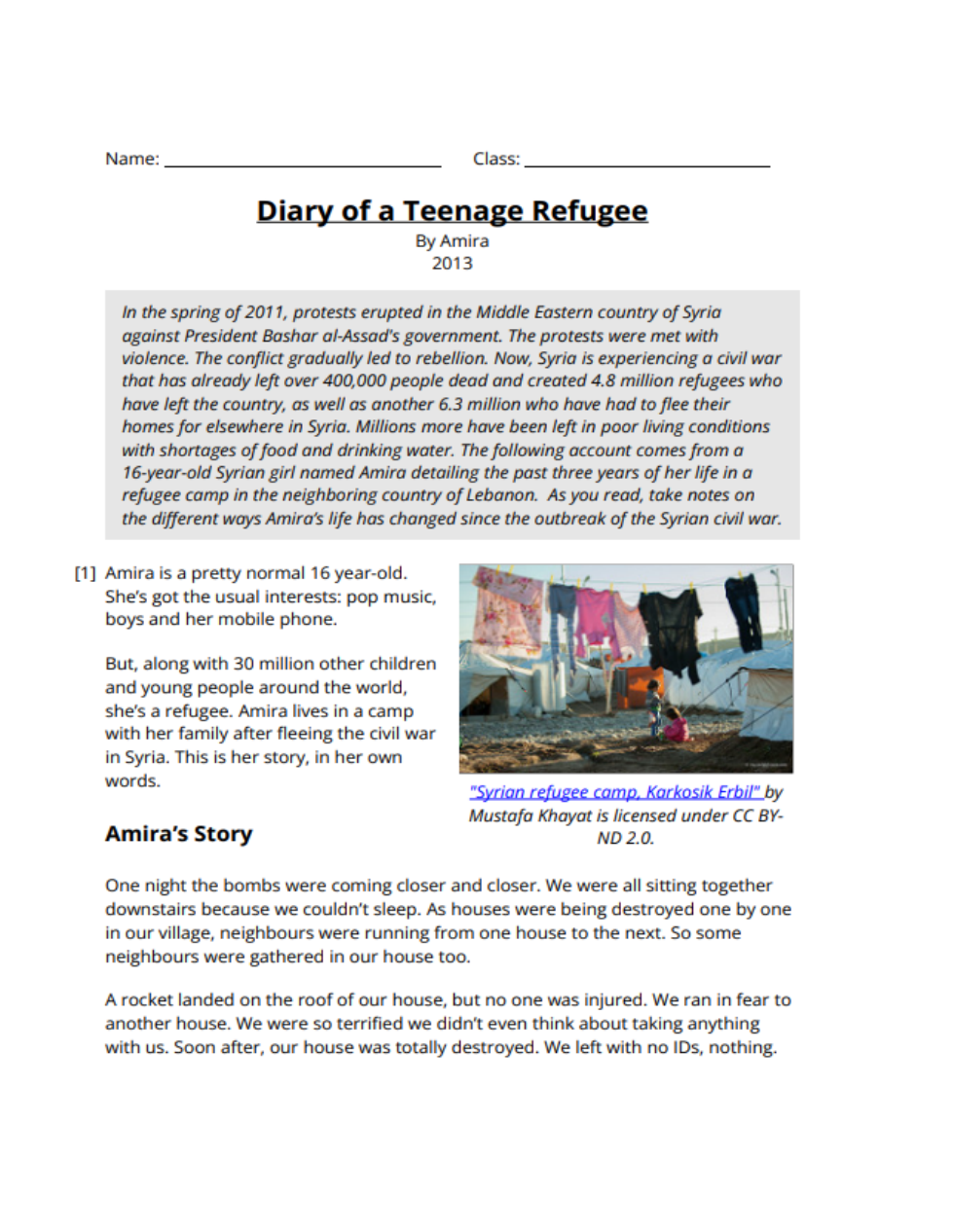
Which of the following best describes the central idea of the text?
A. Amira is a normal teenage girl living through extraordinary circumstances as a refugee.
B. Amira and others like her have built communities in refugee camps that resemble home.
C. The United Nations needs to better protect refugees, particularly those fleeing Syria.
D. More refugees should tell their tales in order to spread awareness about the issues they face.
Question 2
2.
Which statement best describes how the refugee camp is first portrayed in the text?
A. Life in the camp is safer and easier than life at home, where there is war.
B. Life in camp is engaging and fun because community members make it so.
C. Life in the camp is difficult and dirty, and there is no sense of community support.
D. Life in the camp is uncertain and there is little to do, but the community is kind.
Question 3
3.
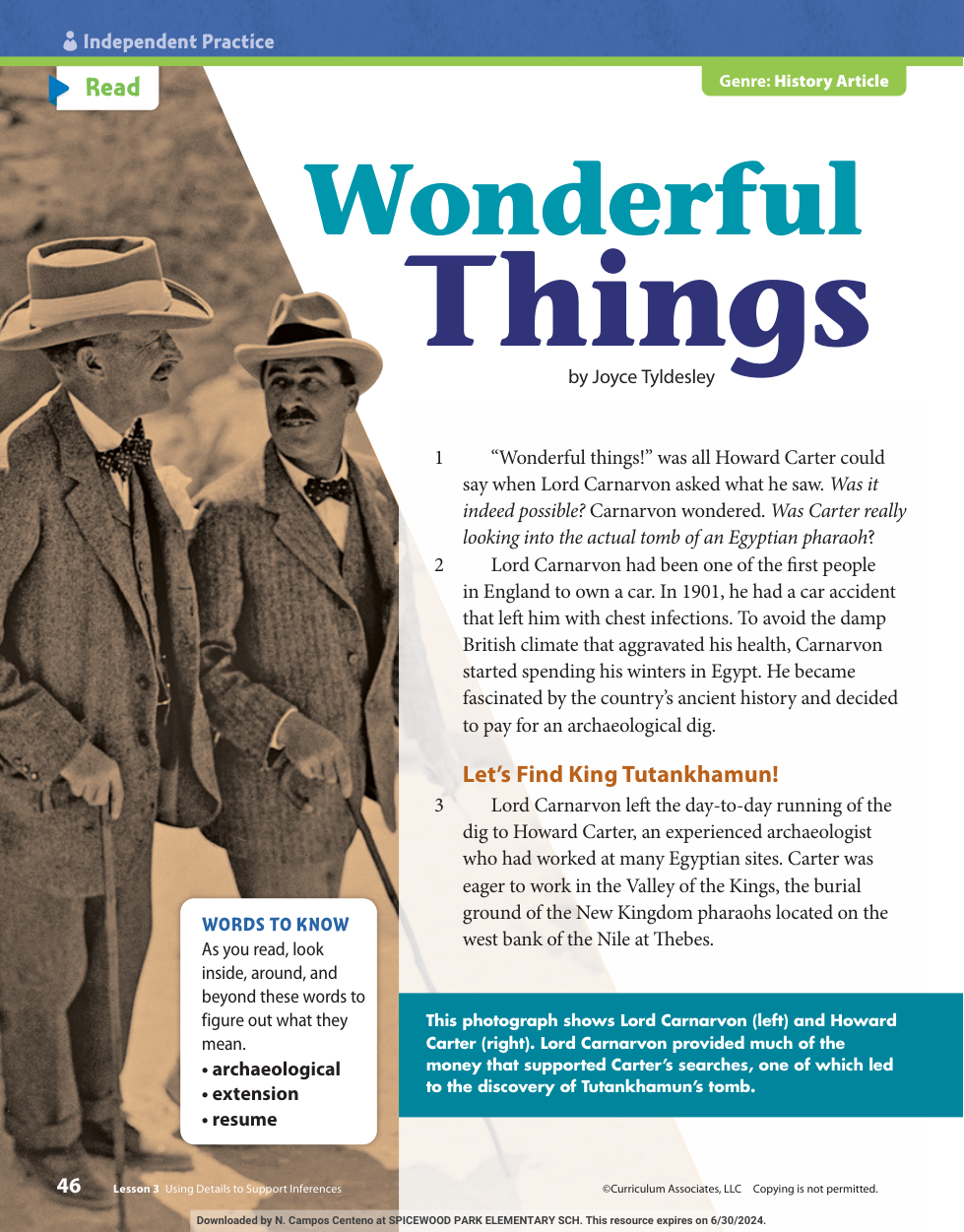
PART A: What does the term "smuggler" most closely mean as used in paragraph 5?
A. one who books safe passage for legal immigrants through dangerous places
B. one who leaves a country to escape danger
C. one who secretly moves something or someone from one country to another
D. someone who avoids paying taxes for goods they bring in or out of a country 4
Question 4
4.
PART B: Which of the following quotes best supports the answer to Part A?
A. "Soon after, our house was totally destroyed." (Paragraph 4)
B. "Our dad took us out of the country" (Paragraph 5)
C. "We escaped that night in a rented car." (Paragraph 5)
D. "We crossed the border illegally, through the mountains." (Paragraph 6)
zoom_in
zoom_in
zoom_in
5
6
7
8
zoom_in
1
1
1
1
9
10
zoom_in
1
1
Question 5
5.
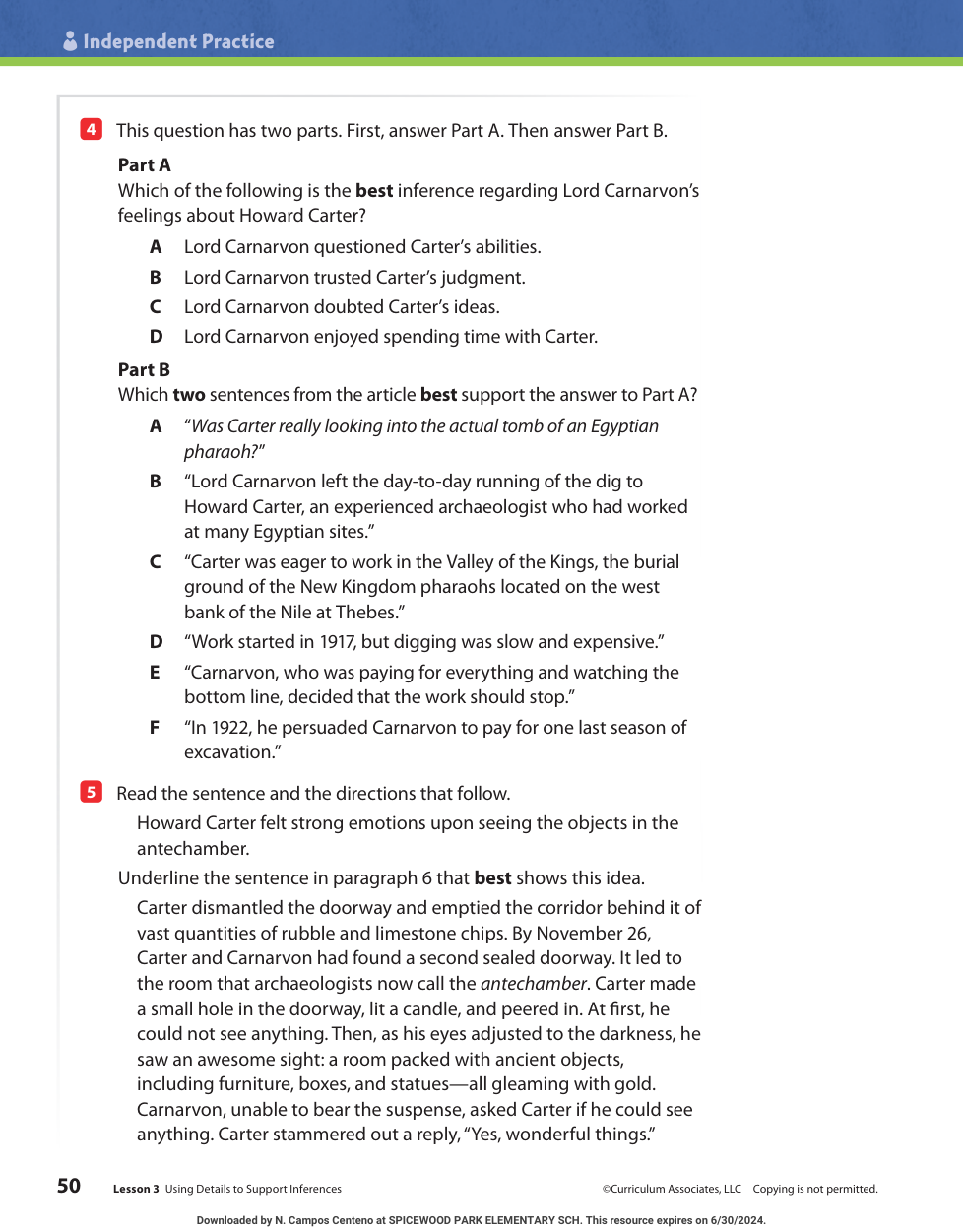
Why might Lord Carnarvon have paid for an archeological dig? Which reason is BEST supported by the information in paragraph 2?
A. to show he had a lot of money
B. to enjoy spending more time in Egypt
C. to learn about the Egyptian climate
D. to find out more about ancient Egypt
Question 6
6.
Part A. What is the meaning of excavation as it is used in paragraph 4 of the article?
A. the discovery of a cave
B. the entrance or exit of a building
C. the digging and removal of materials
D. the locating of objects
Question 7
7.
Part B. Which phrase from paragraph 4 BEST supports the answer to Part A?
A. "... had already been discovered."
B. "... to clear the valley down to the bedrock..."
C. "...Tutankhamun had to be there somewhere."
D. "...he persuaded Carnarvon to pay for one last season..."
Question 8
8.
Which paragraph best supports the idea that finding Tutankhamen's tomb required moving huge amounts of rock and soil over many years?
A. paragraph 4
B. paragraph 5
C. paragraph 7
D. paragraph 9
Question 9
9.
Part A. Which of the following is the best inference regarding Lord Carnarvon's feelings about Howard Carter?
A. Lord Carnarvon questioned Carter's abilities
B. Lord Carnarvon trusted Carter's judgement
C. Lord Carnarvon doubted Carter's ideas
D. Lord Carnarvon enjoyed spending time with Carter
Question 10
10.
Part B. Which two sentences from the article best support the answer to Part A?
A. "Was Carter really looking into the actual tomb of an Egyptian pharaoh?"
B. "Lord Carnarvon left the day-to-day running of the dig to Howard Carter, an experienced archaeologist who had worked at many Egyptian sites."
C. "Carter was eager to work in the Valley of the Kings, the burial ground of the New Kingdom pharaohs located on the west bank of the Nile at Thebes."
D. "Work started in 1917, but digging was slow and expensive."
E. "Carnarvon, who was paying for everything and watching the bottom line, decided that the work should stop."
F. "In 1922, he persuaded Carnarvon to pay for one last season of excavation."