5.1.1: Define skill.
“The
“Skill is the learned ability to bring about predetermined
5.1.2: Describe the different types of skill.
| Draggable item | arrow_right_alt | Corresponding Item |
|---|---|---|
PERCEPTUAL SKILL: | arrow_right_alt | Emphasis on voluntary movement, not much thinking required. |
MOTOR SKILL: | arrow_right_alt | Requires a lot of thinking. Knowledge of the game & decision making required. |
PERCEPTUAL-MOTOR SKILLS: | arrow_right_alt | Using your senses to assess a situation & help you make decisions. Vision, hearing, touch etc. |
COGNITIVE SKILL: | arrow_right_alt | Involve the interpretation of environmental stimuli and the motor response to this sensory information |
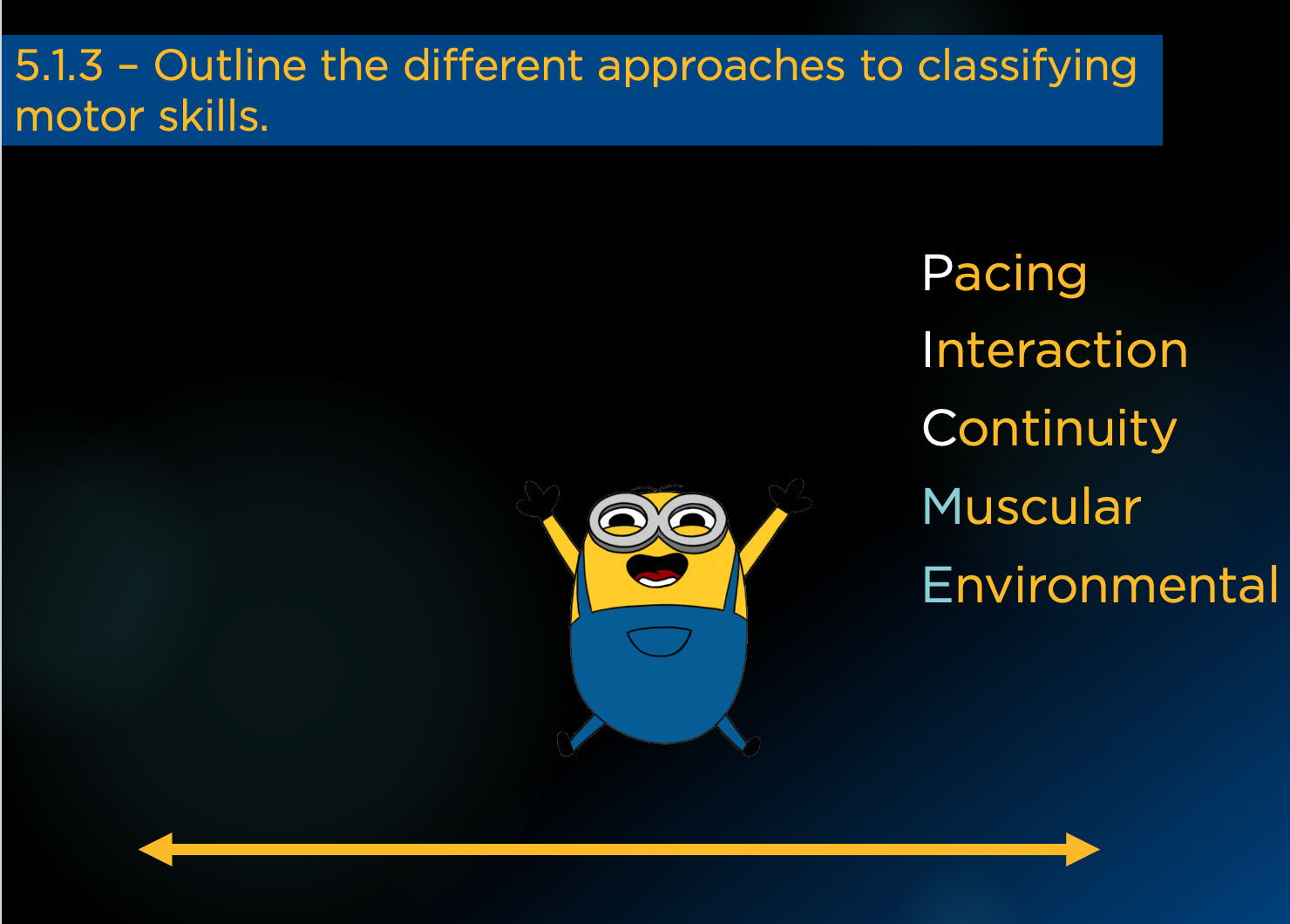
5.1.3: Outline the different approaches to classifying motor skills.
Pacing:
Interaction:
Continuity:
Muscular involvement:
Environmental:
a variety of skills or tasks.
a general trait or
the performance and performance potential of
capacity of
Ability refers to
the individual that is related to
5.1.6: Distinguish between Fleishman’s physical proficiency abilities (physical factors) and perceptual motor abilities (psychomotor factors).
Physical Proficiency Abilities: | Perceptual Motor Abilities: | |
|---|---|---|
Static strength (strength) | ||
Reaction time | ||
Explosive strength (power) | ||
Extent flexibility | ||
Control precision (agility) | ||
Limb coordination | ||
Trunk strength | ||
Response orientation | ||
Dynamic strength (musc. end.) | ||
Rate control (reacting to unpredictable object) |
5.1.7: Define Technique
5.1.8: State the relationship between ability, skill and technique.
5.1.9: Discuss the differences between a skilled and a novice performer.
There are 7 factors mentioned in the syllabus for you to choose from:
*Type the whole word, the letter is only there as a hint for you.
E:
L:
G:
F:
C:
C:
A: