6th-Chapter 2: Lesson 2.2 Moving and Exchanging Substances Pg.45-53
star
star
star
star
star
Last updated 4 months ago
17 questions
Required
10
| Draggable item | arrow_right_alt | Corresponding Item |
|---|---|---|
diaphragm | arrow_right_alt | body system formed by all the structures that move blood through the body; also called the cardiovascular system |
circulatory system | arrow_right_alt | blood vessels that carry oxygen-rich blood |
bronchi | arrow_right_alt | liquid part of blood |
plasma | arrow_right_alt | two air passages, each of which connects the trachea to a lung |
respiration | arrow_right_alt | exchange of oxygen and carbon dioxide between the body and the air around it |
arteries | arrow_right_alt | body system of organs that obtain vitally important oxygen from the outside world |
heart | arrow_right_alt | blood vessels that carry oxygen-poor blood |
veins | arrow_right_alt | small arteries that deliver oxygen and nutrients to cells and pick up cells’ waste |
capillaries | arrow_right_alt | hollow, muscular organ located in the center of the chest; pumps blood into the circulatory system |
respiratory system | arrow_right_alt | sheet of muscle beneath the lungs and above the abdomen that contracts and relaxes to help the chest expand so a person can inhale or shrink so a person can exhale |
Required
10
Circulatory System
The _______ (also called the cardiovascular system) is formed by all the structures that move blood through the body (Figure 2.8). The _______ consists of the heart, blood vessels, and blood. The heart pumps the blood that the _______ transport to every cell in the human body. Functions of the circulatory system include the following:
- transporting _______ and other nutrients to cells in the body
- removing _______ and other waste products
- regulating body _______
- assisting with _______ function
Caring for the circulatory system through healthy eating and physical activity supports these functions. In the next sections, you will learn more about the heart and how blood circulates in the heart. You will also learn more about blood vessels and blood.
Required
10
Heart
The _______ is a hollow, _______ located in the center of the chest. The heart is a steadily working muscle. It beats around _______ times per year and pumps about _______ of blood each day.The heart contains four hollow spaces called _______ . The top two chambers are called atria. The bottom two chambers are called _______ . Valves control the _______ of blood flow in the heart. Like doors that open only one way, the valves make sure blood flows in the right direction. For example, one _______ makes sure that blood flows from an atrium to a ventricle. It will not let blood flow from a ventricle to an _______ . Other valves make sure that blood leaving a ventricle does not flow backward into the ventricle.
The _______ you feel and hear is caused by the contraction of the heart chambers and closing of valves. The first heart sound is the atria squeezing blood into the ventricles. The second sound is the _______ pumping blood out of the heart.
Required
10
Blood Circulation
Blood _______ follows a path that provides the body with a continual supply of _______ blood. You can trace this path in Figure 2.9.
Oxygen-poor blood flows from around the body into the _______ , which passes this blood into the right ventricle. The right ventricle pumps oxygen-poor blood out of the heart to the lungs, where this blood obtains _______ .
Then oxygen-rich blood is returned from the _______ into the left atrium of the heart, which passes blood into the left ventricle. Finally, the _______ pumps oxygen-rich blood into the aorta. The oxygen-rich blood is then pumped around the body. After oxygen is used up, the oxygen-rich blood becomes _______ blood and flows back into the right atrium. The process then begins again.
Required
10
Blood Vessels
_______ are an extensive network of pipes that carry blood throughout the entire body (Figure 2.10). There are three types of blood vessels. These vessels are the _______ , _______ , and _______ .
_______ carry oxygen-rich blood. The largest artery is the _______ , which carries blood from the left ventricle of the heart to other _______ . Most arteries carry blood from the heart to the rest of the body. These arteries have muscular walls that can handle the pressure created by the heart’s pumping. Arteries branch into smaller _______ , and these branch into even smaller ones.
The smallest arteries are the capillaries. _______ have very thin walls with no muscle. They deliver oxygen and nutrients to body cells and pick up cells’ waste. Capillaries lead into tiny veins, which lead into larger veins.
_______ carry oxygen-poor blood. Two large veins, called the vena cavae, carry blood into the right atrium of the heart. One vena cava brings blood from the head and upper body. The other brings blood from the lower body.
Required
10
Blood
_______ plays an important role in maintaining a person’s _______ and sustaining life. As you already learned, blood carries oxygen and nutrients through the body, while also removing carbon dioxide and waste. _______ a person’s body temperature, similar to how a _______ regulates the temperature in a room. Blood also protects the body against infection.
Because of blood’s vital role in the _______ , many people donate blood to organizations such as the American Red Cross. In fact, one pint of donated blood can save up to three lives. For this reason, people who donate blood are actually giving the gift of life.
Blood is made up of both _______ parts (Figure 2.11). The liquid part of blood is called plasma. Plasma makes up at least half of blood's content. It is responsible for carrying all parts of blood throughout the body.The solid parts of blood consist of _______ blood cells, _______ blood cells, and platelets.
Red blood cells make up one-half the blood’s volume. Red blood cells contain a red substance called hemoglobin, which can carry and _______ . As a result, red blood cells transport oxygen throughout the body.
_______ cells move through the blood and live in various organs of the body. They help defend the body against infections.
Platelets are responsible for blood clotting. _______ stops blood from flowing outside the wall of a blood vessel. This action helps prevent blood loss when blood vessels are injured.
Required
10
Respiratory System
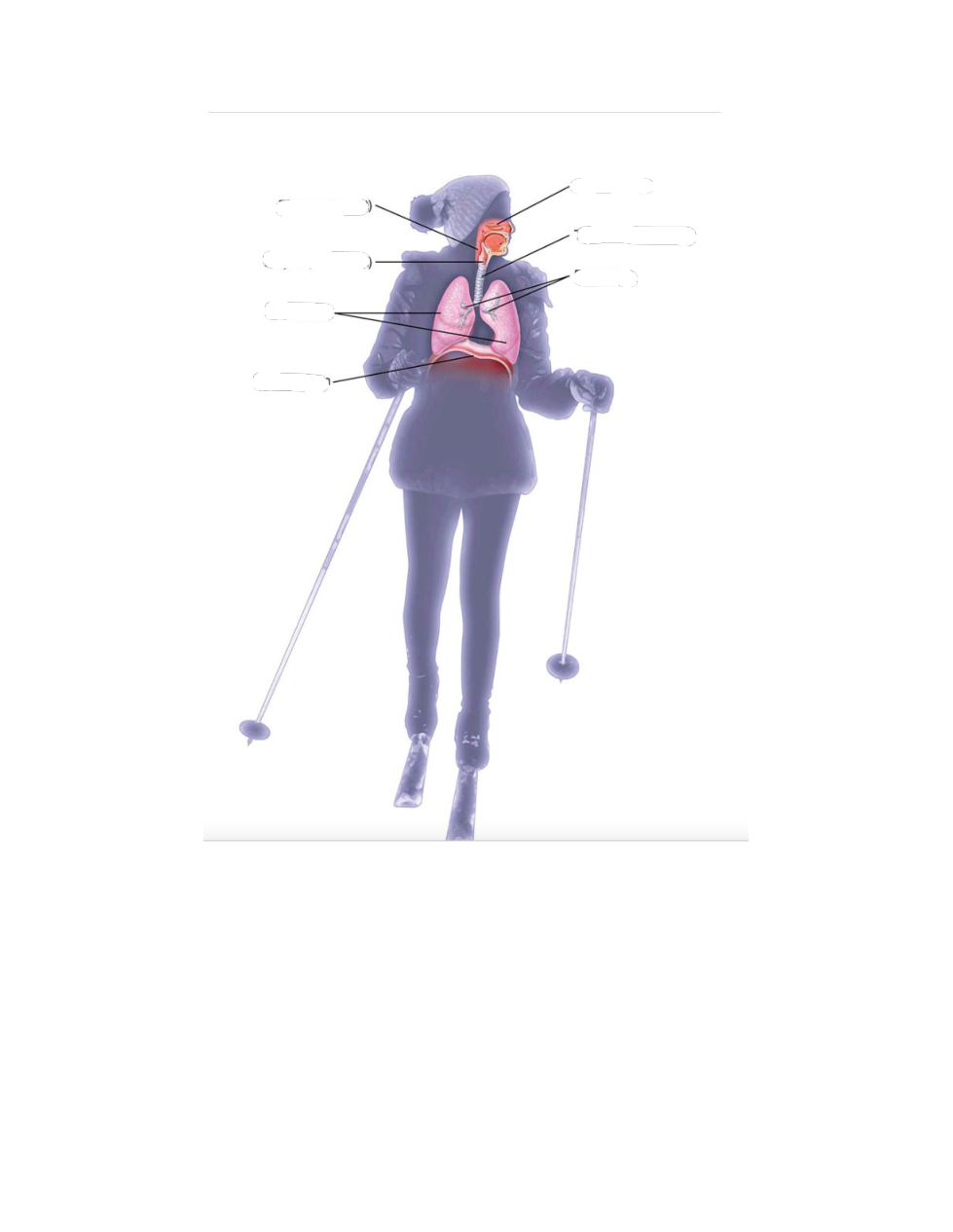
The _______ cannot deliver oxygen to the body’s cells without the help of the respiratory system. The respiratory system includes _______ that obtain vitally important oxygen from the outside world (Figure 2.12). This body system draws oxygen into the _______ and delivers it to blood vessels. It also takes _______ —another gas—out of the blood and sends it outside the body. Since the body’s cells require oxygen, a healthy respiratory system enables all other body functions. Respiratory organs can be divided into the _______ respiratory systems.
Required
10
Upper Respiratory System
The _______ system allows air containing oxygen to enter the body. Air enters the nose and mouth and passes down through the throat to the _______ and then through the trachea to the lungs. You can feel the _______ as a bump in the front of your throat. It vibrates when you speak, as air passes across the _______ . A small structure covers the larynx when you swallow and prevents food from entering the _______ .
The walls of the _______ make a sticky substance called mucus. This mucus traps bacteria and dust particles so they cannot enter the lungs. Extra _______ is made when someone has an infection or an allergic reaction. The passage behind the nose is also lined with mucus and with _______ that warm and moisten air. You see evidence of this on cold days when you exhale. The warm, exhaled air forms water vapor as it contacts the cold outside air.

Required
10
_______
Required
10
_______
Required
10
_______
Required
10
_______
Required
10
_______
Required
10
_______
Required
10
_______
Required
10
Lower Respiratory System
The _______ branches into two bronchi, which are air passages that lead to each lung. The bronchi branch into smaller passages called _______ inside the lungs. These smaller airways end as sacks called _______ . When you inhale, air fills the alveoli. The alveoli are important for oxygen exchange in the lungs. If they fill with fluid, as in _______ , air and oxygen cannot enter them. This can disrupt the vital process of _______ .
Required
10
Respiration
_______ is the exchange of oxygen and carbon dioxide in the respiratory system. It includes two steps: _______ . When you inhale, you take in air, which reaches the lungs. Air fills the alveoli, and oxygen moves into the blood in tiny _______ . These capillaries then deliver oxygen-rich blood to the heart.
At the same time, _______ moves from the blood into the _______ . This air travels back into the respiratory passages. When you exhale, you push the air with carbon dioxide out of the body (Figure 2.13).
_______ help the lungs take in and push out air. During _______ , muscles enlarge the chest. This draws air in through the mouth and nose. The chief muscle doing this work is the diaphragm. The _______ is a sheet of muscle beneath the lungs and above the _______ . As the diaphragm moves down, the chest expands. Other muscles of the chest, especially those between the ribs, also help the chest expand. _______ happens when these muscles relax. The chest collapses and squeezes air out the mouth and nose.