Researchers carried out a survey of fourth-, fifth-, and sixth-grade students in San Antonio. Students were asked if good grades, athletic ability, or being popular was most important to them.
The two-way table summarizes the survey data:
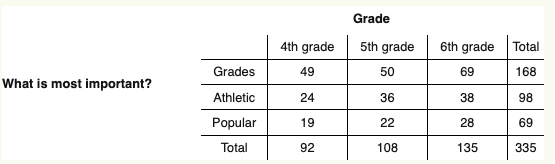
Identify the explanatory and response variables in this context.
5th grade
Popular
4th grade
Athletic
Grade Level
6th grade
Total
Grades
What is Most Important?
Explanatory Variable
Response Variable
Required
3 points
3
Question 2
2.
Using the information from #1, go to statsmedic.com/applets, use 2 categorical variables.
Make a segmented bar chart to show the relationship between grade level and which goal was most important to students.
Based on the graph you made, is there an association between these variables? Explain your reasoning. If there is an association, briefly describe it.
At what age do babies learn to crawl? Does it take longer to learn in the winter, when babies are often bundled in clothes that restrict movement?
There might even be an association between babies’ crawling age and the average temperature during the month when they first try to crawl (around 6 months after birth).
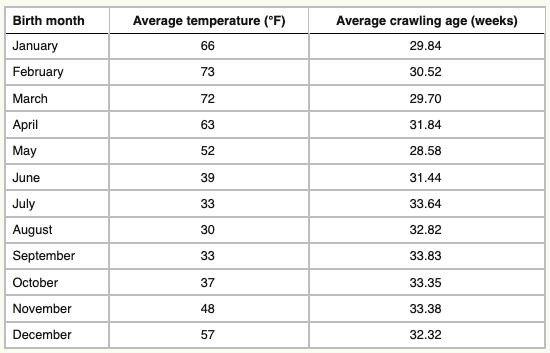
Data were collected from parents who reported the birth month and the age at which their child was first able to creep or crawl a distance of 4 feet within 1 minute.
Information was obtained on 414 infants, 208 boys and 206 girls.
Average crawling age is given in weeks, and the average temperature (in degrees Fahrenheit) is for the month that is 6 months after the birth month.
Required
1 point
1
Question 3
3.
Identify the explanatory and response variables for the study described above if we are trying to determine if the relationship between temperature and the age when crawling begins.
Explain your reasoning.
Required
1 point
1
Question 4
4.
Create a scatterplot in statsmedic.com/applets, 2 quantitative variables.
Use the data table below, copy and paste the data into statsmedic.
Average Temperature (degrees F): 66, 73, 72, 63, 52, 39, 33, 30, 33, 37, 48, 57
Average crawling age (weeks): 29.84, 30.52, 29.70, 31.84, 28.58, 31.44, 33.64, 32.82, 33.83, 33.35, 33.38, 32.32
Describe the relationship shown in the scatterplot in a complete sentence. Use DOFS.
Required
1 point
1
Question 5
5.
The principal of a high school read a study that reported a positive correlation between the number of calculators owned by high school students and their math achievement.
Based on this study, he decides to buy each student at his school 2 calculators, hoping to improve their math achievement. He believes the strong correlation shows owning calculators will cause a higher achievement in math.
Explain the flaw in the principal’s reasoning.
After you enter your answer, check mine in the 'show your work' area to see how you did.
Required
1 point
1
Question 6
6.
A statistics student wonders if tall women tend to date taller men than do short women. She measures herself, her dormitory roommate, and the women in the adjoining rooms.
Then, she measures the next man each woman dates.
Here are the data (height in inches).
Women's height(in) : 66, 64, 66, 65, 70, 65
Men's height(in): 72, 68, 70, 68, 71, 65
Copy and paste the data into statsmedic, make a scatterplot for these data, using women’s height as the explanatory variable.
Calculate the correlation for these data, enter it below. Keep all decimal places.
Required
2 points
2
Question 7
7.
What does this correlation tell us?
Select two answers.
Required
2 points
2
Question 8
8.
What effect does the pair (70, 71) have on the correlation? Explain.
Required
2 points
2
Question 9
9.
How would the correlation change if the heights of the women were measured in centimeters instead of inches? (2.54 cm = 1 inch)
Required
1 point
1
Question 10
10.
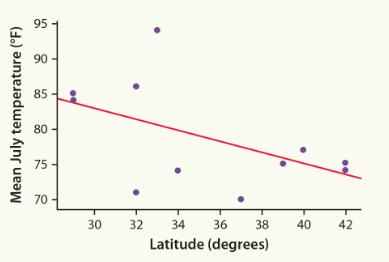
The scatterplot shows the relationship between latitude and mean July temperature (in degrees Fahrenheit) for 12 cities in the United States.
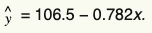
The equation of the regression line relating these variables is
The scatterplot is:
Use the regression equation to predict the mean July temperature in Fairbanks, Alaska, at latitude 65º.
Make sure to include units (degrees F) and all the decimal places in your answer.
Required
1 point
1
Question 11
11.
How confident are you in this prediction? Explain, include what this is called.
Use complete sentences.
When you are finished, check the answer in the 'show your work' area to see if you are correct.
1 point
1
Question 12
12.
Los Angeles, California, is at latitude 34º and has a mean July temperature of 74º.
1st calculate the predicted mean July temperature for 34º.
Then calculate the residual.
Keep all the places past the decimal point.
Did the model over or under predict? Separate your answers with a comma
Required
1 point
1
Question 13
13.
Interpret the slope of the regression line.
Make sure to include 'we predict' since this is a regression equation and we are using
it to predict y.
Enter your answer, then check your answer with mine in the 'show your work' section.
Required
1 point
1
Question 14
14.
Does the value of the y intercept have meaning in this context?
If so, interpret the y intercept. If not, explain why.
Write your answer, then check it with mine in the 'show your work' area.
Required
4 points
4
Question 15
15.
In Exercise 4, we investigated the relationship between the average temperature 6 months after birth (in degrees Fahrenheit) and the average age when babies were able to crawl (in weeks).
Use statsmedic.com/applets, 2 quantitative variables to calculate the equation of the least-squares regression line for these data.
Using your scatterplot from earlier, describe what is unusual about the point representing May.
Choose 4 correct answers.
Required
1 point
1
Question 16
16.
How does the point representing May affect the equation of the least-squares regression line? Use your answer from #15 to explain using complete sentences.
Enter your answer, then check your answer with mine once you have entered it.
Required
2 points
2
Question 17
17.
We used a least-squares regression line to model the relationship between x = latitude and
y = mean July temperature (in degrees Fahrenheit) for a sample of 12 cities in the United States.
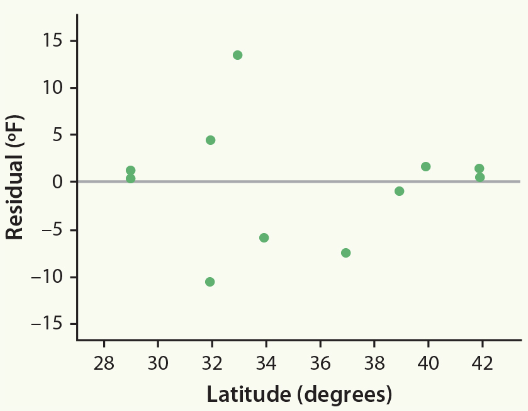
Here is the residual plot for this model.
Explain what the residual plot suggests about the appropriateness of the linear model.
Required
1 point
1
Question 18
18.
The standard deviation of the residuals for this model is s = 6.4.
Interpret this value.
Enter your answer then check the answer I posted in the 'show your work' area.
Required
0 points
0
Question 19
19.
Interpret this value. Enter your answer, then check the answer posted in 'show your work'.
Required
3 points
3
Question 20
20.
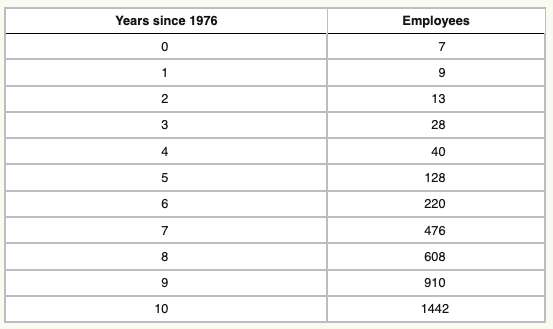
For a number of years after it started up, Microsoft Corporation grew quite rapidly.
The table shows the number of Microsoft employees and the number of years since Microsoft started up in 1976.
Years since 1976: 0, 1, 2, 3, 4, 5, 6, 7, 8, 9, 10
Use statsmedic.com/applets, 2 quantitative variables, copy and paste the list of data values.
Create a scatterplot for these data using years as the explanatory variable and employees as the response variable.
Calculate a linear regression model for the data. Check the residual plot.
Then, calculate a quadratic model for these data. Check the residual plot.
Based on the residual plots, which model is best?
Select three correct answers.
Required
3 points
3
Question 21
21.
Using the quadratic regression model, calculate and interpret the residual for the year 1981, 5 years after the company started.
Select three answers.
Required
1 point
1
Question 22
22.
Use the data entered in statsmedic.com/applets.
Calculate an exponential model for these data using years as the explanatory variable and employees as the response variable.
Enter it below, use employees-hat and use the math keyboard to add exponents.
Keep all the places past the decimal.
Required
1 point
1
Question 23
23.
Using the exponential regression model, calculate the prediction(round to a whole number), then calculate the residual and interpret the residual for the year 1981, 5 years after the company started.
Select three answers.
Required
1 point
1
Question 24
24.
Explain how you could use residual plots to determine which model is better.