2.7 Scatter PLots and Linear Regression

Last updated 10 months ago
17 questions
Note from the author:
OBJECTIVES & STANDARDS
Math Objectives
  • Graph data point given in a table to create a scatter plot
  • Use technology to find a linear regression equation
  • Use a linear regression model to make predictions about the given data
Common Core Math Standards
  • Link to all CCSS Math
  • CCSS.PRACTICE.MP4
  • CCSS.PRACTICE.MP5
  • CCSS.HSF.LE.A.2
  • CCSS.HSF.LE.B.5
Personal Finance Objective
  • This lesson is focused on math. There are no applicable personal finance objectives
National Standards for Personal Financial Education
  • There are no relevant Jump$start standards.
DISTRIBUTION & PLANNING
Distribute to students
  • Student Activity Packet
  • Application Problems
OBJECTIVES & STANDARDS
Math Objectives
  • Graph data point given in a table to create a scatter plot
  • Use technology to find a linear regression equation
  • Use a linear regression model to make predictions about the given data
Common Core Math Standards
  • Link to all CCSS Math
  • CCSS.PRACTICE.MP4
  • CCSS.PRACTICE.MP5
  • CCSS.HSF.LE.A.2
  • CCSS.HSF.LE.B.5
Personal Finance Objective
  • This lesson is focused on math. There are no applicable personal finance objectives
National Standards for Personal Financial Education
  • There are no relevant Jump$start standards.
DISTRIBUTION & PLANNING
Distribute to students
  • Student Activity Packet
  • Application Problems
Intro - Warm-Up
Checking Account Balance vs. Age
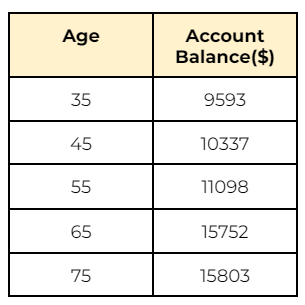
The following table represents the relationship between your age and how much you can expect to have in your checking account.
1

Plot these ordered pairs on the graph.

1

Is this data linear? How can you tell?

1

Does the data appear to have a pattern?

Learn It
Scatterplots and Correlation
A scatter plot is a type of graph used to compare two sets of data to see if they are related. The graph that you made in your intro is a scatter plot that relates age and money in checking account
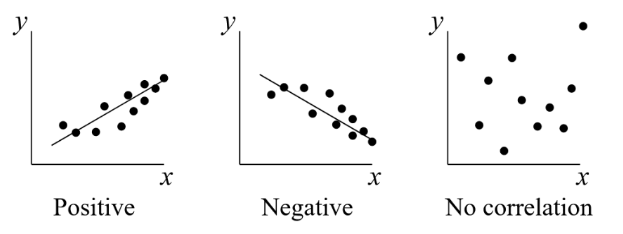
If the data is related, it is said to have a correlation. There are three basic linear correlations:
  1. If the data appears to be closely grouped around a line that trends up from left to right, then it has a positive correlation - as one piece of data goes up, so does the other.
  2. If the data appears to be closely grouped around a line that trends down from left to right, then it has a negative correlation - as one piece of data goes up, the other goes down
  3. If the data does not appear to be grouped around any line, then it has no correlation - the data has no useful linear relationship

ACTIVITY: GRAPHING SCATTER PLOTS AND TREND LINES IN DESMOS (Video Walkthrough)
A linear regression model is an equation that tries to best represent the relationship between two sets of data that appear to have a linear correlation.
Before we do that, let’s learn how to make a regression equation in Desmos.
Step 1: Launch the Desmos Graphing Calculator
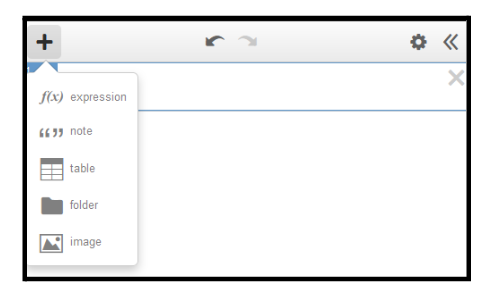
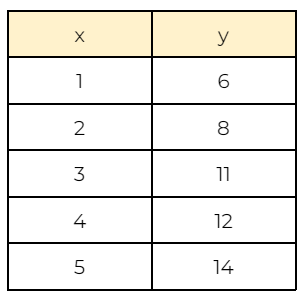
Step 2: Click on the + sign and add a table, then input the following table of values at the top of the next page


Step 3: We can’t see all of our data points, so let's change the view. Click the magnifying glass in the bottom left corner of the table box
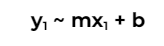
Step 4: Good! Now let’s have Desmos write a linear equation that can best fit this data. In the next box below the table, type the following linear model:
Helpful Hints
  • To type y1, type y1.
  • The ~ key is next to the number 1 on the keyboard using the shift key
  • You do not need to add any spaces to your entry
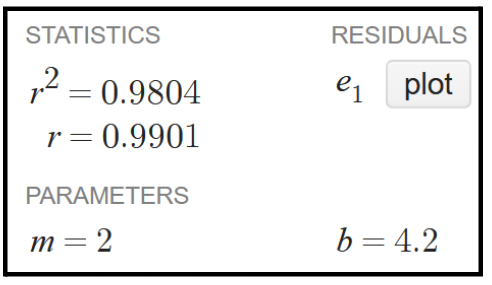
You should end up with information below box 2 that looks like this:

If we substitute the m and b values into our model, we can write an equation of:
y = 2x + 4.2
This is the linear model of our table of values!
If we wanted to estimate the output when x = 10, we can plug in.
y = 2(10) + 4.2
y = 24.2
5

Screen shot your desmos here!

Practice It
Use Desmos to Write a Linear Regression Model
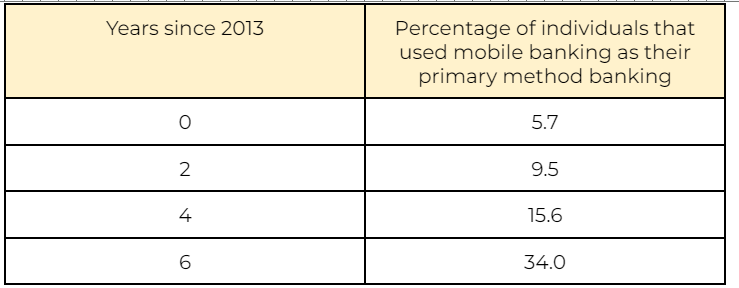
This table shows the growth in mobile banking from 2013 to 2019.

Enter the data into Desmos
1

Does the data appear to have a positive, negative, or no linear correlation? Explain how you know.

1

Use Desmos to find the linear regression model for the data. Write the linear equation below.

1

Use your model to estimate the percentage of individuals that will use mobile banking as their primary banking method in 2025.

APPLICATION: Scatter Plots and Linear Regression in Finance Transactions
Ice Cream Sales
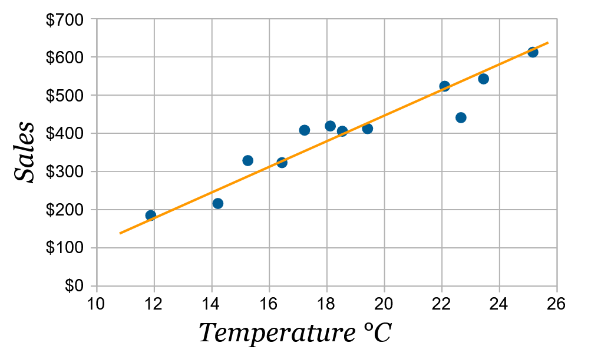
Ari recorded the daily high temperature (in Celsius) and total sales from his ice cream shop for 12 days. He plotted the data on the graph below and drew a line of best fit.

1

Does the data appear to have a correlation? If so, is it positive or negative?

1

Based on the line of best fit that Ari drew, how much money in sales should he expect when the temperature is 21℃?

1

In your own words, explain why it makes sense that this data has a correlation?

1

Create a scenario like Ari’s ice cream shop that will have a negative correlation.

Level 2:
Check Cashing
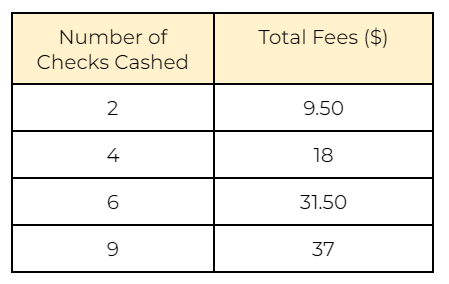
Camilla used a check cashing service to cash checks of different values.
The chart below represents the number of transactions and the total fees that Camilla paid when she cashed her checks.


Equation
  1. Launch the Desmos Graphing Calculator
  2. Input the data above and perform a linear regression using
y1 ~ mx1 + b
5

Write an equation that represents the average fee structure of the check cashing store.

1

What does m represent in the context of Camilla’s fees?

1
If Camilla continues to cash checks, what is the total fee that she will pay after cashing 20 checks?_______
Reflection:
After watching this video about the check cashing stores until the 5:10:
1

Why do people use check cashing services instead of traditional banking services?

1

Do you think that these types of businesses provide a necessary service?

1

What can be done to make traditional banking services more appealing to those who use check cashing services?

The End!