Make a claim that supports the statement above.
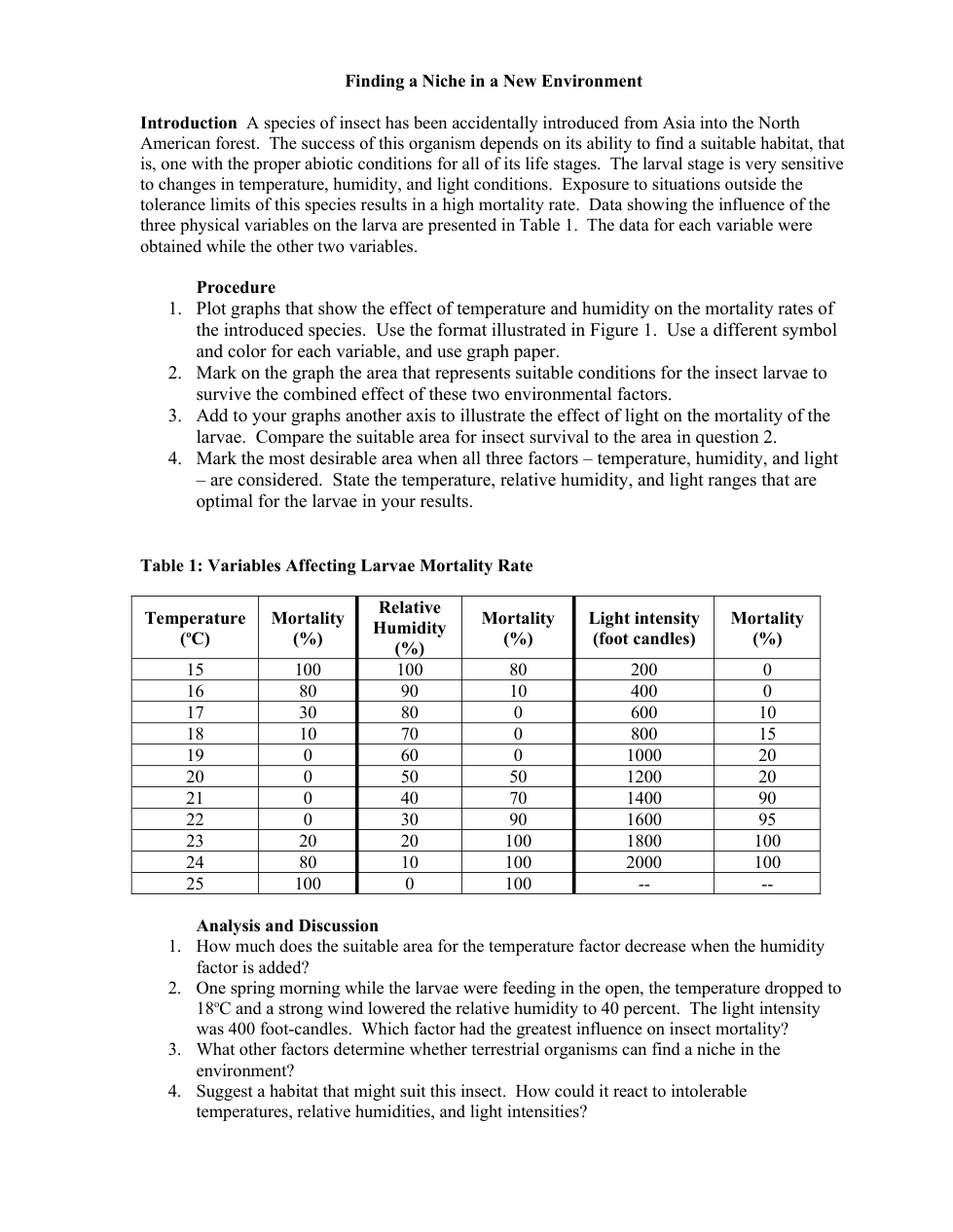
Introduction A species of insect has been accidentally introduced from Asia into the North American forest. The success of this organism depends on its ability to find a suitable habitat, that is, one with the proper abiotic conditions for all of its life stages. The larval stage is very sensitive to changes in temperature, humidity, and light conditions. Exposure to situations outside the tolerance limits of this species results in a high mortality rate. Data showing the influence of the three physical variables on the larva are presented in Table 1. The data for each variable were obtained while the other two variables.
Plot graphs that show the effect of temperature and humidity on the mortality rates of the introduced species. Use the format illustrated in Figure 1. Use a different symbol and color for each variable, and use graph paper.
Mark on the graph the area that represents suitable conditions for the insect larvae to survive the combined effect of these two environmental factors.
Add to your graphs another axis to illustrate the effect of light on the mortality of the larvae. Compare the suitable area for insect survival to the area in question 2.
Mark the most desirable area when all three factors – temperature, humidity, and light – are considered. State the temperature, relative humidity, and light ranges that are optimal for the larvae in your results.
Graph Figure 1 using the data.
What type of species is this insect?
Explain why for your answer in #3.
Describe how much the suitable area for the temperature factor decreases when the humidity factor is added.
One spring morning while the larvae were feeding in the open, the temperature dropped to 18C and a strong wind lowered the relative humidity to 40 percent. The light intensity was 400 foot-candles.
Explain which factor had the greatest influence on insect mortality?
Identify 3 other factors that determine whether terrestrial organisms can find a niche in the environment.
Propose a habitat that might suit this insect.
Describe how could it react to intolerable temperatures, relative humidities, and light intensities?