3.2 K-Selected r-selected Species
star
star
star
star
star
Last updated about 1 year ago
16 Nsɛmmisa
1
1
1
1
1
1
1
1
1
1
1
1
1
1
1
1
Imagine that you are one of the many invertebrate organisms which existed during the Cambrian or one of their descendants living today. Maybe you live in a tide pool which is washed by waves. A storm appears on the horizon. The waves increase in height. You feel yourself being dashed upon the rocks or into the mouth of a much larger and predatory animal. Finally, you begin to see your brothers and sisters die, one by one, as the forces of nature change your unpredictable environment.
If you could design a "strategy" to overcome the problems created by an unpredictable environment, you would have two choices - go with the flow or cut and run to a more stable environment.
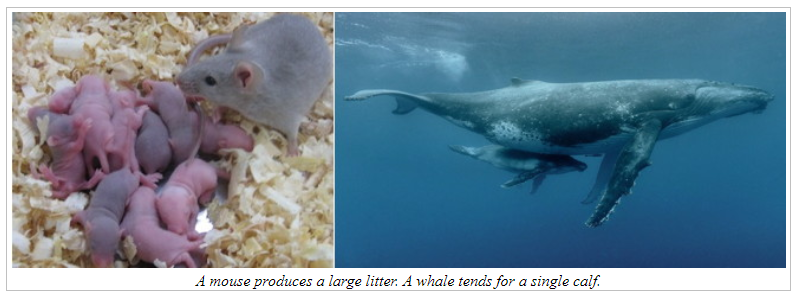
Suppose you stayed. Then, one thing you could do would be to increase the number of offspring. Make lots of cheap (requiring little energy investment) offspring instead of a few expensive, complicated ones (requiring a lot of energy investment). If you lose a lot of offspring to the unpredictable forces of nature, you still have some left to live to reproductive age and pass on your genes to future generations. Many invertebrates follow this strategy - lots of eggs are produced and larvae are formed but only a few survive to produce mature, reproductive adults. Many insects and spiders also follow this strategy.
Alternatively, you could adapt to a more stable environment. If you could do that, you would find that it would be worthwhile to make fewer, more expensive offspring. These offspring would have all the bells and whistles necessary to ensure a comfortable, maximally productive life. Since the environment is relatively stable, your risk of losing offspring to random environmental factors is small. Large animals, such as ourselves, follow this strategy.
Plants are also subject to the same sorts of forces as animals. Some live in unstable environments such as a floodplain near a river or a gap in the forest caused by falling trees. Others live in a quite stable environment, such as a climax forest.
Of course, the animal or plant is not thinking: "How do I change my characteristics?" Natural selection is the force for change, not the individual's conscious decision. But, natural selection has produced a gradation of strategies, with extreme r-selection at one end of the spectrum and extreme K-selection at the other end.
The following table compares some characteristics of organisms which are extreme r or K strategists:
Which of the following would be a species that is a very small size?
Which of the following would be a species that reproduces multiple times in a lifetime but has relatively few offspring?
Which of the following would be a species that has low parental care?
Which of the following would be a species whose sexual maturity occurs later in life?
Which of the following would be a species that has high parental care?
Which of the following would have a short life expectancy?
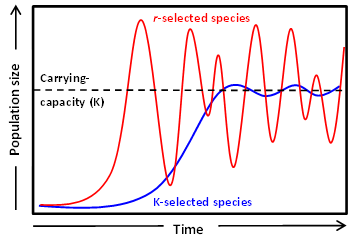
K-selected species, also called K-strategist, species whose populations fluctuate at or near the carrying capacity (K) of the environment in which they reside. Such species make up one of the two generalized life-history strategies posited by American ecologist Robert MacArthur and American biologist Edward O. Wilson;
R-selected species, also called r-strategist, species whose populations are governed by their biotic potential (maximum reproductive capacity, r)
Which of the following would have a population that fluctuates wildly around the carrying capacity with a "boom-bust" life cycle?
Which of the following would have a population that reaches carrying capacity and remains close to that level?
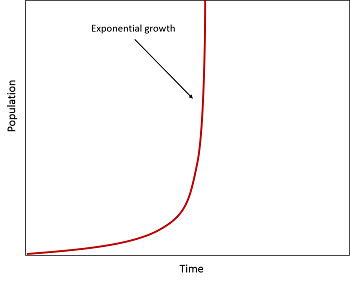
Since r-selected species grow very quickly and produce a lot of offspring at once, when we graph this growth it looks like a J. The population increases very rapidly over a short period of time, giving us exponential growth. Remember when you used exponents in math and you got a very large number very quickly? The same principle applies here. Think of the r as meaning 'rapid' growth. This is also the biotic potential of an organism. It is the maximum reproductive rate of a population in ideal conditions.
Describe the meaning of biotic potential.
Which of the following would have a population that grows at its biotic potential?
If we had 20 r-selected species living in their unpredictable environment and 20 K-selected species living in their predictable environment- and neither reproduces, which of the following would you predict?
Why do r-selected species do better in harsh environments?
Which of the following is true about K- selected species?
What are the population dynamics for each type?
Exponential growth
Growth to limit
Carrying capacity
Fast growth rate
Boom/bust life cycle
Slow growth rate
r - selected
K - selected
Explain why endangered species are more likely to be k selected species.
Upload the K vs r Chart here