Log in
Sign up for FREE
arrow_back
Library

CP Chemistry - Covalent Bonding & Molecular Polarity (2/26/2025)

star
star
star
star
star
Last updated 11 months ago
11 questions
Required
2
Required
3
Required
2
Required
3
Required
3
Required
3
Required
2
Required
2
Required
2
Required
2
Required
2
Question 1
1.

Question 2
2.

Question 3
3.

Question 4
4.

Question 5
5.

Question 6
6.

Question 7
7.

Question 8
8.

Question 9
9.

Question 10
10.

Question 11
11.

Which is the correct molecular formula for dinitrogen monoxide?
N2O2
NO2
O2N
N2O
How many valence electrons does Nitrogen have, and how many covalent bonds does it form?
5, 3
4, 4
6, 2
Polar covalent bonds tend to form between two atoms with what characteristics? (Choose the best answer)
Different elements with similar electronegativity
The same element and electronegativity
The same element with different electronegativity
Different elements and electronegativities
If you want to change the polarity of HBr (Hydrogen bromide) by substituting bromine with a different atom. Which atom would increase the polarity of the molecule?
sulfur (S)
iodine (I)
chlorine (Cl)
hydrogen (H)
Which of the following statements about covalent bonds are true? Select all that apply.
Covalent bonds form when atoms of nonmetals are close enough to each other for their orbitals to overlap.
Covalent bonds hold the atoms together in discrete molecules.
Covalent bonds are comprised of metal atoms that share at least some of their valence electrons.
Covalent bonds hold ionic compounds together.
Covalent bonds can be single, double, or triple bonds.
Chemistry students are learning about Lewis structures. Their instructor asks them to draw Lewis structures for carbon dioxide using both electron dots and bonds to show bonding relationships.

Which of the following Lewis structures are correct? Select all that apply.
I
II
III
IV
What is the name of the chemical with the formula SF6?
sulfur heptafluoride
sulfur (6) fluoride
sulfur (VI) fluoride
sulfur hexafluoride
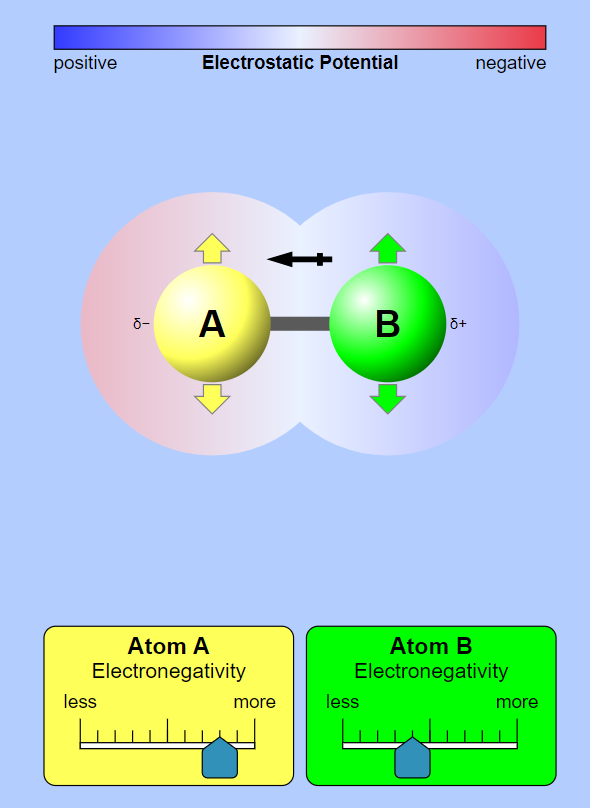
What type of covalent bond is shown here?
ionic
moderately polar covalent
extremely polar covalent
nonpolar covalent
What type of bond forms when atoms share electrons?
Covalent bond
Ionic bond
Hydrogen bond
Metallic bond
What type of molecule has equal sharing of electrons?
Covalent bond
Polar molecule
Nonpolar molecule
Ionic compound
What happens to electrons in a covalent bond?
They are shared between atoms.
They are lost to the environment.
They are transferred completely.
They form a crystal lattice.