OBJECTIVES & STANDARDS
Math Objectives
Interpret real-world data presented in different types of charts and graphs
Common Core Math Standards
Link to all CCSS Math
Personal Finance Objectives
Analyze factors that make saving challenging
Describe what it’s like to live paycheck to paycheck
Reflect on the connection between income and saving
National Standards for Personal Financial Education
Saving
9a: Explain how external influences (e.g. peers, family, or social media) can impact personal savings decisions
Spending
4a: List different ways retailers advertise the prices of their product
DISTRIBUTION & PLANNING
Distribute to students
OBJECTIVES & STANDARDS
Math Objectives
Interpret real-world data presented in different types of charts and graphs
Common Core Math Standards
Link to all CCSS Math
Personal Finance Objectives
Analyze factors that make saving challenging
Describe what it’s like to live paycheck to paycheck
Reflect on the connection between income and saving
National Standards for Personal Financial Education
Saving
9a: Explain how external influences (e.g. peers, family, or social media) can impact personal savings decisions
Spending
4a: List different ways retailers advertise the prices of their product
DISTRIBUTION & PLANNING
Distribute to students
Answer the question on the first slide in the space below. Then, compare your answer to the answer on the second slide. Finally, follow your teacher’s directions on how to answer the follow-up questions on the last slide.
Are you surprised by this number? Why or why not?
What are some emergency expenses that could amount to $400?
How do you think the remaining 37% cover this emergency cost?
Your friend says “Why would you want to save money when interest rates that banks pay for savings are so low?” Convince them that saving money is a good idea.
ACTIVITY: Why Does Saving Seem Hard?
It can be hard to build up a habit of saving when there are so many factors encouraging you to spend. Choose one resource about a common challenge to saving from the list below and answer the questions.
VIDEO: 3 Sneaky Tactics that Websites Use to Make You Spend
ARTICLE: Do People Really Spend More With Credit Cards?
CARTOON: Present Bias
ARTICLE: How Social Media Can Impact Your Financial and Mental Health
INFOGRAPHIC: Saving for Sooner
What resourse did you use?
Summarize the main idea of your resource.
Based on your resource, what is one reason it is hard to save money? You may have to make an inference based on the main idea of your resource.
Do you personally relate to the challenge(s) described in your resource? Why or why not?
What strategies could you possibly use to avoid or overcome the challenges highlighted in your resource?
GRAPH: 4 in 10 Americans Would Need to Borrow to Pay for an Unexpected Bill
As you’ve learned, saving can be challenging. Many Americans have almost no savings. Study the graph to learn more about the ways Americans would cover an unexpected expense.
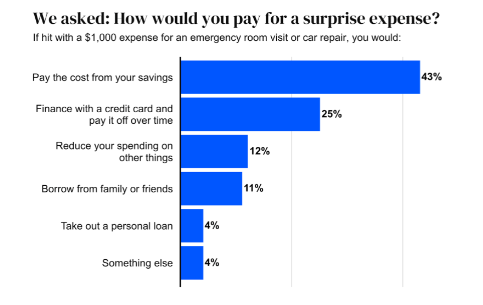
What do you think are the disadvantages of borrowing to cover an unexpected expense?
INFOGRAPHIC: Who Has Enough Cash to Get Through the Coronavirus Crisis?
Experts recommend having an emergency fund to cover 3-6 months of expenses, as a cushion for unexpected income changes. How long does it take different families to build up enough savings to cover 1 month of expenses?
Review the infographic in the first section of this article. Stop reading at “Do you have enough money saved to weather this pandemic?”
Link to slides with same info.
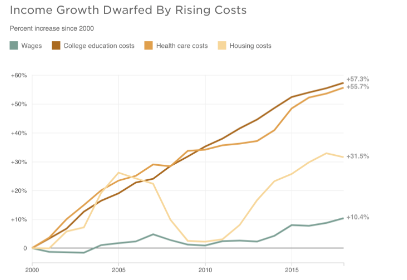
GRAPH: Income Growth Dwarfed by Rising Costs
Of course, challenges to saving go beyond our personal habits. Many Americans spend carefully, but still struggle to save as the cost of living exceeds their income.
How does this graph illustrate a challenge to saving?
Hypothesize: Who do you think is the most impacted by these rising costs? Why?
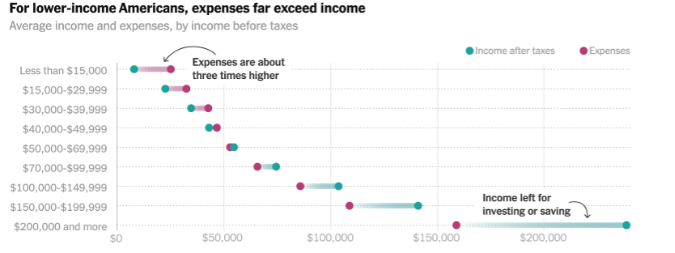
GRAPH: For Lower-Income Americans, Expenses Far Exceed Income
In order to save, you need to have extra money left over after you’ve paid for your basic living expenses. How much you can save depends on that gap. Study the graph below to see how income and expenses compare at different income levels.
At which income level does average income begin to exceed average expenses?
Is there more variation in average income or expenses? Hint: What is the difference between the highest income and the lowest income? What is the difference between the highest expenses and the lowest expenses?
Hypothesize: Why do you think expenses do not go down drastically at lower incomes? What does this imply about expenses?
What are the implications of this graph for saving? For reference, the median American household income is approximately $65,000.
VIDEO: What does it mean to live paycheck-to-paycheck?
Without savings, approximately half of Americans use each paycheck to cover their current expenses. Watch the video to hear from four different people about their experience living paycheck to paycheck.
What are the impacts of living paycheck to paycheck?
What are some ways people get money in time to pay bills when living paycheck to paycheck?
INTERACTIVE: Living Paycheck to Paycheck
Interactive: Spent
Living paycheck to paycheck means that you need every bit of your paycheck to meet your expenses which drains your balance back down to near $0 before your next paycheck arrives...and then you start the cycle again. As a result, you don’t have savings to fall back on, every dollar counts, and you’re faced with tough decisions on a daily basis. In this activity, you’ll experience what it’s like to live paycheck to paycheck by playing the game Spent. At the start of the game, you are faced with the following scenario:
Over 14 million Americans are unemployed. Now imagine you’re one of them. Your savings are gone. You’ve lost your house. And you’re down to your last $1,000. Can you make it through the month?
Your friend Emma is struggling to save money and often finds herself over-spending on impulsive online purchases. All of the following are effective strategies to reduce her online spending, EXCEPT...
Unsubscribe from the sales and marketing emails that prompt her to start online shopping.
Identify the cues that start her online shopping and create a new routine and reward that don’t involve spending money.
Find ways to gamify her online shopping and share her purchases on social media.
Set aside cash for her monthly shopping budget. Each time she makes a purchase, she pays with cash or removes that amount of cash from the budget.
It can be challenging for many low-income Americans to save money. All of the following are reasons why, EXCEPT....
Expenses have risen faster than wages in the last 20 years
Average expenses exceed income for low-income Americans
Living paycheck-to-paycheck is expensive because it results in additional fees
Building an emergency fund takes two months of consistent savings
Approximately what percentage of Americans are able to pay an unexpected $1000 expense from their savings?
20%
40%
60%
80%
How do you feel about your situation? Do you think you can live 30 days with $1,000? Explain.
Go to playspent.org. Click on Continue to Spent on the right side of the screen to start the game and play it all the way through.
PRO TIP: Keep an eye on the left-hand bar which keeps track of your progress and includes 3 options to get more money during the month:
Did you make it through the entire month? If so, how much money did you have left? If not, on what day did you run out of money? screen shot your screen for 15 BONUS POINTS
Think about your emotional state as you played the game and select the top 5 adjectives below that best describe what you felt.
Calm
Disappointed
Embarrassed
Excited
FOMO
Frustrated/Angry
Hopeful
Hopeless
Motivated
Proud
Relieved
Sad
Scared
Self-sufficient
Shocked/Surprised
Stressed
Other _______________________________
How did some of your initial decisions (job, health insurance, where to live) impact the rest of your month in ways you did not expect?
Did you ever reach out to a friend for help? Why or why not?
Describe a scenario in which you thought you were making a good decision but there was still a negative outcome.
Describe a scenario that forced you to wrestle with your values. What was your ultimate decision and how do you feel about it? Explain.
Did you ever use any of the 3 options on the left-hand side of the game to get more money?
If yes, which one(s) and why?
If no, why not?
What is your main takeaway from playing Spent?