Twa kɔ nsɛm atitiriw so
Log in
Sign up for FREE
arrow_back
Laabri

3.9 Where to Save

star
star
star
star
star
Last updated over 1 year ago
47 Nsɛmmisa
Hyɛ no nsow a efi ɔkyerɛwfo no hɔ:
Intro - Warm-Up
Learn It
Math Connection
1
1
1

OBJECTIVES & STANDARDS

Math Objectives

  • Explore compound interest equation

  • Compare exponential and linear growth outcomes

  • Distinguish between situations that can be modeled with linear functions and with exponential functions.

Common Core Math Standards

  • Link to all CCSS Math

  • CCSS.PRACTICE.MP2

  • CCSS.PRACTICE.MP4

  • CCSS.HSF.LE.A.1

  • CCSS.HSF.IF.B.5

  • CCSS.HSA.REI.B.3

Personal Finance Objectives

  • Explain the difference between banks and credit unions

  • Understand the difference between a checking and savings account

  • Compare different types of savings accounts with their costs and benefits

  • Explore alternatives to a traditional savings account

  • Investigate modern saving apps that can integrate into a personal savings plan

National Standards for Personal Financial Education

Saving

  • 2a: Select a preferred location for a savings account based on comparison of interest rates and fees at different types of financial institutions.

  • 4b: Illustrate how inflation can reduce the purchasing power of savings over time if the nominal interest rate is lower than the inflation rate.

DISTRIBUTION & PLANNING

Distribute to students

  • Student Activity Packet

OBJECTIVES & STANDARDS

Math Objectives

  • Explore compound interest equation

  • Compare exponential and linear growth outcomes

  • Distinguish between situations that can be modeled with linear functions and with exponential functions.

Common Core Math Standards

  • Link to all CCSS Math

  • CCSS.PRACTICE.MP2

  • CCSS.PRACTICE.MP4

  • CCSS.HSF.LE.A.1

  • CCSS.HSF.IF.B.5

  • CCSS.HSA.REI.B.3

Personal Finance Objectives

  • Explain the difference between banks and credit unions

  • Understand the difference between a checking and savings account

  • Compare different types of savings accounts with their costs and benefits

  • Explore alternatives to a traditional savings account

  • Investigate modern saving apps that can integrate into a personal savings plan

National Standards for Personal Financial Education

Saving

  • 2a: Select a preferred location for a savings account based on comparison of interest rates and fees at different types of financial institutions.

  • 4b: Illustrate how inflation can reduce the purchasing power of savings over time if the nominal interest rate is lower than the inflation rate.

DISTRIBUTION & PLANNING

Distribute to students

  • Student Activity Packet

VIDEO: Banks vs. Credit Unions: What's the Difference?

Watch the video and answer the following questions. Compare your answers with a partner and discuss any similarities and differences.

1
Asemmisa {{asɛmmisaAhyɛnsode}}
1.

What are the three main categories where banks and credit unions differ?

1
Asemmisa {{asɛmmisaAhyɛnsode}}
2.

Describe the differences in one of these categories.

1
Asemmisa {{asɛmmisaAhyɛnsode}}
3.

Does a bank or a credit union fit better with your own personal ideas of what you’d like out of your banking institution? Why?

VIDEO: What's the Difference Between Checking and Savings?

You may be tempted to think you’re all set once you have a checking account, but it’s important to have a savings account, too. Watch this video and then answer the following questions.

1
Asemmisa {{asɛmmisaAhyɛnsode}}
4.

What is one way banks make money, according to the video?

1
Asemmisa {{asɛmmisaAhyɛnsode}}
5.

Why can banks offer you interest on your savings account but not your checking account?

1
Asemmisa {{asɛmmisaAhyɛnsode}}
6.

Would you expect someone earning more than they spend to keep the majority of their money in a checking account or a savings account for the long term? Why?

INFOGRAPHIC: What is the Difference Between Checking and Savings Accounts?

Checking and savings accounts are both important tools for managing your money, but they are used for very different purposes. Read through this infographic for further details about how these accounts are different. Then, answer the questions.

1
Asemmisa {{asɛmmisaAhyɛnsode}}
7.

How does the interest rate compare between checking and savings accounts?

1
Asemmisa {{asɛmmisaAhyɛnsode}}
8.

What is one fee with a savings account that you do NOT have with a checking account?

1
Asemmisa {{asɛmmisaAhyɛnsode}}
9.

Up to what value does FDIC insurance cover your deposits?

1
Asemmisa {{asɛmmisaAhyɛnsode}}
10.

Does FDIC insurance cover checking accounts, savings accounts, both, or neither?

ACTIVITY: COMPARE: Types of Savings Accounts

Now that you know the difference between checking and savings accounts, let's take a closer look at different types of savings accounts.

There are multiple types of savings accounts that can help you meet your savings goals. You’ll explore and compare four different types of savings accounts in this activity by first researching the basics of the accounts, then comparing which of those accounts a specific bank or credit union offers, and finally applying what you have learned about those accounts to various saving goal scenarios!

0
Asemmisa {{asɛmmisaAhyɛnsode}}
11.

Part I: Research Savings Accounts

TEAMWORK: Your teacher will assign you one of the four types of savings accounts to research: (1) Traditional Savings Account, (2) Online Savings Account, (3) Certificate of Deposit, or (4) Money Market Account. With your teammates, conduct online research on your assigned savings account type. Complete each field in the drawing below.

0
Asemmisa {{asɛmmisaAhyɛnsode}}
12.

0
1
1
1
1
1
1

ACTIVITY: Savings...or NOT?

For each of the 7 situations below, circle whether the descriptions apply to savings or some other account.

Savings=True

Not Savings=False

1
1
1
1
1
1
1
1
1

ARTICLE: Best Money-Saving Apps

If savings accounts and CDs are a thing of the past, then what ARE people using nowadays? Often in today’s digital society, consumers do not interact as much directly with their banks but instead use other apps to track and manage their finances.

Pick one of the three apps in the article and fill out the following table. Fill in the rest of the table and answer the questions as you share out with the class.

0
Asemmisa {{asɛmmisaAhyɛnsode}}
29.

Pick one of the three apps in the article and fill out the following table. Fill in the rest of the table and answer the questions as you share out with the class.

0
Asemmisa {{asɛmmisaAhyɛnsode}}
30.

How could paying for an app like one of these possibly help you save money?

0
Asemmisa {{asɛmmisaAhyɛnsode}}
31.

What are some alternative ideas you could use for free?

Now that you know the basics of savings accounts and earning interest, answer the following questions about saving, interest growth, and how your money grows in different accounts.

Part I: Checking Account Balances

Phillip has two accounts where he is storing his money. He has zero interest checking accounts and has met all the minimum requirements to have zero fees. The Account at Bank A starts with $300 and saves $20/month. The Bank B account starts with $100 and he deposits $1/day. Assume every month has 30 days.

6
Asemmisa {{asɛmmisaAhyɛnsode}}
32.

How much money will the accounts have after 1 month? After 1 year? After 10 years?

1 Month 1 Year 10 Years

Bank A:

Bank B:

2
Asemmisa {{asɛmmisaAhyɛnsode}}
33.

Write equations that represent the balance in each account (y) as a function of time (x).

Bank A:

Bank B:

1
Asemmisa {{asɛmmisaAhyɛnsode}}
34.

When will the accounts have the same balance? months

1
Asemmisa {{asɛmmisaAhyɛnsode}}
35.

On a graph, how could you tell the point where the accounts have the same balance?

2
1

Part II: Compounding Interest

Phyllis (Phillip’s sister) has also learned good saving habits, but she wants to know what different savings accounts will help her earn. She invests $3000 in each of three different savings account types each with different interest rates as shown below. You will use this compounding interest formula to calculate how much her money will earn in each of the accounts based on the interest rate (r) as a decimal and time (t) in years. For each different account, you will change the variable for interest rate (r) and time (t). For one month, use 0.083 years.

9
Asemmisa {{asɛmmisaAhyɛnsode}}
38.

How much money will the accounts have after 1 month? After 1 year? After 10 years?

Interest 1 Month 1 Year 10 Years

Saving @ .005

$Mark@.0055

CD@.0075

3
Asemmisa {{asɛmmisaAhyɛnsode}}
39.

How much did the money grow in each bank account from just interest over 10 years?

Savings:

Money Market:

CD:

1
Asemmisa {{asɛmmisaAhyɛnsode}}
40.

What brought in more money over 10 years, monthly savings or interest growth?
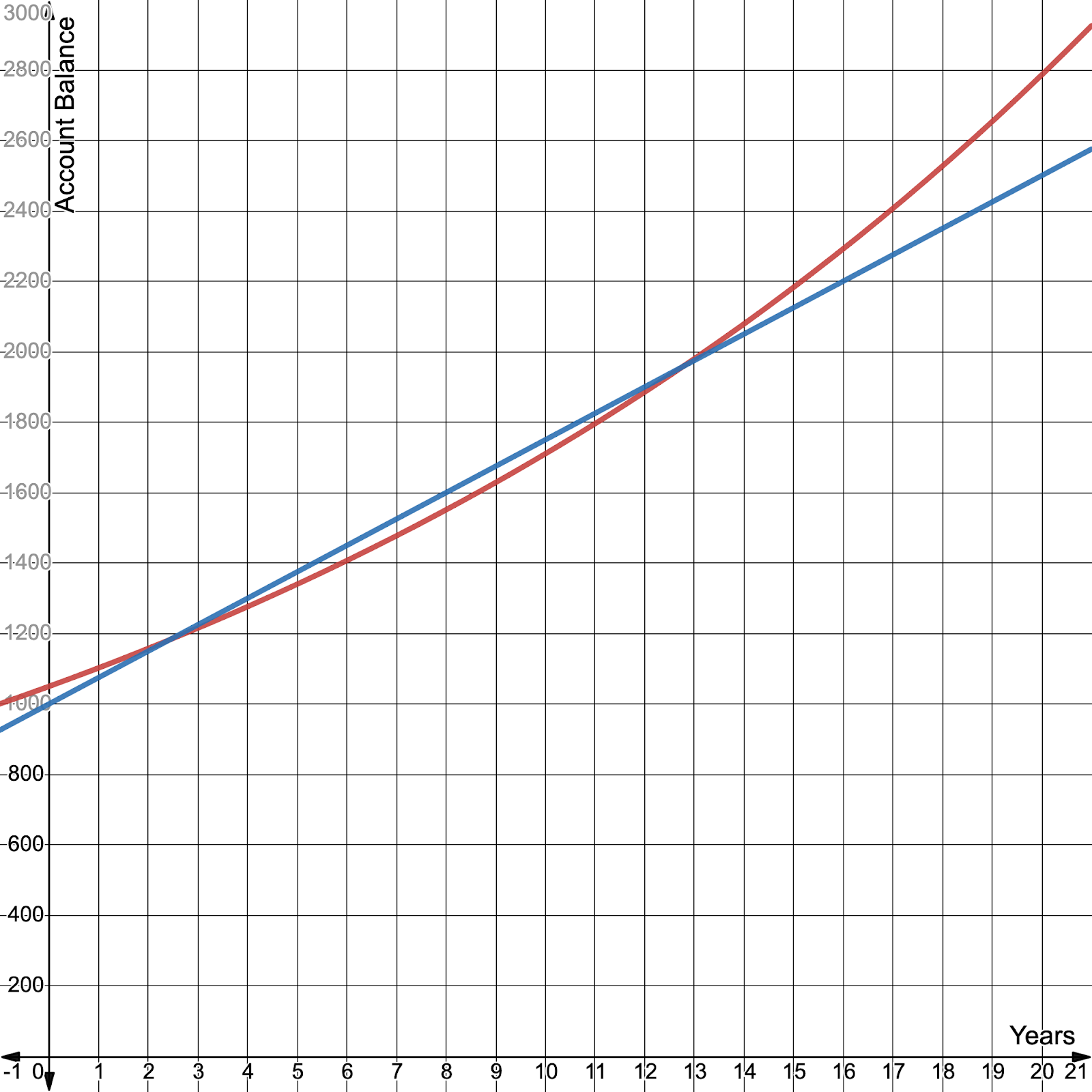
Part III: Simple vs Compound Interest

Philomena, trying to get more growth from her money, is deciding between two investment accounts for her $1050. The Red account predicts a 5% interest compounded annually and a $1050 starting balance. The Blue account guarantees a 7.5% simple interest added annually and a one-time $50 fee making it a $1000 starting balance. Below are the two accounts plotted on the same graph.

1
Asemmisa {{asɛmmisaAhyɛnsode}}
41.

Which earns more after 5 years?

1
Asemmisa {{asɛmmisaAhyɛnsode}}
42.

Which earns more after 20 years?

5
1
Asemmisa {{asɛmmisaAhyɛnsode}}
45.

Which statement about saving is true?

  1. Savings accounts have had about the same interest rates throughout history

  2. Every savings account is the same except for the interest rate they offer

  3. Savings accounts differ wildly and it is worth hours of research to choose the best one

  4. Savings accounts are largely similar and your choice is mostly personal preference

Asemmisa {{asɛmmisaAhyɛnsode}}
46.

This type of account features a low to modest interest rate, requires that you not withdraw your funds for a set period of time, and can be set up at most major banks and credit unions.

1 Checking Account

2 Savings Account

3 Certificate of Deposit

4 Money Market Account

Asemmisa {{asɛmmisaAhyɛnsode}}
47.

Which statement about savings accounts is true?

  1. Savings accounts typically pay lower interest than checking accounts

  2. Savings accounts are insured by the FDIC but checking accounts are not

  3. Savings accounts are for building wealth while checking accounts are for spending

  4. Savings accounts often have transaction limits but checking accounts are unlimited

SHARE OUT: After each group has finished their research, go around the classroom and each team will share their research from each savings account type. Assign each teammate in your group different parts of your research to share to the class. When another group is presenting on a savings account type that you did NOT research with your team, follow along with their presentation by completing the main points in the table below.

Asemmisa {{asɛmmisaAhyɛnsode}}
13.

Part II: Research A Bank or Credit Union

Now that you know the basics of how these four types of savings accounts work, let’s take a closer look at how these accounts compare against each other at your favorite bank or credit union. Select one bank or credit union (it can be one that you or your parents / guardians currently use, or one that you are interested in learning more about). Then, research the bank or credit union’s options for savings accounts. NOTE: If the bank offers multiple products in the same category (ex: two tiers of MMA or CDs at 10 different time intervals) just record answers for ONE of the options.

Part III: Apply Your Knowledge!

Congratulations - you now have a deeper understanding of how various types of savings accounts can be used for different savings goals! Now that you know more about the details on these different accounts, apply your learning by helping out the following characters by reading each scenario below and selecting which type of savings account, from the 3 you’ve chosen above, fits best.

Asemmisa {{asɛmmisaAhyɛnsode}}
14.

Robert wants to get serious about saving for a new car. Which account would you recommend? Why?

Asemmisa {{asɛmmisaAhyɛnsode}}
15.

Cindy has been working for 8 years, and she’s built up a huge emergency fund -- $45,000, which would be 6 months of her salary. She’s hoping to earn a bit more interest than she currently is with that $45,000 just sitting in her traditional bank’s savings account. Which account would you recommend? Why?

Asemmisa {{asɛmmisaAhyɛnsode}}
16.

Janelle likes to keep all her savings goals separate, so she has an account for each one, including an account to save for her college textbooks every semester. She buys books about every 6 months, with roughly $550 due each time. She likes to save the money up in installments, with auto-deposits from each of her twice monthly paychecks. She’s wondering if her online savings account, earning 0.75%, is still her best option for monthly deposits toward her textbooks. Which account would you recommend? Why?

VIDEO: EdPuzzle: Is the Savings Account Dead?

Watch this EdPuzzle video (up to the 5:05 mark) and answer the questions about savings accounts and wealth building.Watch this video to learn more about the role of savings accounts. Then, answer the questions either in EdPuzzle or below.

Asemmisa {{asɛmmisaAhyɛnsode}}
17.

The video references a high yield account. What does "high yield" mean?

  1. Giving a low return

  2. Giving a high return

  3. Free to open with any deposit amount

  4. Requiring a high initial deposit amount

Asemmisa {{asɛmmisaAhyɛnsode}}
18.

What happens to the money that you deposit at a bank?

  1. The bank lends out the money at a higher interest rate than what they are paying you.

  2. The bank lends out the money at a lower interest rate than what they are paying you.

  3. The money sits at the bank until you are ready to withdraw or use it.

  4. The money is sent to the Federal Reserve, where it sits until you’re ready to withdraw or use it

Asemmisa {{asɛmmisaAhyɛnsode}}
19.

If inflation is at 2% and you are earning 1% return on your savings account, what is your "real return?"

  1. +3%

  2. -3%

  3. +1%

  4. -1%

Asemmisa {{asɛmmisaAhyɛnsode}}
20.

Chris wants to put money aside so he can buy his mom a birthday present.

Savings=True

Not Savings=False

Asemmisa {{asɛmmisaAhyɛnsode}}
21.

Sam wants to buy school supplies for a project she is working on.

Savings=True

Not Savings=False

Asemmisa {{asɛmmisaAhyɛnsode}}
22.

Aisha wants to withdraw $20 from an ATM so she can buy a movie ticket and go watch the movie with her friends.

Savings=True

Not Savings=False

Asemmisa {{asɛmmisaAhyɛnsode}}
23.

Neil rides his bike every day to school and back and is responsible for maintaining his bike. He wants to make sure he has money to fix or replace anything that might break in the future.

Savings=True

Not Savings=False

Asemmisa {{asɛmmisaAhyɛnsode}}
24.

Rosa is going on a vacation with her parents in a few months and wants to put the money she just got from the holidays aside to buy souvenirs.

Savings=True

Not Savings=False

Asemmisa {{asɛmmisaAhyɛnsode}}
25.

Jamil wants to take his birthday money and put it away where it can grow for 15 years and help with a down payment on a future house he wants.

Savings=True

Not Savings=False

Asemmisa {{asɛmmisaAhyɛnsode}}
26.

Harry has an account at his bank. It has a linked debit card and no limits on monthly withdrawals. He earns no interest on this account.

Savings=True

Not Savings=False

Asemmisa {{asɛmmisaAhyɛnsode}}
27.

What are some things the “Savings” scenarios have in common?

Asemmisa {{asɛmmisaAhyɛnsode}}
28.

For each of the “NOT” scenarios, discuss with a partner what might be a good alternative to savings

Asemmisa {{asɛmmisaAhyɛnsode}}
36.

How much did the money grow in each bank account from just deposits over 10 years?

Bank A:$

Bank B: $

Asemmisa {{asɛmmisaAhyɛnsode}}
37.

What seems to be more important in the long-term, starting balance or monthly savings rate?

Asemmisa {{asɛmmisaAhyɛnsode}}
43.

Approximately how much more does account 1 earn after 20 years?

Approximately when will the two accounts have the same balance? years and again at years

How many solutions does this system of equations have? How can you tell?

Asemmisa {{asɛmmisaAhyɛnsode}}
44.

Compound interest leads to an exponential growth equation while simple interest results in linear growth. If you go further out to 25 years or 50 years, what do you think will happen to the difference between the compounding function and the simple interest function?