3.6 Age Structure Diagram

Last updated 7 months ago
19 questions
Many of the vast differences we see in societies across the globe can be related to the composition of their respective populations. This is true on the local, state, and national levels. So when exploring variations among countries, a good place to start is with their age structure diagrams (population pyramids) – graphs that display the age and sex distribution of the country’s population.

To help make population projections for different countries, demographers look at the profile of the countries’ residents. What are the ages of the people? How many are men? How many are women? Taking this information, they construct population pyramids that depict the configuration of a country’s population as impacted by 70 to 80 years of economic, political, and natural events.
1

What do age structure diagrams display?

This is a type of graph used by demographers to study the distribution of people across sex and age categories.
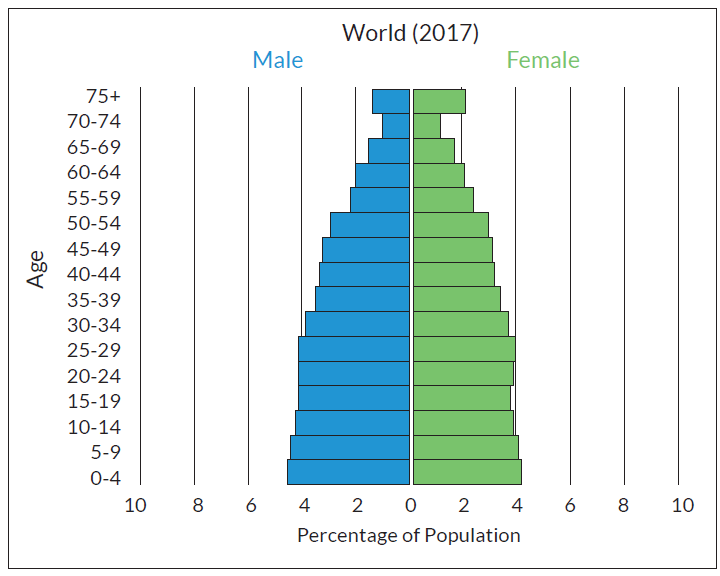
The graph represents the entire world population, sorted by age and sex – with the youngest at the bottom and the oldest at the top and males on the left, females on the right. Each age level/sex grouping is called a cohort. A cohort represents the percentage of people within that sex and age range within the population. So
on the world population pyramid, we can see that 4.5 percent of the global population is made up of
males aged 0-4.
1

What is the largest age cohort?

1

What cohort makes up 4% of the global population?

1

IDENTIFY where are you represented on the age structure diagram?

1

Are there currently more old people or young people living on the planet?

1

Describe how can you tell?

1

In general, the bars get smaller as we move up the graph until the top cohorts – they break the pattern and extend further out.

Explain why? Hint: Look at the y-axis and the ages represented in each cohort.

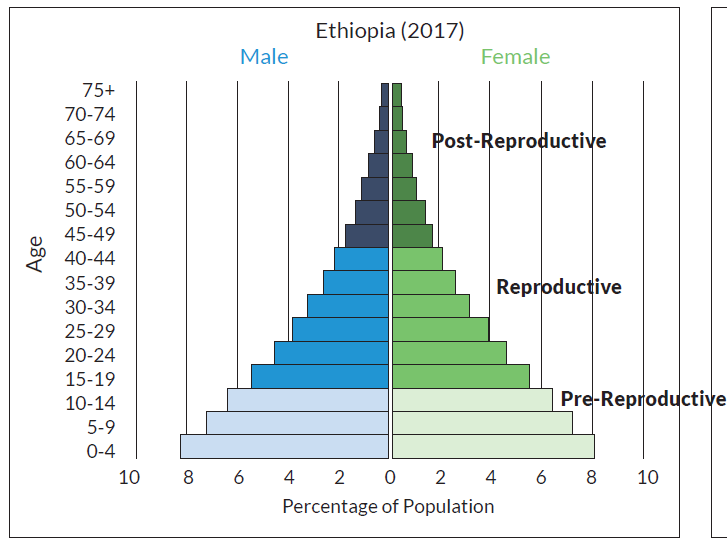
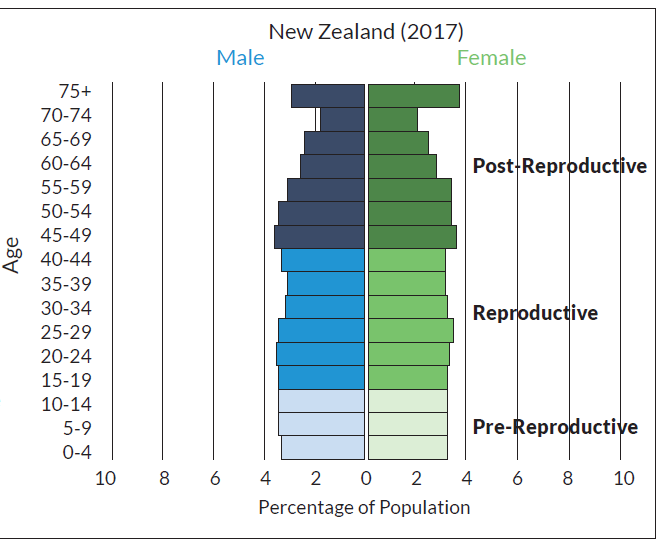
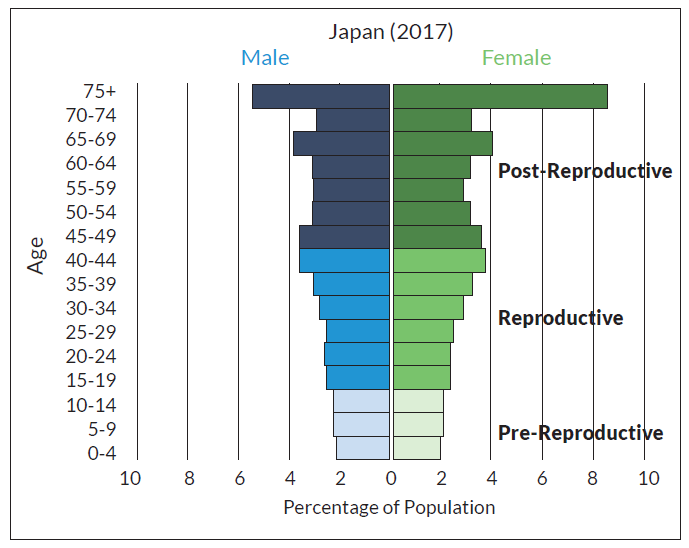
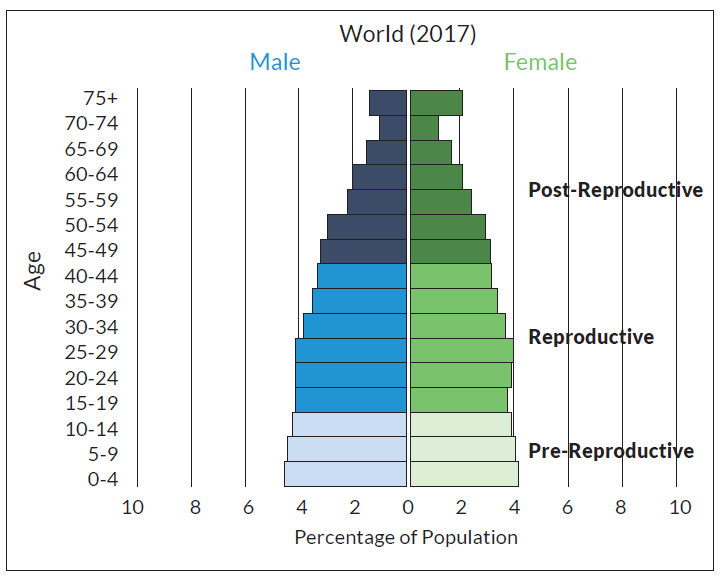
The graph below is broken down into pre-reproductive, reproductive, and post-reproductive levels.
The shape of the age structure diagram shows if a population is rapidly growing, slowly growing, stable, or shrinking.
1

The world population is

1

Explain why for #8.

This graph is of Ethiopia. The triangular shape reflects a growing population.
1

Explain why Ethiopia has a rapidly growing population.

This graph is of New Zealand. The rectangular shape shows a stable population.
1

Explain why New Zealand has a stable population.

This graph is of Japan. The cup shape shows a shrinking population.

1

Explain why Japan has a shrinking population.

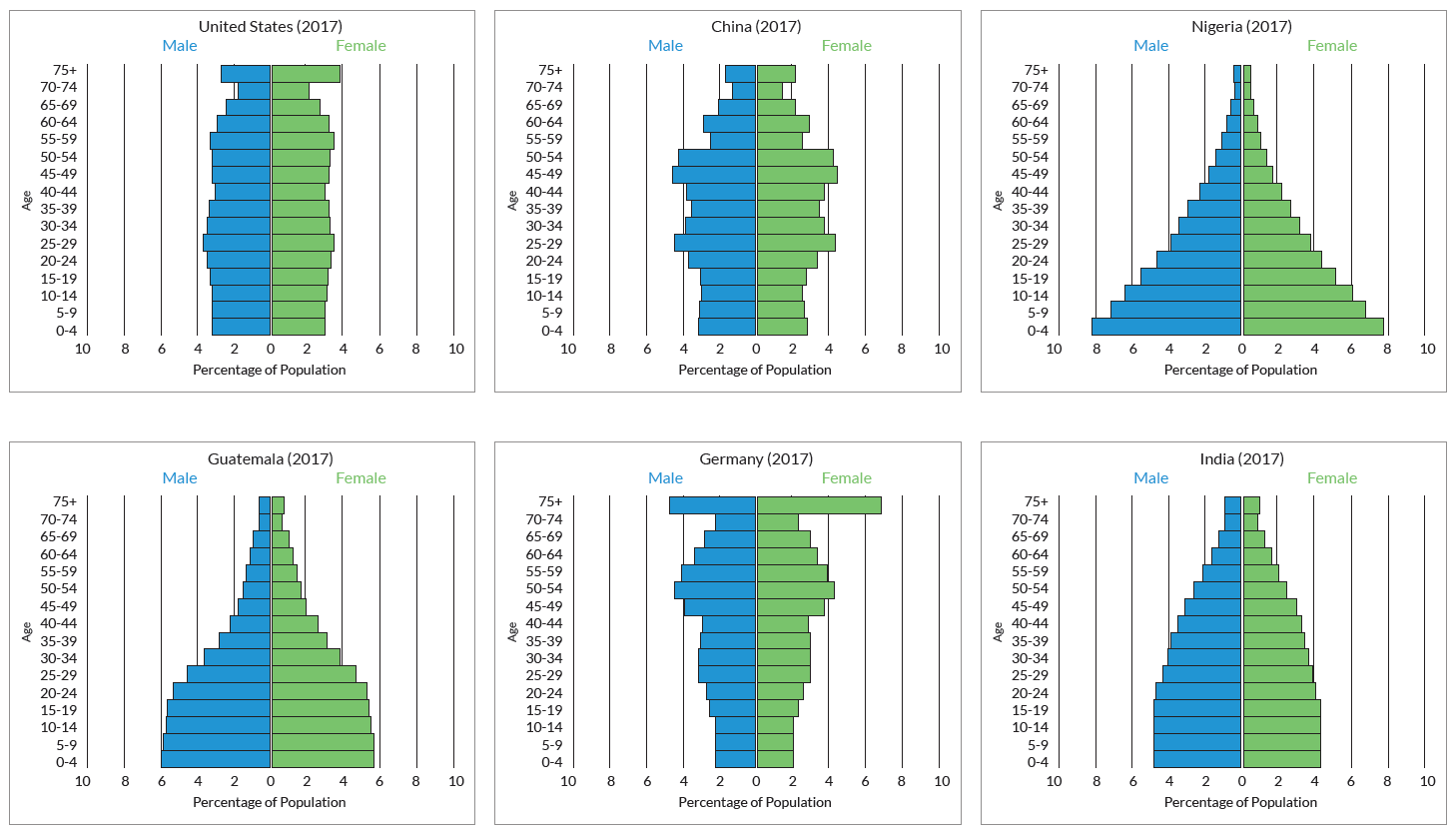
Look at the age structure diagrams of these six countries to answer the following questions.
1

You tell from the age structure diagram which country has the most people.

1

Can you tell from the graphs which country has the most people?

Explain why for #13.

1

Which of the six countries is growing the fastest?

1

Looking at the pyramids, which countries appear to have the negative rates of population growth?

1

Submit your photo of an age structure diagram of a country with a growing population.

1

Submit your photo of an age structure diagram of a country with a declining population.

1

Submit your photo of an age structure diagram of a country with a stable population.