Digital Inquiry - Refraction
star
star
star
star
star
Last updated over 2 years ago
10 Nsɛmmisa
TEXT: BENDING LIGHT
As you read the text, think about other objects in water. Does their appearance change in some way?
1
5.6.C
7
5.6.C
As you read the text, think about other objects in water. Does their appearance change in some way?
Click the link to watch the 2-minute video and learn how light travels through different materials.
In this video segment adapted from Shedding Light on Science, learn about the refraction of light. Observe how a straight straw placed in a bowl of water appears to bend where it enters the water. Learn about how the speed of light changes in different transparent materials and the direction of the light changes at the boundary of the materials. Fermat's principle of least time is explained through the analogy of a lifeguard on a beach trying to reach a swimmer in the water in the least amount of time.
Why do we often perceive objects as being closer or further away?
How is the path of light being changed?
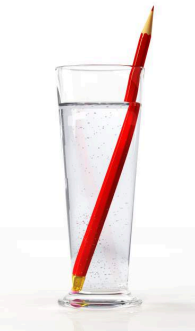
Light travels in a straight line until it passes through another medium. When the light enters a different medium, like from air to water, the light refracts, changes speed and direction. This makes a pencil in a glass of water appear to be at a different bent angle in water than in the air.
Light slows down because the density (how close together molecules are) of the new medium, water, is greater than the density of the previous medium, air. Light travels slower through water than through air. So, the light that reaches your eyes is received at a slightly slower speed when it travels through water.
In a lab, or in space, when light travels through a vacuum, where there is no air or any other substance, it travels the fastest of all.
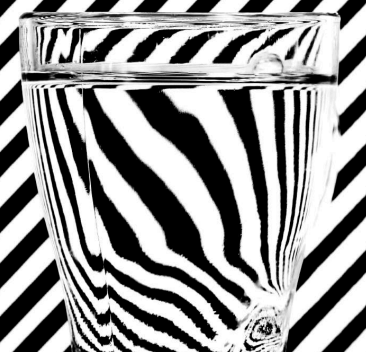
When light travels through a new medium, light refracts, and objects seen appear to bend.
Why does light slow down as it enters different types of matter?
How does light energy in space compare to light energy on Earth?
How does refraction change the way we see images?
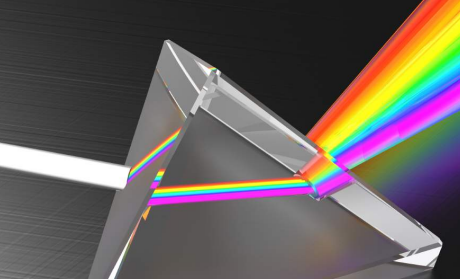
Click the link to learn how prisms bend light, causing white light to split into a spectrum of colors.
How does white light separate into color?
How do water molecules in the atmosphere act like prisms?
Click the link to watch the 3-minute video about microscopes and refraction.
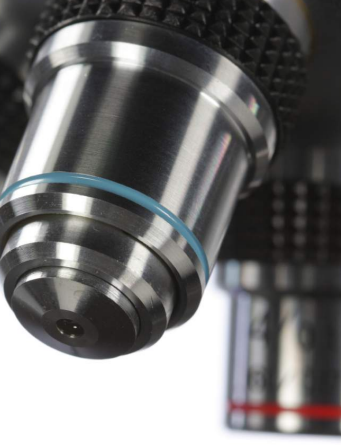
Watch a Stanford Bioengineer explain how microscopes work, and how he was able to use micro-optics to build one out of paper with this video from KQUED's Science 2015 series. This video is part of our Engineering Is: Diagnosing Diseases with Origami Microscopes e-book. The e-book explores the science and engineering principles behind Manu Prakash’s Foldscopes project, and includes videos, interactives and media making opportunities.
Why do microscopes use refraction rather than reflection?
How do the lenses in microscopes allow us to see matter at the cellular level?
Light is energy that allows us to see. In a vacuum, such as space, light rays travel in a path and at the same speed. On Earth, however, light travels through different types of . This affects both the speed and direction. When light rays change speed and direction, this is called .
Refraction happens all the time and all around us. Refraction is most easily observed when we place an object like a straw or pencil in water. The object appears bent or enlarged. The path of light is creating an . Remove the item from the water and you can see that it is not changed.
The speed at which light travels changes as it moves through solids, liquids, and gases. Light will always take the fastest path it can between two places even if that path is not straight. Light travels faster through gas than it does liquids and solids.
A is a tool used to separate white light into a spectrum of colors. White light refracts when it passes through a prism, causing the light to split apart. The light travels through the air, through the solid glass, and back through the air again into our eyes.
Many technologies today rely on the refraction of light to work. Lenses in glasses, some telescopes, and microscopes are all examples. use a small curved lens or sphere to refract light and enlarge the image to see more than what the naked eye is capable of.