3.2 Graphing Systems of Equations

Last updated 10 months ago
39 questions
Note from the author:
OBJECTIVES & STANDARDS
Math Objectives
  • Graph systems of linear equations in slope-intercept form
  • Identify solutions to systems of linear equations graphically
  • Determine whether a system of linear equations has one solution, no solutions, or infinite solutions
Common Core Math Standards
  • Link to all CCSS Math
  • CCSS.PRACTICE.MP1
  • CCSS.PRACTICE.MP4
  • CCSS.HSF.IF.B.4
  • CCSS.HSF.IF.C.7.A
  • CCSS.HSF.BF.A.1
Personal Finance Objectives
  • Compare different savings rates over time and how they impact the achievement of savings goals.
National Standards for Personal Financial Education
Saving
  • 2a: Select a preferred location for a savings account based on comparison of interest rates and fees at different types of financial institutions.
DISTRIBUTION & PLANNING
Distribute to students
  • Student Activity Packet
  • Application Problems
  • Application Card Sort
OBJECTIVES & STANDARDS
Math Objectives
  • Graph systems of linear equations in slope-intercept form
  • Identify solutions to systems of linear equations graphically
  • Determine whether a system of linear equations has one solution, no solutions, or infinite solutions
Common Core Math Standards
  • Link to all CCSS Math
  • CCSS.PRACTICE.MP1
  • CCSS.PRACTICE.MP4
  • CCSS.HSF.IF.B.4
  • CCSS.HSF.IF.C.7.A
  • CCSS.HSF.BF.A.1
Personal Finance Objectives
  • Compare different savings rates over time and how they impact the achievement of savings goals.
National Standards for Personal Financial Education
Saving
  • 2a: Select a preferred location for a savings account based on comparison of interest rates and fees at different types of financial institutions.
DISTRIBUTION & PLANNING
Distribute to students
  • Student Activity Packet
  • Application Problems
  • Application Card Sort
Intro- Warm-Up
1

DESMOS: Systems of Two Linear Equations
Linked in Google Classroom, after completing answer the following question.
What did you learn from this activity?

Learn it 1:
Systems of Equations
In the last activity, you began exploring how to find a solution that works for two different linear functions. This is called a system of equations.
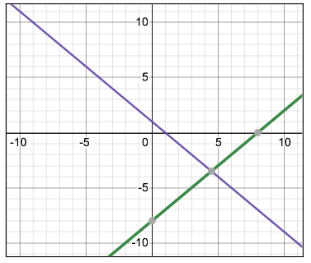
A system of equations is when two or more equations share the same variables. A solution to that system has to be true for all the equations, not just one. Think back to the last activity when we graphed two lines on the same coordinate plane. The green line represents the number pairs that had a difference of 8. The purple line represents the number pairs with a sum of 1.
1
Where did you see the solution to the system of equations on the graph?_______
1

How can you test if that point is a solution to both equations in the system?

2
Tatiana starts with $8 in her piggy bank and saves $2 per week. Julian starts with $0 in his piggy bank and saves $4 per week.
  1. Write an equation to model how much money Tatiana has in her piggy bank after x weeks._______
  2. Write an equation to model how much money Julian has in his piggy bank after x weeks._______
1

Graph both equations in Desmos and Screen Shot in Show your Work below.

3
Who will have more money after 2 weeks? _______ How much does Julian have?$_______ Tatiana?$ _______
2
When will they have the same amount of money?Week_______ Justify your answer._______
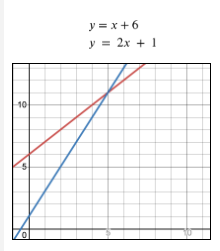
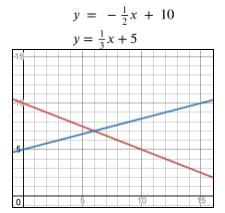
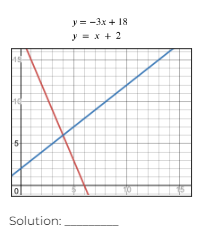
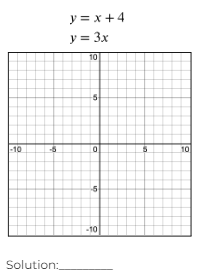
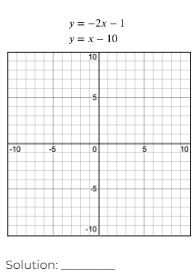
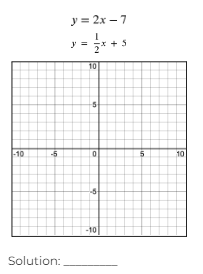
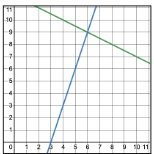
Practice It (on your own):For each problem, find the solution to the system of equations in (x,y) form.
1
Solution: _______
1
Solution: _______
1

Solution: _______
2
Screen Shot Desmos in Show Your Work
_______ Solution:
2
Screen Shot Desmos in Show Your Work
_______
1
Screen Shot Desmos in Show your work
_______
4
Rowan opens a savings account with $25 and saves $75 per month. Reem opens a savings account with $225 and saves $25 per month. Graph in Desmos and Screen shot your answer.
  1. Write an equation for Rowan’s savings account balance._______
  2. Write an equation for Reem’s savings account balance._______
  3. When will their account balances be the same? Week _______ How much will they have? $_______
2
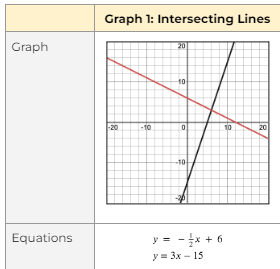
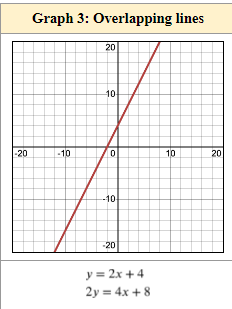
Number of Solutions: _______
Points that are Solutions: _______
2
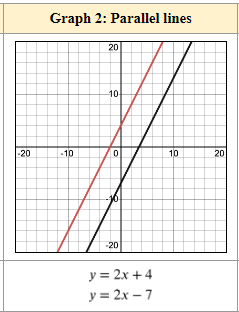
Number of Solutions: _______
Points(s) that are solutions: _______
2
Number of Solutions: _______
Points that are solutions: _______
1

How could you identify that a system has no solutions, based on the equations in that system?

1

How could you identify if a system has infinite solutions algebraically?

1

Could there be a system of linear equations with exactly two solutions? Why or why not?

2
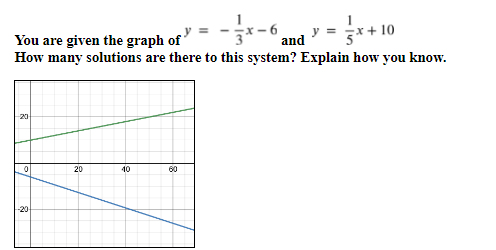
  1. Given the graph of y=3x-9 and y=-1/2x+12
  2. Identify the number of solutions_______
  3. If possible, find one solution to the system. If there are no solutions, justify how you know. _______
2
Solutions: _______
How do you know?_______
2


Solutions: _______
How do you know? _______
Application Problems: Level 1 Desmos #2
Application Problems: Level 2
Part I: Writing Equations
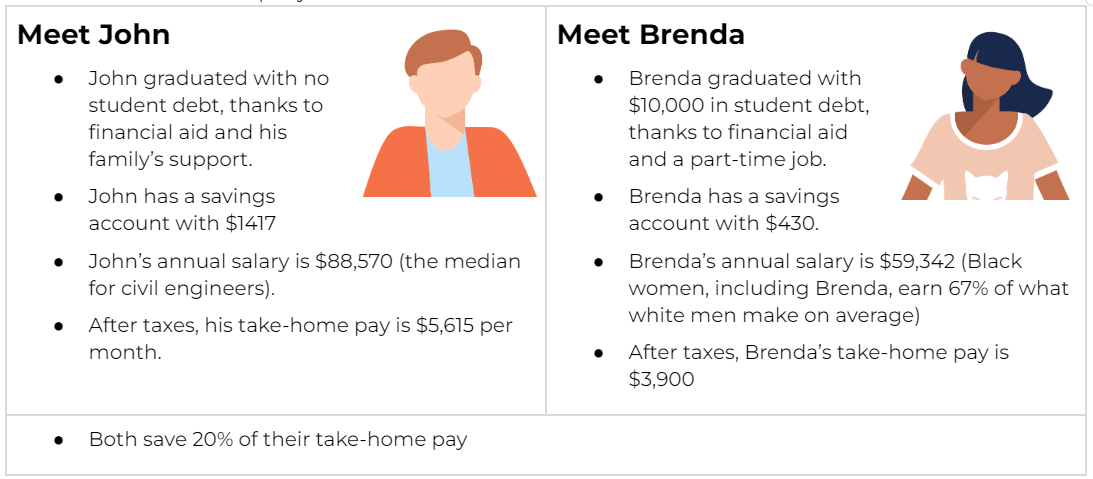
John and Brenda both recently graduated from Hightower University and started jobs as civil engineers at BuildIt Construction company.
1
Calculate how much John saves each month._______
1

Write an equation that represents John’s savings account balance, y, after x months.

1
Calculate how much Brenda saves each month._______
1

Write an equation that represents Brenda’s savings account balance, y, after x months.

1

Your friend Brian looks at this problem and says “You don’t have to bother graphing this, there’s no solution. John and Brenda both save 20% of their income each month, which means their lines will have the same slope. If you graph them, they’ll be parallel.” Is Brian correct? Why or why not?

Part II: Graphing
  1. Complete the first two equations in the Desmos interactive using your equations from part 1. Do not close this page, you will continue using the graph to answer the following questions.
3
Both Brenda and John have worked at BuildIt for one year. Answer the following questions by either using the Desmos graph or your equations from Questions 3 and 5.
a. How much money does John have in his savings account after one year?_______
b. How much more money does John have saved than Brenda after one year?_______
c. One way to measure the wage gap is to consider how many additional months one person has to work to have the same total earnings, or in this case savings, as another. During which month will Brenda surpass John’s 1-year savings total?_______
3
John and Brenda both want to have $25,000 saved, so they can be ready to pay for a down payment on a house.
a. After how many months will John have met his goal? _______
b. After how many months will Brenda have met her savings goal?_______
c. How can you use the graph to find those points?_______
2
Brenda is considering increasing how much she saves each month, so she can meet her goal sooner.
a. How much would she need to save each month to reach $25,000 at the same time as John?_______ Hint: You can use the Desmos graph from Question 7 to help answer this question.
b. How did you find the answer to part a? Describe your process or show your work._______
0

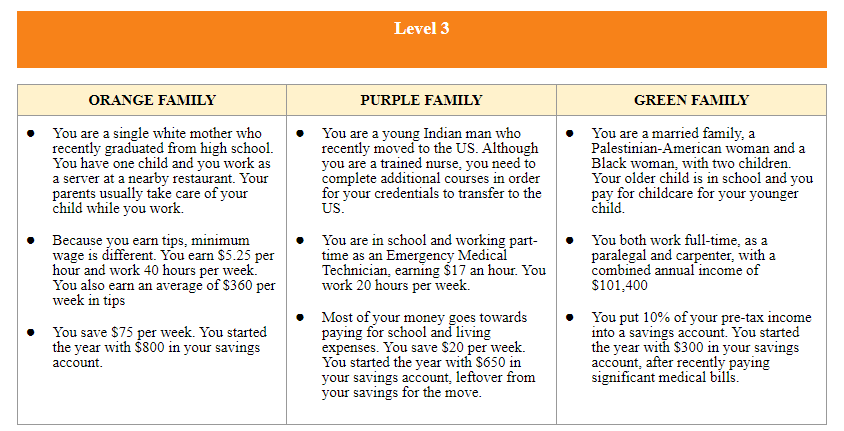
Fill in the table below from the information provided on the Left.

0

Read the graph below and note each initial balance on the graph.

0
Which family has the highest savings account balance after 3 weeks? _______ Approximately how much do they have?_______
0
After how many weeks do the Green family _______ and the Purple family _______ have the same amount in savings? Justify your response algebraically._______
0

Is there a point where all three families have the same amount in savings? Why or why not?

Part II: Building an Emergency Fund
  1. Using the Family Budget Calculator, search for your county or closest major city. For each family, input the number of adults and children to find out the monthly income they would need in order to attain a modest yet adequate standard of living. Then, complete the first row of the table in question #15.
0

Bonus Points: A common rule of thumb is to save up an emergency fund that could cover 3 months of living expenses. Complete the second row to show how much each family would need to save.

0

Bonus Points: How many weeks would each family need to save in order to build an emergency fund that covered 3 months of living expenses?

0

Bonus Points: Which family would take the longest to build up that emergency fund? How might they adjust their approach to savings?