Log in
Sign up for FREE
arrow_back
Library
#1. Describing Matter: Outcome A1
By Andrew Wilson
star
star
star
star
star
Share
share
Last updated about 1 year ago
8 questions
Add this activity
zoom_in
1
1.1f
For questions 2-5, determine whether each description applies to solids, liquids, or gases...
1
1.1f
1
1.1f
1
1.1f
1
1.1f
zoom_in
1
1.1f
2
1.1e
2
1.1e
Question 1
1.
Which option best summarizes the Particle Theory of Matter?
All matter is made of particles. Depending on the size of particles, matter may exist as a solid, liquid, or gas.
All matter is made of particles. Depending on how much energy the particles possess, matter may exist as solid, liquid, or gas.
All matter is made of particles. Depending on how attracted they are to one another, matter may exist as solid, liquid, or gas.
Question 2
2.
Particles move freely, and will continue moving away from one another until they are stopped by the walls of a container
solid
liquid
gas
Question 3
3.
When cooled, this state of matter turns to solid *
solid
liquid
gas
Question 4
4.
Particles are touching, but are still able to move past each other to take the shape of their container
solid
liquid
gas
Question 5
5.
Particles of this state possess the least energy *
solid
liquid
gas
Question 6
6.
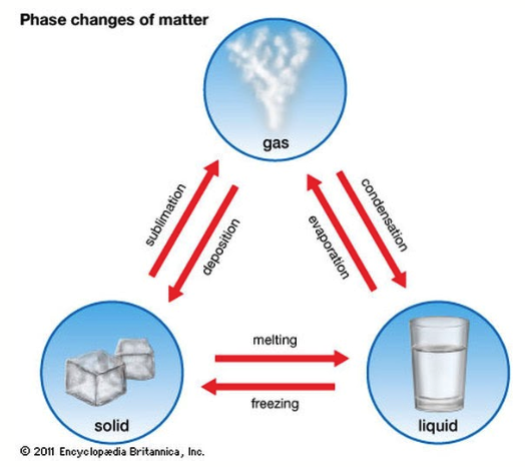
In the diagram, which phase changes involve the greatest amount of energy?
sublimation & deposition
melting & freezing
condensation & evaporation
Question 7
7.
Which of the options are examples of physical properties? Check all that apply. (Wrong answers will be subtracted)
shape
blue colour
flammable
conductivity
acidity
mass
reacts with water
Toxicity
Question 8
8.
Which of the options are examples of chemical properties? Check all that apply. (Wrong answers will be subtracted)
shape
blue colour
flammable
conductivity
acidity
mass
reacts with water
Toxicity