Log in
Sign up for FREE
arrow_back
Library

"The People" Keystone Practice Set

star
star
star
star
star
Last updated 4 months ago
9 questions
Required
1
L.F.1.2.3
Required
1
L.F.2.5.1
Required
1
L.F.2.5.1
Required
1
L.F.1.1.3
Required
1
L.F.2.5.3
Required
1
L.F.2.1.1
Required
1
L.F.2.1.2
Required
1
L.F.2.3.1
Required
1
L.F.1.3.1
Read the entire passage below and answer the following questions.
Question 1
1.

Question 2
2.

Question 3
3.

Question 4
4.

Question 5
5.

Question 6
6.

Question 7
7.

Question 8
8.

Question 9
9.

Read the line from the drama.

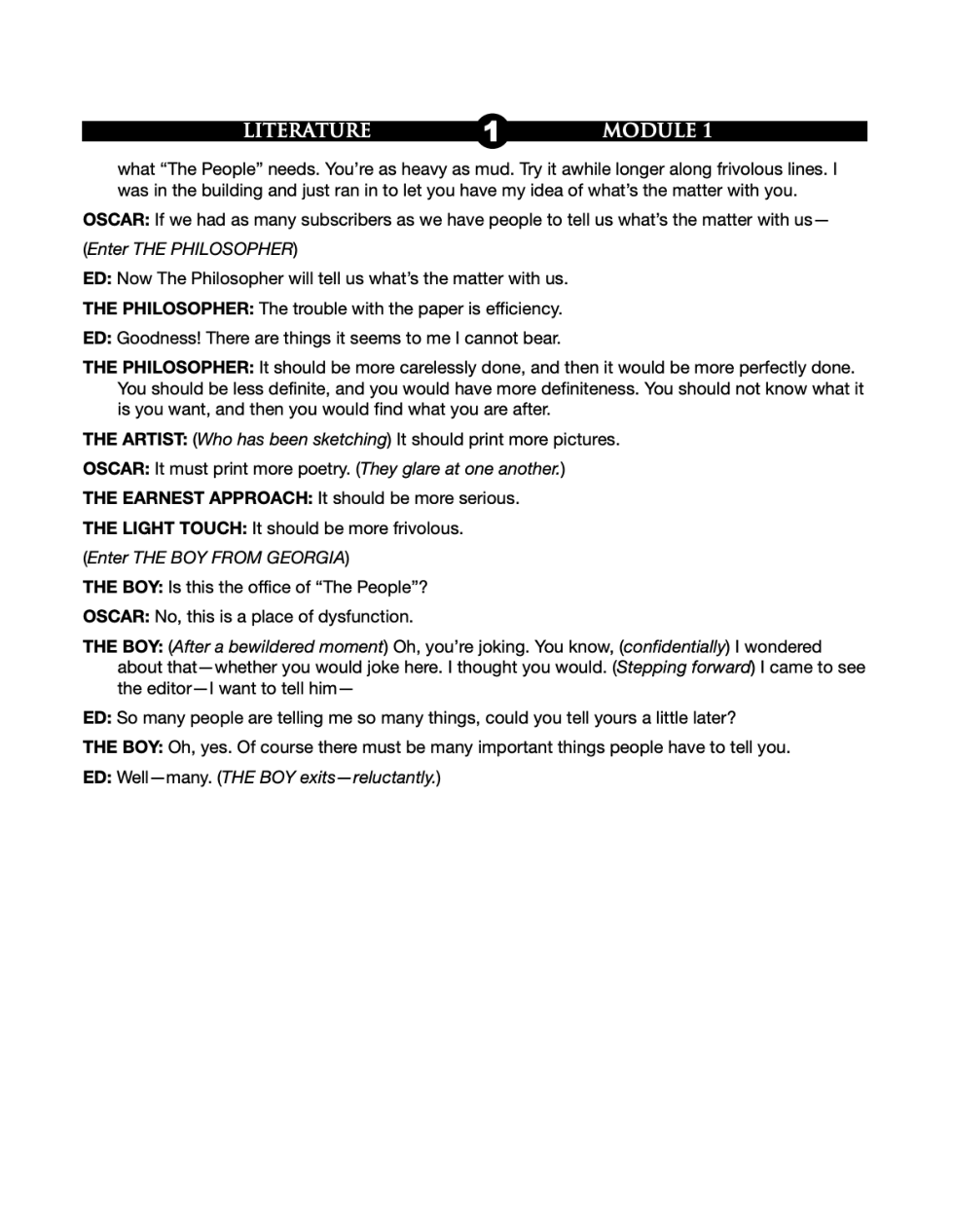
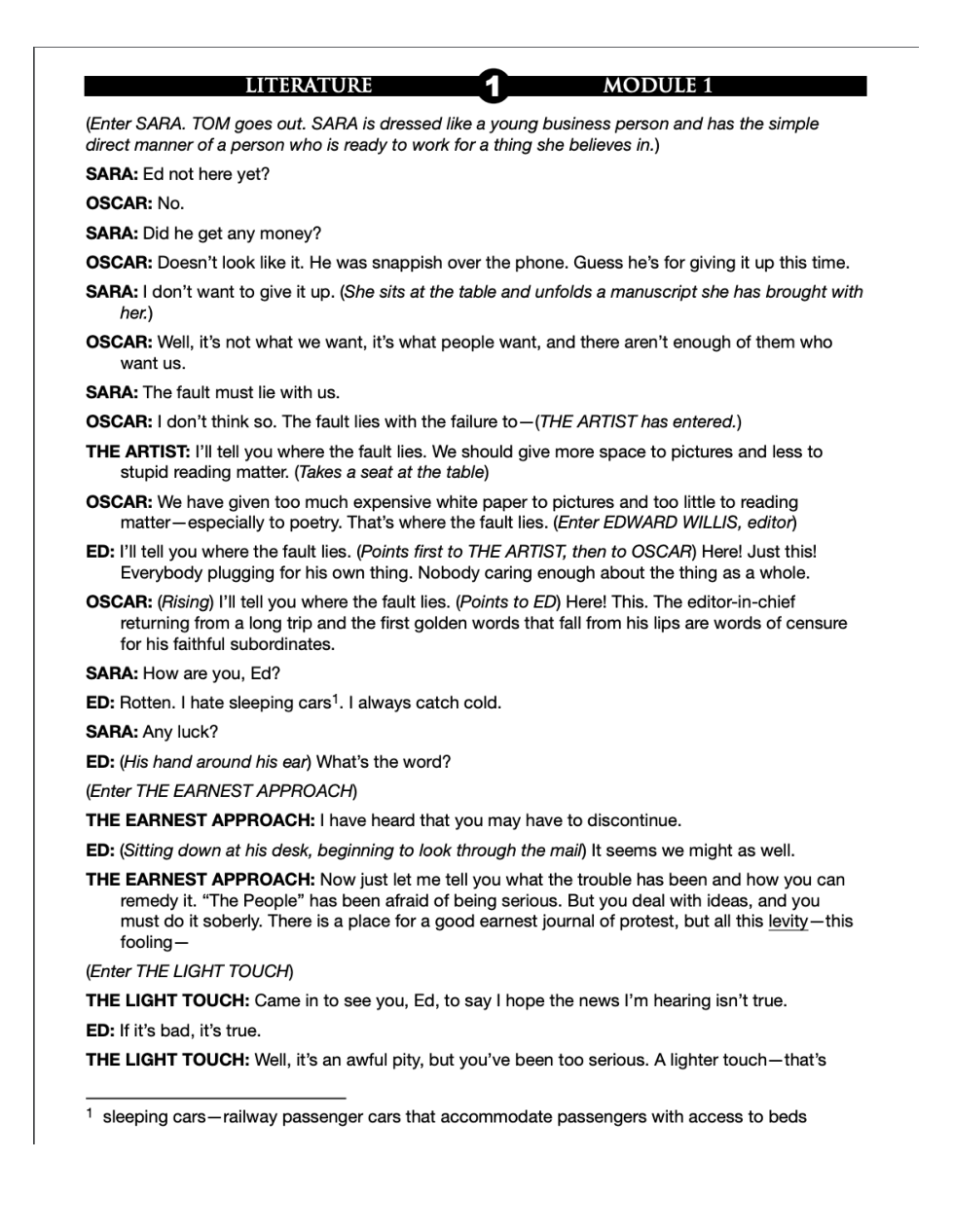
“THE EARNEST APPROACH: ... But you deal with ideas, and you must do it soberly. There is a place for a good earnest journal of protest, but all this levity—this fooling—”

What does the word levity mean?
overload of work
unnecessary worry
uncomfortable silence
lack of seriousness
Read the line from the drama.

“OSCAR: (Rising) I’ll tell you where the fault lies. (Points to ED) Here! This. The editor-in-chief returning from a long trip and the first golden words that fall from his lips are words of censure for his faithful subordinates.”

Which sentence best explains the effect of the figurative language?
It conveys Oscar's resistant attitude with sarcasm.
It represents Oscar's questioning tone with imagery.
It displays Oscar's respect for the work Ed has done.
It symbolizes Oscar's belief that the publication will continue.
Read the line from the drama.

“THE LIGHT TOUCH: ... A lighter touch—that’s what ‘The People’ needs. You’re as heavy as mud.”

What is meant by the simile “heavy as mud”?
Business for "The People" is doing poorly.
"The People" is too serious of a publication.
"The People" has too strict of an editor.
Customers of "The People" are unhappy.
Read the line from the drama.

“THE PHILOSOPHER: It should be more carelessly done, and then it would be more perfectly done. You should be less definite, and you would have more definiteness. You should not know what it is you want, and then you would find what you are after.”

How does the author’s use of paradox communicate an idea?
It creates suspense about what the characters will do.
It emphasizes the uncertainty related to the problem.
It hints at how the problem will be resolved.
It adds an anxious mood to the plot.
Read the line from the drama.

“THE BOY: (After a bewildered moment) Oh, you’re joking. You know, (confidentially) I wondered about that—whether you would joke here. I thought you would.”

Which idea is emphasized by the stage directions for The Boy?
The Boy is young in age.
There is confusion surrounding "The People."
The Boy has important news to tell the editor.
The office of "The People" is a lighthearted place.
Which inference is most supported by the drama?
The future of "The People" will be successful.
The workers at "The People" enjoy spending time together.
"The People" has struggled as a business for awhile.
"The People" frequently holds cooperative meetings.
Which line from the drama best supports the generalization that some people see their cause as more important than other causes?
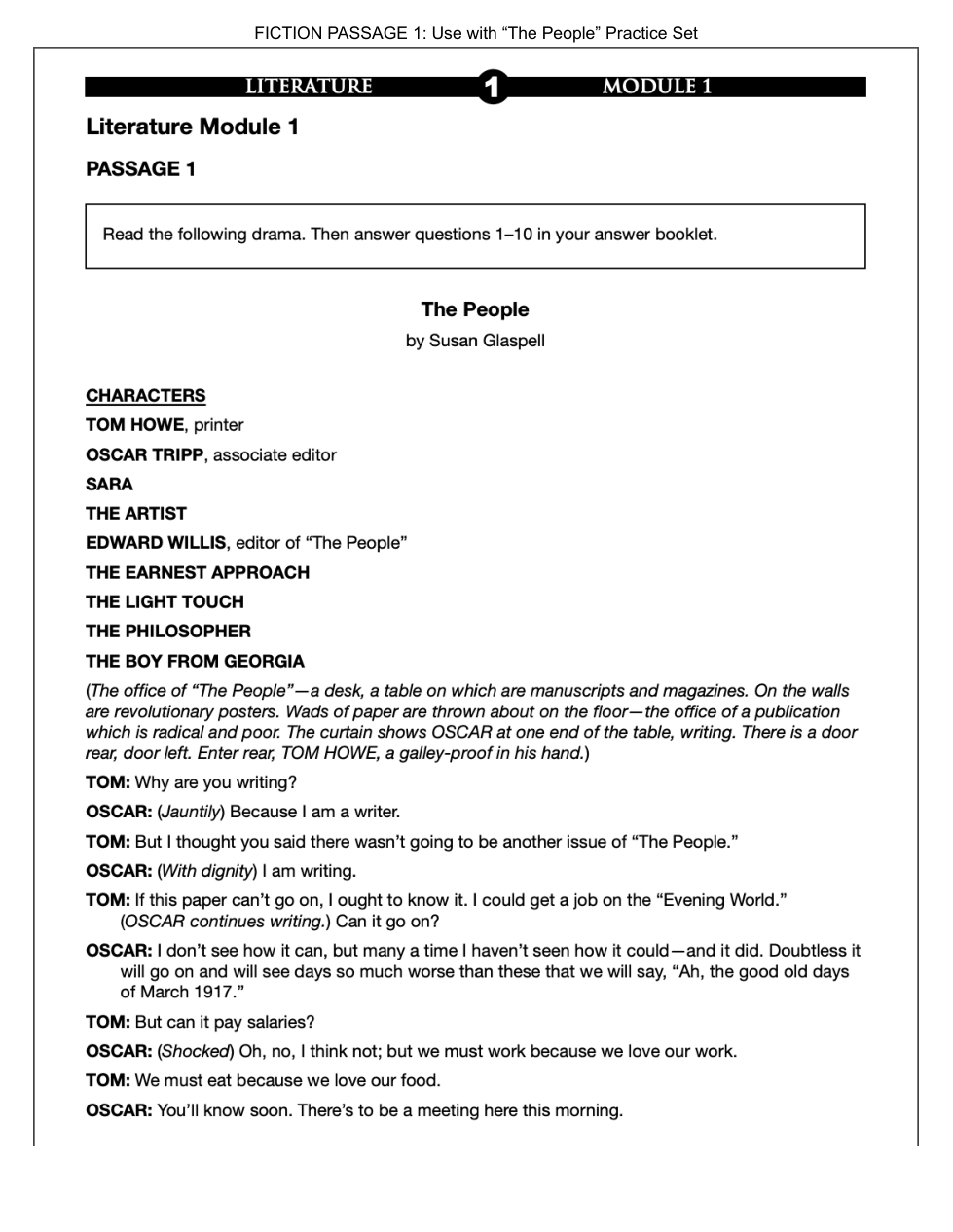
“OSCAR: You’ll know soon. There’s to be a meeting here this morning.”
“SARA: I don’t want to give it up. (She sits at the table and unfolds a manuscript she has brought with her.)”
“THE ARTIST: I’ll tell you where the fault lies. We should give more space to pictures and less to stupid reading matter. (Takes a seat at the table)”
“THE EARNEST APPROACH: I have heard that you may have to discontinue.”
How does Tom’s view of “The People” differ from Oscar’s view?
Tom believes the publication must earn money, while Oscar believes its content must evolve.
Tom enjoys his job at the publication, while Oscar is discouraged about his job.
Tom wants the publication to take a more artistic approach, while Oscar wants it to focus more on the reporting of facts.
Tom thinks the publication will survive through difficult times, while Oscar doubts it will continue.
Which line from the drama best represents the main idea?
“SARA: Did he get any money?”
“OSCAR: Well, it’s not what we want, it’s what people want, and there aren’t enough of them who want us.”
“OSCAR: We have given too much expensive white paper to pictures and too little to reading matter—especially to poetry. That’s where the fault lies. (Enter EDWARD WILLIS, editor)”
“ED: I’ll tell you where the fault lies. (Points first to THE ARTIST, then to OSCAR) Here! Just this! Everybody plugging for his own thing. Nobody caring enough about the thing as a whole.”