3.4 Manipulating Equations

Last updated 10 months ago
31 questions
Note from the author:
OBJECTIVES & STANDARDS
Math Objectives
  • Solve literal equations for a given variable
  • Convert linear equations from standard form to slope-intercept form
Common Core Math Standards
  • Link to all CCSS Math
  • CCSS.PRACTICE.MP2
  • CCSS.HSA.SSE.B.3
  • CCSS.HSF.BF.A.1
Personal Finance Objectives
  • Explore simple interest and savings accounts
National Standards for Personal Financial Education
Saving
  • 2a: Select a preferred location for a savings account based on comparison of interest rates and fees at different types of financial institutions
DISTRIBUTION & PLANNING
Distribute to students
  • Student Activity Packet
  • Application Problems
OBJECTIVES & STANDARDS
Math Objectives
  • Solve literal equations for a given variable
  • Convert linear equations from standard form to slope-intercept form
Common Core Math Standards
  • Link to all CCSS Math
  • CCSS.PRACTICE.MP2
  • CCSS.HSA.SSE.B.3
  • CCSS.HSF.BF.A.1
Personal Finance Objectives
  • Explore simple interest and savings accounts
National Standards for Personal Financial Education
Saving
  • 2a: Select a preferred location for a savings account based on comparison of interest rates and fees at different types of financial institutions
DISTRIBUTION & PLANNING
Distribute to students
  • Student Activity Packet
  • Application Problems
Intro - Warm-Up
CALCULATE: Solving equations
Solve each of the following equations for x.
SHOW YOUR WORK FOR FULL CREDIT
1
-2x + 11 = 15
x=_______
1
6x + 4 = -3x - 5
x=_______
1
½(3x - 1) = 7
x=_______
1
4x+2x-5(x-3)=18
x=_______
Learn It
Solving Literal Equations
Let’s solve some more equations, except this time, we’re going to write down what steps we’re doing and why we’re doing them.
  • In the “Equation” column, write the equation solving steps.
  • In the “Description and Reason” column, write a short word description of what you did and why you did it. For example, “I subtracted by 5 on both sides of the equation to get the 2x by itself.” *Use the Properties of Equality*
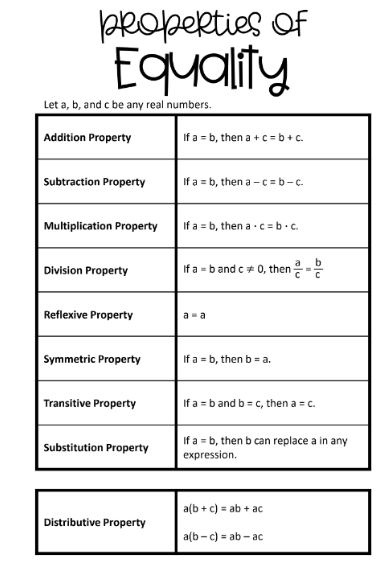
4
Solve the Equation for x:
Equation Reason
1. 4x+5=25 1. Given
2. 4x=_______ 2. _______ Prop. of =
3. x=_______ 3. _______ Prop of =
4
Solve the equation for b:
Equation Reason
1. ab+c=d 1. Given
2. ab=_______ 2. _______ Prop. of =
3. _______ 3. _______ Prop of =
Notice how the steps for these two problems are identical! The only difference is that when numbers are included, you can simplify as you go and when there are only variables, you can’t. These equations that contain mostly variables are called literal equations.
Notice how the steps for these two problems are identical!  The only difference is that when numbers are included, you can simplify as you go and when there are only variables, you can’t.  These equations that contain mostly variables are called literal equations.

Here are some basic steps you can follow to solve any equation for a given variable.
  1. Review the completed example problem, using the video walkthrough.
1
Find and Combine:
Find the term with your variable. Combine like terms if necessary.
Solve for y:

zx+by=r

2
Isolate the term:
Add or subtract all other terms to isolate the term containing your variable.
zx - zx + by = r - zx
by = r - zx

3
Isolate the variable:
Multiply or divide away anything that is connected to your variable. Be sure to apply your operation to ALL terms on both sides


4
Check your Answer:
Your variable should be the only term on that side of the equation

1

Solve for d:


1

Solve for y


1

Solve for k


1

Solve for y


1

Solve for x


1

Solve for r
*type pi and it will change to the symbol for pi

1

Solve for w


1

Solve for y


1

Solve for y


Application Problems
Simple Interest
Interest is the amount of money that someone is paid for allowing someone else to borrow their money.  If you take out a loan on a car, you may have to pay interest to borrow the money you need to make the car purchase.  Similarly, if you put money into a savings account, you can EARN interest.
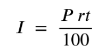
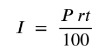
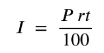
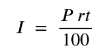
There are many different ways of calculating interest.  We are going to be focusing on simple interest, where only your initial deposit earns interest.  Simple interest is calculated using the following formula:

Where
  • I = Total Interest
  • P = Principal (the amount that is being borrowed or deposited)
  • r = the annual interest rate as a percent (APR)
  • t = the number of years
1

Solve for P:

1

Solve for r:

1

Solve for t:

Part II
Use the most appropriate equation from part 1 to answer each of the following questions.  Since we’re dealing with money, round all answers to the nearest hundredth.
1
What was the principal balance if you earned $240 in interest at 4.5% over 3 years?_______
1
How many years did you accrue interest if you received $110 in interest on a $12,000 principal balance at 3.25%?_______
1
What was the interest rate (as a percentage) if you accrued $97 in interest on a $8000 principal balance over 5 years?_______ %
Level 2
Savings Account Interest
You invest a total of $12,000 in two savings accounts paying 0.61% and 0.70% simple annual interest. If the yearly interest is $75, how much of the $12,000 did you deposit into each account?
Review:  To convert a percent into a decimal, move the decimal point two places to the left.  For example, 3% becomes 0.03.
4
Write a system of equations that represents this situation.
a. Focus on the question at the end of the situation. What is unknown?  Define variables to represent these unknowns.
x=_______ y=_______
b. What are the TWO situations that are being described in the problem?  Write an equation that represents each situation._______ _______
1
Where do these lines intersect? Enter both equations from Part 1 into the Desmos Graphing Calculator and write down the intersection point.  You may need to zoom out to find the intersection._______
1

Part II: Reflection
What does this intersection point represent in the context of the original problem?

1

Do you think that investing your money into these accounts was worth it?  Why or why not?

1

What else could you have done with your money instead of keeping it in a savings account?

Calculate the interest rates
You deposit $10000 into a standard simple interest savings account.  You deposit $12000 into a higher yield account whose interest rate is triple the basic account.  In one year, you make $460 in interest.  What were the interest rates for each account?
Part I
  1. Write a system of equations that represents this situation where x represents the standard savings account and y represents the high yield savings account.
  • Focus on the question at the end of the situation. What is unknown about the situation?  Define variables to represent these unknowns.
  • What are the TWO situations that are being described in the problem?  Write an equation that represents each.

1
Enter both equations from Part 1 into the Desmos Graphing Calculator and write down the intersection point.  You may need to zoom in to see the intersection._______
1

What does this intersection point represent in the context of the original problem?

6
Part II: Reflect
Look up the interest rates for standard and high yield savings accounts online.  List 3 results for each here:
Standard Savings Account: _______ _______ _______
High Yield Savings Account: _______ _______ _______
1

Were the interest rates that you calculated in this word problem higher or lower than what they currently are in the real world?

1

Do you think savings accounts are a good way to earn money on your deposits? Why or why not?