3.6 Strategies to Save
star
star
star
star
star
Last updated 10 months ago
27 questions
Note from the author:
OBJECTIVES & STANDARDS
Math Objectives
- Write a linear equation in slope-intercept form from a word problem
- Solve a linear equation from a word problem
Common Core Math Standards
- Link to all CCSS Math
- CCSS.PRACTICE.MP4
- CCSS.HSF.BF.A.1
- CCSS.7.RP.A.3
Personal Finance Objectives
- Learn the advantages of pay yourself first, the 50/30/20 Rule, and other strategies to help meet savings goals
- Realize that saving can be difficult when income is too small to cover necessities
National Standards for Personal Financial Education
Saving
- 9d: Explain how the saving strategy “pay yourself first” can help people achieve their saving goals
DISTRIBUTION & PLANNING
Distribute to students
- Student Activity Packet
OBJECTIVES & STANDARDS
Math Objectives
- Write a linear equation in slope-intercept form from a word problem
- Solve a linear equation from a word problem
Common Core Math Standards
- Link to all CCSS Math
- CCSS.PRACTICE.MP4
- CCSS.HSF.BF.A.1
- CCSS.7.RP.A.3
Personal Finance Objectives
- Learn the advantages of pay yourself first, the 50/30/20 Rule, and other strategies to help meet savings goals
- Realize that saving can be difficult when income is too small to cover necessities
National Standards for Personal Financial Education
Saving
- 9d: Explain how the saving strategy “pay yourself first” can help people achieve their saving goals
DISTRIBUTION & PLANNING
Distribute to students
- Student Activity Packet
Intro-Warm-Up
CALCULATE: Savings Goals
Let’s say you set a savings goal of $50 per month.
1
How much will you have saved at the end of 4 months? $_______
1
How much will you have at the end of 2 years?$_______
1
You dream of owning a PS5, multiple controllers, a small collection of games, and a few other accessories. When you put it all in your online cart, the bill comes to $1225. How long will it take you to save enough to afford the whole purchase?_______ months
1
If, instead, you had the target of buying the gaming bundle in 7 months, how much would you need to save per month instead to meet your goal?_______ a month
Learn It
EDPUZZLE: Pay Yourself First
In the intro, we assumed you’d be able to save $50/month. But what strategies can you use to actually save that money? First and foremost, you should consider “paying yourself first.” Watch this video to learn more about the benefits of making your savings automatic. Then, answer the questions either in EdPuzzle or below.
1
Which strategy will help you save the most money?
A. Wait until the end of the month and any money that you have not spent, add it to your savings account.
B. On the last day of each month, deposit a fixed $10 to your savings account.
C. As soon as you receive your paycheck, put a fixed amount or percentage of your money directly into your savings.
D. Only deposit into your savings account when you have a large lump sum of money.
Which strategy will help you save the most money?
A. Wait until the end of the month and any money that you have not spent, add it to your savings account.
B. On the last day of each month, deposit a fixed $10 to your savings account.
C. As soon as you receive your paycheck, put a fixed amount or percentage of your money directly into your savings.
D. Only deposit into your savings account when you have a large lump sum of money.
1
What is the benefit of automating your savings account contributions?- You can change the amount you deposit each month.
- The fees are relatively small to enroll in this service.
- Your money will be transferred automatically and guarantees you will be contributing to your savings.
- Your employer will contribute additional money to your savings account if you enroll in this service.
What is the benefit of automating your savings account contributions?
- You can change the amount you deposit each month.
- The fees are relatively small to enroll in this service.
- Your money will be transferred automatically and guarantees you will be contributing to your savings.
- Your employer will contribute additional money to your savings account if you enroll in this service.
1
What does it mean to "pay yourself first"?- Deposit money into your savings account before spending on anything else.
- Purchase an item you want before something you need.
- Pay all of your mandatory expenses before paying for optional expenses.
- Obtain an additional job to supplement your income.
What does it mean to "pay yourself first"?
- Deposit money into your savings account before spending on anything else.
- Purchase an item you want before something you need.
- Pay all of your mandatory expenses before paying for optional expenses.
- Obtain an additional job to supplement your income.
GRAPH: The 50/30/20 Budget Rule
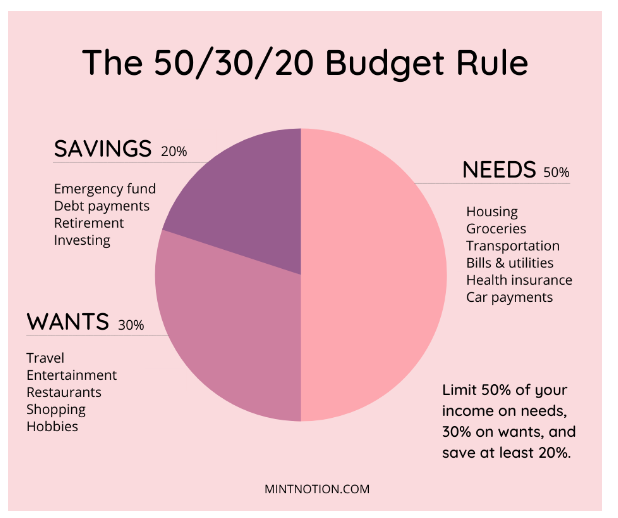
Another strategy that helps quantify and encourage savings is the 50/30/20 method for budgeting, where 20% should go to saving and debt repayment.
1
First, picture yourself as a 25-year-old, living your best life. What types of items would future-you put in each of these three categories for the 50/30/20 Rule?
Now, use this pie chart as a reference to answer the questions:
3
If my after-tax income is $2000/month, how much would I put into each category?
Needs (50%)=_______
Wants(30%)=_______
Savings(20%)=_______
6
- Which budget category would each of these items fall into: (copy and paste from one of these three choices: Wants Needs or Savings)
- Wireless headphones:_______
- Minimum monthly payment on student loan debt:_______
- Electric bill:_______
- Gym membership:_______
- Extra payment toward credit card bill to pay it off faster:_______
- Concert tickets with friends:_______
1
The average household in the US takes home $4,362 per month. Assume that the household follows the 50/30/20 rule, then splits their savings portion equally towards paying down student debt and saving for a house. How much would go toward saving for a house?_______
1
How long will it take them to save $30,000 for a home down payment?_______ months
INTERACTIVE: Income + Financial Stability in America
50% toward needs, 30% toward wants, 20% toward saving and debt repayment. That sounds easy, right? Anyone can pull that off, right? Here are a few examples of hypothetical but realistic families that would struggle with this strategy. Scroll through the interactive, reading as you go along, and then select one pathway in the “Take a look at a typical American” section and learn “How does this add up?”
1
Which household did you choose?
1
Review the section titled “How does this add up?”. What is the pain point for this household?_______
1
What would you recommend for a household that cannot make this 50/30/20 method work?
ACTIVITY: How to Save Money: 22 Proven Ways
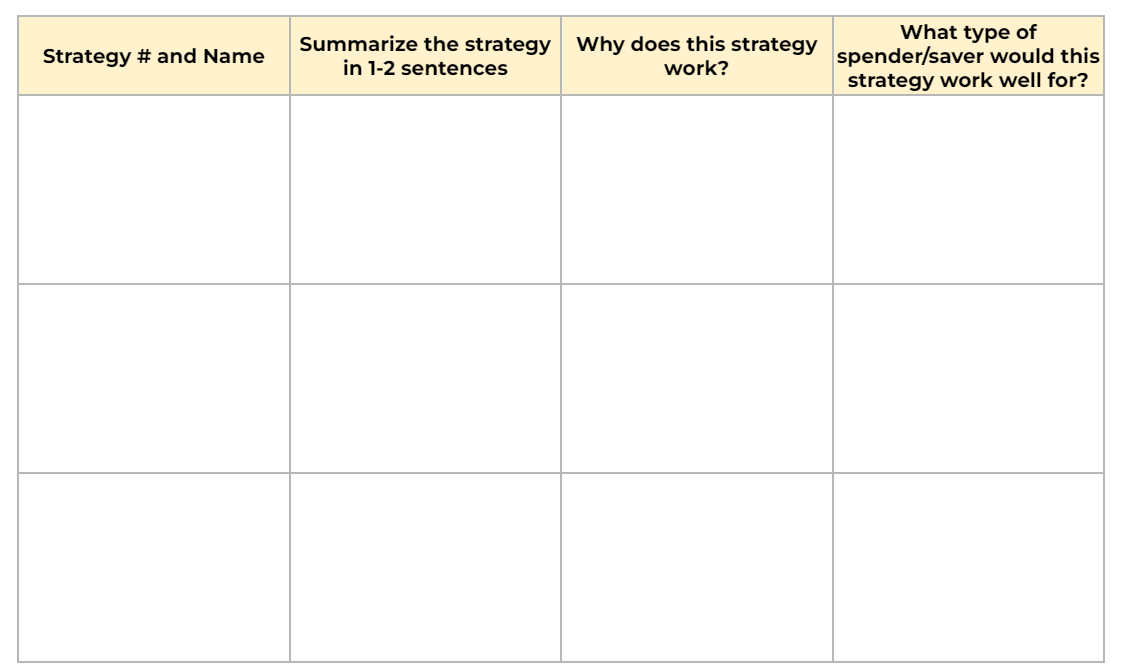
In order to reach your savings goals, you need an achievable target and a plan for how to get there. 22 strategies are far too many for anyone to keep track of, so open this article and use the QUICK LINKS at the top to investigate THREE strategies from the list. Your teacher may have you work individually or in a group to complete the table below.
4
Strategy:_______
Summarize the strategy in 1-2 sentences_______
Why does this strategy work?_______
What type of spender/saver would this strategy work well for?_______
4
Strategy:_______
Summarize the strategy in 1-2 sentences_______
Why does this strategy work?_______
What type of spender/saver would this strategy work well for?_______
4
Strategy:_______
Summarize the strategy in 1-2 sentences_______
Why does this strategy work?_______
What type of spender/saver would this strategy work well for?_______
1
Which of the three strategies you just researched do you think would work best for you, personally? Explain why.
Math Connection: Writing and Solving Linear Equations
For each scenario, write a linear equation to model what’s happening, and then solve the equation to answer the question.
2
Melody has $50 in her savings account right now. She wants to save $250 for a Taylor Swift concert ticket. She figures she can save $20/week from her part-time job.
- Write an equation to model her savings account balance after x weeks._______
b. How long will it take to be able to afford the ticket?_______weeks
2
After a really rough winter, Kristoff can’t afford to fix his sled until he has $7000 saved. Every month, his take-home pay is $2500, and he uses the 50/30/20 rule to determine how much he’ll spend and save.
A. Write an equation to model Kristof’s savings after x months._______
b. How long will it be before he can get his sled fixed if he’s already got $900 in the bank?_______months
2
Raven is starting with absolutely no savings, but she wants to have an emergency fund of $10,000 saved by the end of her first year at her new job.
- How much will she need to save per month in order to meet this savings goal?_______ Per Month
- What would Raven’s take-home pay need to be in order for that monthly savings target to represent 20% of her pay?_______ Year
4
Fill-in-the blanks to write a word problem for your own personal savings goal.
Right now I have _______ already saved. This money is located in _______. I would like to have a total of _______ in order to_______ __________________________________________________.
4
Select one of these two statements to complete:
- I can save_______ per month, which means it will take me_______ to reach my goal.
- I would like to reach my goal in_______ months, so I’ll need to save _______ per month.
1
What do “paying yourself first” and “automating your savings” have in common?- They both require you to use online or mobile banking
- They both focus on making sure you can afford necessities like housing and transportation
- They both prioritize saving money before you have the opportunity to spend your entire paycheck
- They both require you to make a middle class income before you become eligible to use them as your saving strategy
What do “paying yourself first” and “automating your savings” have in common?
- They both require you to use online or mobile banking
- They both focus on making sure you can afford necessities like housing and transportation
- They both prioritize saving money before you have the opportunity to spend your entire paycheck
- They both require you to make a middle class income before you become eligible to use them as your saving strategy
1
The 50/30/20 Rule suggests that you budget your money into___- 50% savings, 30% needs, 20% wants
- 50% needs, 30% wants, 20% savings
- 50% needs, 30% debt repayment, 20% savings
- 50% wants, 30% savings, 20% needs
The 50/30/20 Rule suggests that you budget your money into___
- 50% savings, 30% needs, 20% wants
- 50% needs, 30% wants, 20% savings
- 50% needs, 30% debt repayment, 20% savings
- 50% wants, 30% savings, 20% needs
1
Most savings strategies focus on these two actions:- Spend less money and make saving a higher priority in your budget
- Spend less money and change where you do your banking
- Earn more income and donate more to charity
- Keep a tight budget and eliminate fun temporarily
Most savings strategies focus on these two actions:
- Spend less money and make saving a higher priority in your budget
- Spend less money and change where you do your banking
- Earn more income and donate more to charity
- Keep a tight budget and eliminate fun temporarily