s2w3 Elastic and Inelastic collisions

Last updated 3 months ago
32 questions
1

Review: A fireman is holding a hose in front of a burning building. When the water is turned on, the fireman moves backwards. Explain why.

1

Review: If you have ever fired a gun, you will have experienced recoil. explain recoil in terms of momentum or impulse.

1

Review: If you have ever played baseball, you have been taught to move your glove with the motion of the ball to catch it, and not to keep your glove rigid and unmoving. Explain why in terms of momentum or impulse.

1
In any collison the __________ is always constant
1
When the two colliding objects stick together after the collision, then the collision is ___________________ . If the colliding objects do not stick together, but some of the kinetic energy is lost, then the collision is considered ____________ . If ALL the kinetic energy could be conserved, then the collision would be considered _________________ , but that would defy the _________________________________
Other Answer Choices:
100% elastic
elastic
100% inelastic
Second law of thermodynamics
1

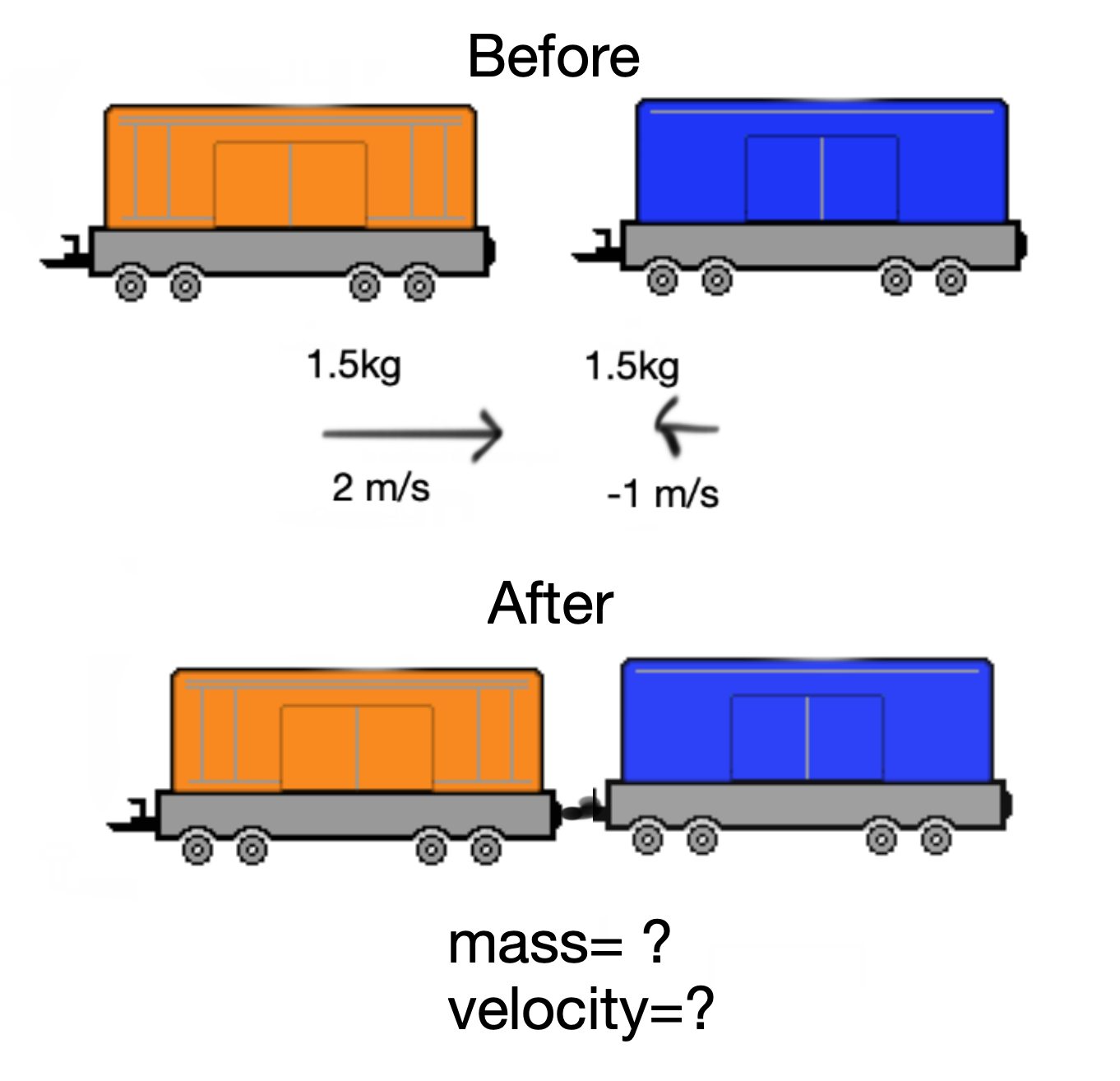
In a physics experiment, two carts of mass 1.5 kg each are rolled towards each other.  The orange cart has a velocity of 2 m/s and the blue cart has a velocity of -1m/s.  The carts stick together when they collide.
What type of collision is this?

1

using p=mv --> What is the initial momentum of the orange cart?

1

What is the initial momentum of the blue cart?

1

What is the total inital momentum of the system?

1

What is the total final momentum of the system?

1

A 9300 kg railroad car A traveling at a velocity of 5 m/s strikes a second railroad car B that weighs 5000 kg at rest. After the collision railroad car A stops moving while railroad car B begins moving in the same direction as the collision.
What is the initial momentum of the system?

1

A 9300 kg railroad car A traveling at a velocity of 5 m/s strikes a second railroad car B that weighs 5000 kg at rest. After the collision railroad car A stops moving while railroad car B begins moving in the same direction as the collision.
At what speed will railroad car B move at?

1

What do you notice about the speeds of the two railroad cars in the above problem? Why do you think this happens?

1

Two skaters begin at rest. Skater 1 has a smaller mass than Skater 2. After they push off each other,...

1

use
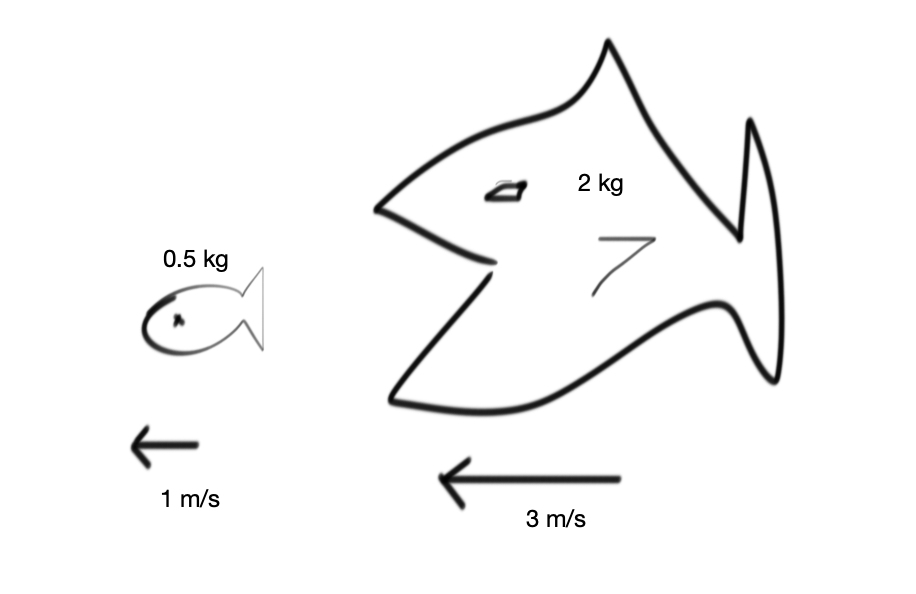
to find the kinetic energy of the big fish.

1

Use the same equation above to find the kinetic energy to the small fish.

1

use p=mv to find the momentum of the large fish.

1

use p=mv to find the momentum of the small fish.

1

large fish eats small fish. explain how you know this is an inelastic collision.

1

What is the total momentum of the fishes before the big fish eats the little fish.

1

what is the total momentum of the fishes AFTER the big fish eats the little fish?

1

what is the total mass of the big fish after it eats the little fish whole?

1

assuming there is no swimming or friction, etc, what is velocity of the big fish after eating the small fish.

1

If the small fish was swimming in the opposite direction, would the change in speed of the big fish be larger or smaller? Why?

1

Just a quick note here - if you can draw a straight line from the center of mass (the hole in the center) of one disk to the other, and the moving disk travelled along this line, then this would be a 1d problem. Is the yellow disk travelling along that line?

1

When Bo notes the mass of the yellow, mass of the red and the initial velocity, what section of our GUESS system is he doing?

1

Ahhh!! the math!!! it burns!! Look at this picture - I deconstructed the velocity of the yellow disk. if you multiply the legs of the triangle by the mass of the yellow disk, you have the total momentum of the yellow disk after the collision. Do this, and calculate the initial momentum (entirely in the x direction) of the yellow disk

1
The equations are ugly, see if this makes sense - There is no momentum in the y direction to start with, only the x. After the collision, one disk has some x momentum, the other disk has some x momentum. The x momentums added together afterwards are __________the initial momentum.
1

you can stop watching this now if you want

1

Play with this phet diagram (in 2d mode). Specifically, play with changing the mass, elasticity. What do you expect to happen when you set the elasticity to 100% and set the balls to run into each other?

1

Notice that the elasticity only goes down to 5%, play with the "inelastic" mode at the bottom. What is the main difference in the way the two modes work?

1

In the 1d mode, set a large ball and a small ball going the same direction with the same velocity towards a wall. Make sure the reflecting boarder is checked. Note what happens. Now go out and find a large ball and a small ball in your house. Basketball and bouncy ball work best. place one on top of the other, then drop them together. Does it work the same way as it did in the simulation?