Ɛhia
1.5
Which of the following are examples of the zeroth law of thermodynamics? Click all that apply.
Which of the following are examples of the zeroth law of thermodynamics? Click all that apply.
Ɛhia
2
Unit B: Energy Flow and Technological Systems.
STS Outcome 3: Apply the principles of energy conservation and thermodynamics to investigate, describe, and predict the efficiency of energy transformation in technological systems
- 3.1 Describe, qualitatively and in terms of thermodynamic laws, the energy transformations occurring in devices and systems
- 3.2 Describe how the first and second laws of thermodynamics have changed our understanding of energy conversions
- 3.4 Recognizes that there are limits to the amount of “useful” energy that can be derived from the conversion of potential energy to other forms in a technological device
- 3.6 Apply concepts related to the efficiency of thermal energy conversion to analyze the design of a thermal device
ICT Outcomes
- C6 Students will use technology to investigate and/or solve problems
4.4 generate new understandings of problematic situations by using some form of technology to facilitate the process
- C7 Students will use electronic research techniques to construct personal knowledge and meaning
4.2 analyze and synthesize information to determine patterns and links among ideas
- F4 Students will become discerning consumers of mass media and electronic information
4.2 evaluate the influence and results of digital manipulation on our perceptions
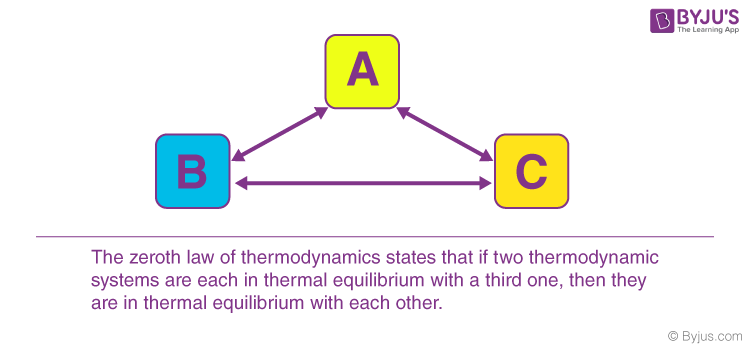
Key Point of the Zeroth Law:
there is an energy form called heat
heat has a tendency to spread through a system
temperature is a variable that measures the spread of heat
heat always flows from areas of HIGH concentration (high temperature) to areas of LOW concentration (low temperature).
Which of the following are examples of the zeroth law of thermodynamics? Click all that apply.
Key Points of the First Law:
energy can ONLY be transformed from one form to another
energy in the universe remains the same or constant
the formulation of the law of conservation
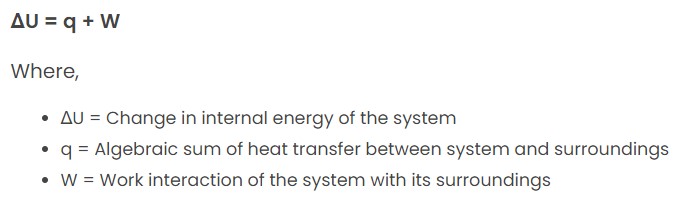
the equation for the First Law is
Energy cannot be created or destroyed.
Energy is created by the sun.
Match the type of energy the example.
Light Bulb | Moving an Object | Magnesium reacting with Water | Glycogen | Batteries | |
|---|---|---|---|---|---|
Thermal Energy | |||||
Radiant Energy | |||||
Kinetic Energy | |||||
Chemical Energy | |||||
Potential Energy |
Key Points for the Second Law:
as energy is transformed from one form to another, more and more is wasted
refers to the nature of energy
there is a natural tendency of any isolated system to degenerate into a more disordered state
describes the amount of useful work that can be done from a process that exchanges or transfers energy
Define entropy and the principles that describe entropy. Select all that apply.
Describe the second law of thermodynamics in a way you would teach it to a friend.
Key Points for the Third Law:
the entropy of a system approaches a constant value as the temperature approaches absolute zero
at zero temperature, the system must be in a state with the minimum thermal energy
mathematically, the absolute entropy of any system at zero temperature is the natural log of the number of ground states times Boltzmann's constant (kB)
For the entropy at absolute zero to be zero, the magnetic moments of a perfectly ordered crystal must themselves be perfectly ordered
No system can reach absolute zero.
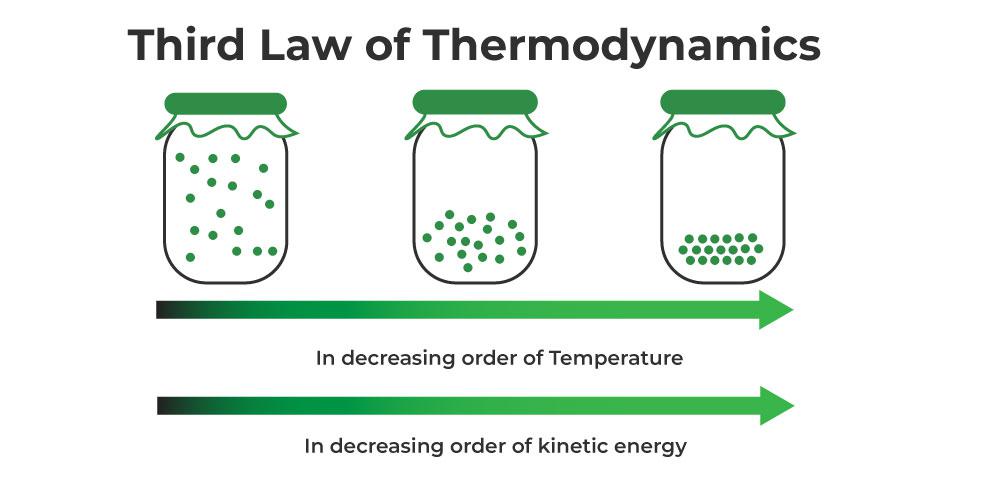
Plot the relationship between Temperature (X-Axis) and Kinetic Energy (Y-Axis)
Identify whether the statements are true or false for the term 'absolute zero'.
Ture | False | |
|---|---|---|
It is the lowest temperature possible. | ||
It is 0 degrees Celsius | ||
It is 0 degrees Kelvins | ||
It is the temperature at which there is no motion and no heat. |
Why can no system reach absolute zero? Identify 1 reason and justify your answer with an credible online source.
Define THERMAL EQUILIBRIUM