3.10 Specialized Savings Accounts
star
star
star
star
star
Last updated 10 months ago
31 questions
Note from the author:
OBJECTIVES & STANDARDS
Math Objectives
- Analyze real world data presented graphically
- Calculate percent change
- Compare the graphs of exponential and linear growth in a real-world context
Common Core Math Standards
- Link to all CCSS Math
- CCSS.PRACTICE.MP3
- CCSS.HSF.LE.A.1
- CCSS.HSF.LE.A.3
- CCSS.HSF.LE.B.5
- CCSS.7.RP.A.3
Personal Finance Objectives
- Learn the basics of how 529s, HSAs, and IRAs work
- Understand the growth potential and tax benefits of specialized investment accounts
- Analyze how compounding builds wealth over time
National Standards for Personal Financial Education
Saving
- 2b: Explain why an increase in the number of people who want to borrow money might result in banks paying higher rates on deposits
- 6a: Explain how traditional IRAs (individual retirement accounts), Roth IRAs, and education savings accounts provide incentives for people to save
- 6b: Compare the tax advantages of traditional and Roth IRAs
- 6c: Compare the tax advantages of different types of education savings accounts
DISTRIBUTION & PLANNING
Distribute to students
- Student Activity Packet
OBJECTIVES & STANDARDS
Math Objectives
- Analyze real world data presented graphically
- Calculate percent change
- Compare the graphs of exponential and linear growth in a real-world context
Common Core Math Standards
- Link to all CCSS Math
- CCSS.PRACTICE.MP3
- CCSS.HSF.LE.A.1
- CCSS.HSF.LE.A.3
- CCSS.HSF.LE.B.5
- CCSS.7.RP.A.3
Personal Finance Objectives
- Learn the basics of how 529s, HSAs, and IRAs work
- Understand the growth potential and tax benefits of specialized investment accounts
- Analyze how compounding builds wealth over time
National Standards for Personal Financial Education
Saving
- 2b: Explain why an increase in the number of people who want to borrow money might result in banks paying higher rates on deposits
- 6a: Explain how traditional IRAs (individual retirement accounts), Roth IRAs, and education savings accounts provide incentives for people to save
- 6b: Compare the tax advantages of traditional and Roth IRAs
- 6c: Compare the tax advantages of different types of education savings accounts
DISTRIBUTION & PLANNING
Distribute to students
- Student Activity Packet
Intro-Warm-Up
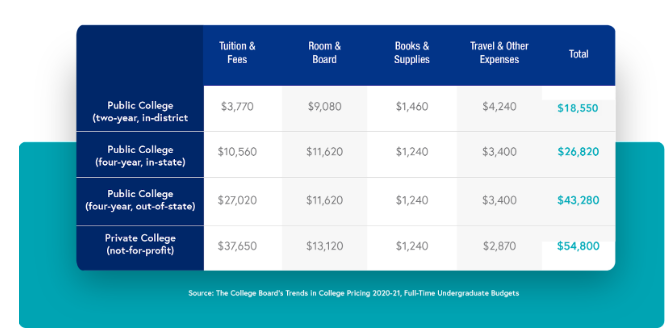
GRAPH: Average College Tuition & Costs 2020-2021
What happens when we want to save for something in the distant future like buying our first home or paying for college? Study the chart of annual college costs to answer the questions below.
1
Dan just had a baby, and he wants to start saving for her college education now. His goal is to have enough for 4 years of in-state public college costs saved by the time she’s 18. How much would Dan need to save PER MONTH starting today?$_______month
1
Dan feels good about this plan, but the baby’s grandma says, “Dan, this is never going to work!” Hypothesize some reasons that Grandma might be skeptical.

Learn It
VIDEO: What's the Difference Between Saving & Investing?
Have you ever heard someone say, “Back in my day, a gallon of milk only cost $1.25!” The fact that goods become more expensive over time has to do with inflation. Watch this video to learn more about how investing can help you “beat” inflation.
4
Savings | Investing | |
|---|---|---|
Auto-depositing $40 from each paycheck into an emergency fund | ||
Buying shares of stock in your favorite video game store | ||
Putting your tax refund into an account to pay for books next semester | ||
Giving your cousin $5000 for his new business in exchange for 2% of profits |
1
Think back to Dan in the Intro. Why might Grandma be concerned about inflation, specifically?
1
How does investing help you “beat” inflation in a way that savings cannot?
VIDEO: Investing Basics: The Power of Compounding Interest
In the last resource, you learned the difference between saving and investing, including how investing can help you outpace inflation. For long-term goals, investing is the key to growing your money through compounding returns. Watch this video to explore how compounding works and answer the questions.
1
How can compounding increase your investment’s growth?
1
Sketch a visual representation of how investments grow over time due to compounding.
1
Why is it beneficial to invest over a long period of time?
INFOGRAPHIC & GRAPH: 529 Plans
In the previous lesson, you learned about types of savings accounts and how to open one with a bank or credit union. But, with their super low interest rates, a savings account won’t keep pace with inflation. To invest for college many years in the future, you can use a special account called a 529. Use the infographic, the written info, and the graph to answer the questions that follow.
1
What does it mean that money in a 529 can “grow tax free” and “be withdrawn tax free as long as you use funds for qualifying expenses?”a. Grow Tax Free-b. Be withdrawn tax free as long as you use funds for qualifying expences.-
What does it mean that money in a 529 can “grow tax free” and “be withdrawn tax free as long as you use funds for qualifying expenses?”
a. Grow Tax Free-
b. Be withdrawn tax free as long as you use funds for qualifying expences.-
1
Give some examples of what you think might be qualifying expenses to pay for using a 529 plan?
1
Looking at the second graph, explain why the yellow and blue data points start close together but diverge quite substantially by year 18.
VIDEO: Benefits of a Health Savings Account?
If you think college can be expensive, just wait until you become responsible for paying your own health expenses, especially as you age and may require even more expensive healthcare. A specialized health savings account (HSA) option exists, and it shares quite a few characteristics with 529 plans. As you watch, take note of the benefits of saving or investing into an HSA.
1
What are at least 3 potential benefits of using an HSA?
1
What are 2 ways an HSA is similar to a 529 plan?
1
What is 1 potential downside of investing in an HSA?
ARTICLE: IRA: What It Is, How It Works, and How to Get Started
Once you start working, you’ll want to start saving or better yet INVESTING for retirement. Depending on your employer, you might have a pension or 401(k). But, almost anyone who works to earn income can open a retirement fund called an IRA. There are even Roth IRAs specifically for kids and teens! Read to learn more.
TEACHER TIP: This full article is a bit lengthy. Recommended sections are What is an IRA, Understanding IRAs, Roth IRA, and What is the benefit of an IRA.
1
What is a huge advantage of opening an IRA at a broker or robo-advisor, rather than at a bank?
1
The purpose of an IRA is to invest money for use in retirement. What is the penalty for taking the money out early?
3
Review the section on Roth IRAs and taxes. Answer these three questions by circling or highlighting the correct answer.
Yes | No | |
|---|---|---|
Do you qualify for a tax deduction for putting money into a Roth IRA? | ||
If the investments in your Roth IRA grow in value, are those gains taxed? | ||
When you remove money from your Roth during retirement, do you pay taxes? |
1
We’ve now learned about 3 specialized “savings” accounts. What two things are common to all 3 plans - 529s, HSAs, and IRAs - that make them a better place to “save” for the long term than a traditional savings account or CD?
Math Connection - Analyzing Visual Data
MATH CONNECTION - Analyzing Visual Data
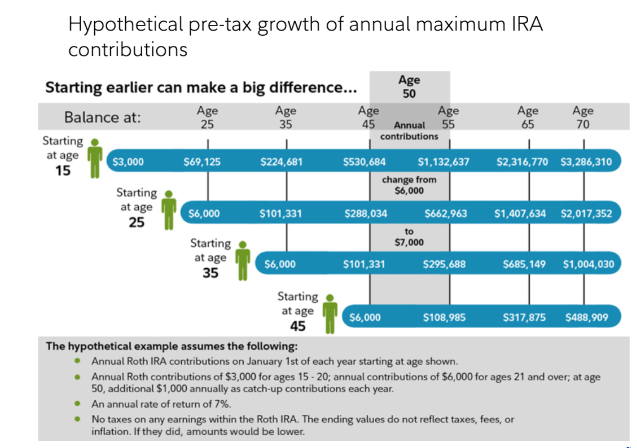
Investing for your long-term goals is smart because you’ll have many years during which your returns can compound. So, rather than earning tiny amounts of interest like a savings account, you can make big gains if the market goes up and if your returns have time to compound over years or decades. This graph shows some possible scenarios.
Part I: Infographic
To answer these questions, analyze the infographic and the fine print written in the grey box at the bottom.
1
When the person who starts investing at age 25 is 55, how much money will be in their IRA?$_______
1
If they had started investing at age 35 instead, how much money would be in their IRA at age 55?_______
1
At the standard retirement age of 65, how much more money will someone who started contributing at age 15 have than someone who started at age 45?_______
1
Regardless of what age someone starts investing, why is the jump in their age 65 balance to their age 70 balance so substantial?
Part II: Graph
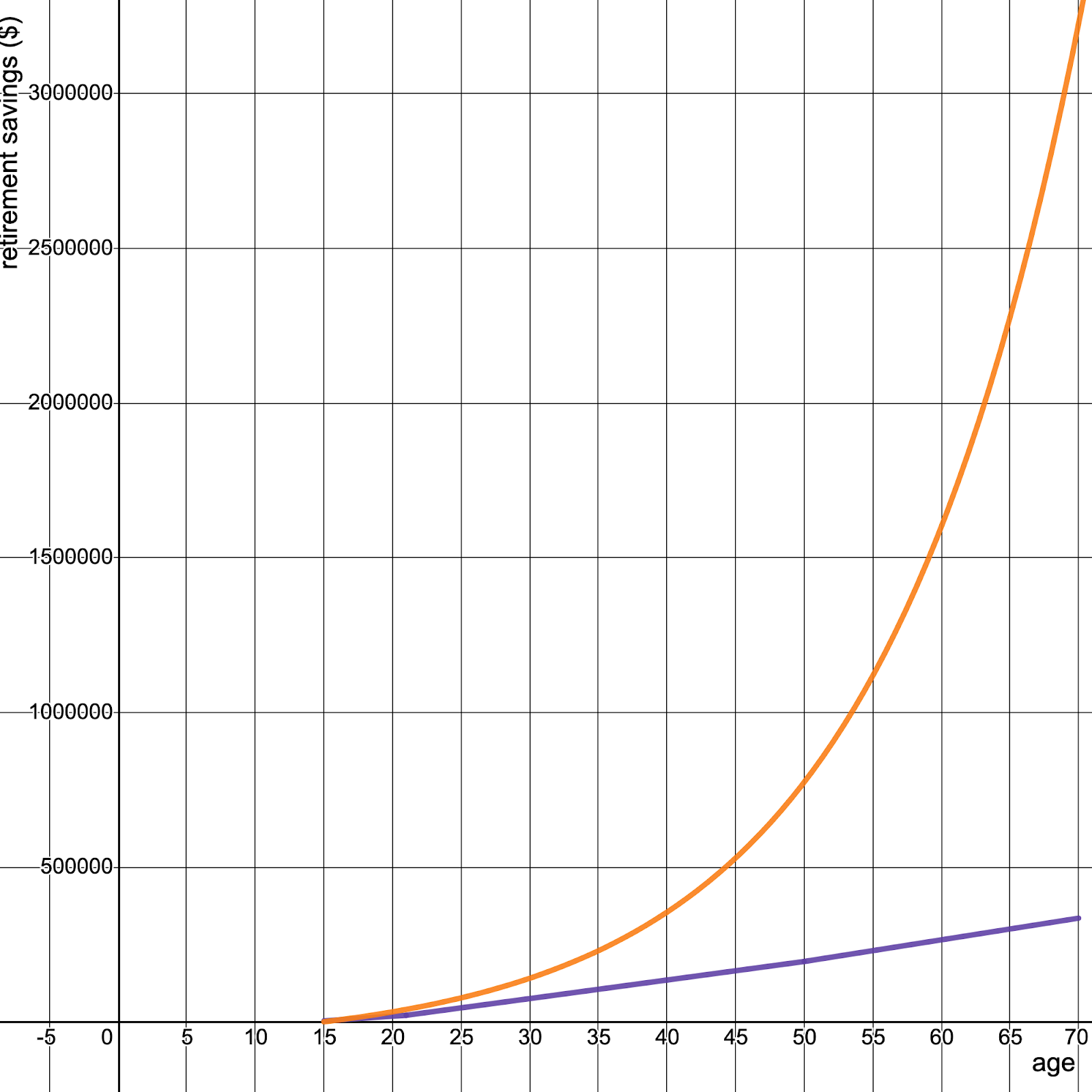
The graph below illustrates the growth of retirement investments for the investor who starts at 15 years old. The purple line represents the total contributions made over time. The orange line represents the total value of those investments.
1
The investor who started at 15 contributes $339,000 total by age 70. Why is their investment worth $3,286,310 - almost ten times their contributions?
1
Imagine the investor did not start investing until age 35. How would the graph differ? How would that impact the value of their investments at age 70?
1
Refer back to the Infographic in Part 1 (#19-22) to find the rate of return they are projecting.- In this hypothetical situation, what investment rate of return are they assuming?
2. How would the graph change if that assumption was higher or lower?
Refer back to the Infographic in Part 1 (#19-22) to find the rate of return they are projecting.
- In this hypothetical situation, what investment rate of return are they assuming?
2. How would the graph change if that assumption was higher or lower?
Part III: Percent Change
You can determine how much an investment account (or really anything) has grown by using the formula for percent change.
1
Based on the chart from part 1, an investor who starts at age 15 will have contributed a total $339,000 to their Roth IRA at age 70. Their investment’s value is an estimated $3,286, 310. Calculate the percent change for that investor._______
1
An investor who starts at age 35 will contribute a total of $237,000 and end up with an investment value of $1,004,030. Calculate the percent change for their investment._______ %
1
Why is the percent change so much higher for the investor who started at age 15, compared to the investor who started at age 35?
1
Which statement best describes the difference between saving and investing?- Saving in an account guarantees a fixed interest rate that is low, and investing might generate a return that is high
- Money in a savings account grows quickly while money in an investment account grows slowly
- Savings accounts are for low-income households and investments are for high earners
- Saving is for long-term goals and investing is for short-term goals
Which statement best describes the difference between saving and investing?
- Saving in an account guarantees a fixed interest rate that is low, and investing might generate a return that is high
- Money in a savings account grows quickly while money in an investment account grows slowly
- Savings accounts are for low-income households and investments are for high earners
- Saving is for long-term goals and investing is for short-term goals
1
One reason that people invest in 529 plans, HSAs, and IRAs is the potential for large growth. A second reason is…- There are tax advantages
- You can then avoid checking and savings accounts altogether
- The state government will contribute $1 for every $1 you invest
- The funds can be used for a house downpayment
One reason that people invest in 529 plans, HSAs, and IRAs is the potential for large growth. A second reason is…
- There are tax advantages
- You can then avoid checking and savings accounts altogether
- The state government will contribute $1 for every $1 you invest
- The funds can be used for a house downpayment
1
If your goal is to save at least $2,000,000 for retirement in an IRA, you’ll want to...- Contribute the max amount per year and start when you are young
- Contribute as little as possible per year and start when you are young
- Contribute the max amount per year and start when you are old
- Contribute as little as possible per year and start when you are old
If your goal is to save at least $2,000,000 for retirement in an IRA, you’ll want to...
- Contribute the max amount per year and start when you are young
- Contribute as little as possible per year and start when you are young
- Contribute the max amount per year and start when you are old
- Contribute as little as possible per year and start when you are old