Log in
Sign up for FREE
arrow_back
Library

Unit 3 REVIEW

star
star
star
star
star
Last updated about 2 hours ago
18 questions
Note from the author:
This assignment is a series of videos that cover the major concepts of Unit 3, there will be questions throughout the videos that you will need to answer to continue. These are not graded and are meant for self assessment, to help you gauge how well you are understanding the concepts. If you feel like you need more help with these concepts, let me know and we can schedule time for us to meet and go over them.
Questions 1 & 2
04:07
keyboard_arrow_down
1
1
Question 3
06:02
keyboard_arrow_down
1
Question 4, Text
07:51
keyboard_arrow_down
1
Question 5
08:58
keyboard_arrow_down
1
Question 6
09:44
keyboard_arrow_down
1
Question 7
01:49
keyboard_arrow_down
1
Question 8
02:12
keyboard_arrow_down
1
Question 9
02:53
keyboard_arrow_down
1
Question 10
03:07
keyboard_arrow_down
1
Question 11, Image, Question 12
04:24
keyboard_arrow_down
1
1
Question 13, Text
06:09
keyboard_arrow_down
1
Image, Question 14
02:39
keyboard_arrow_down
1
Text
02:41
keyboard_arrow_down
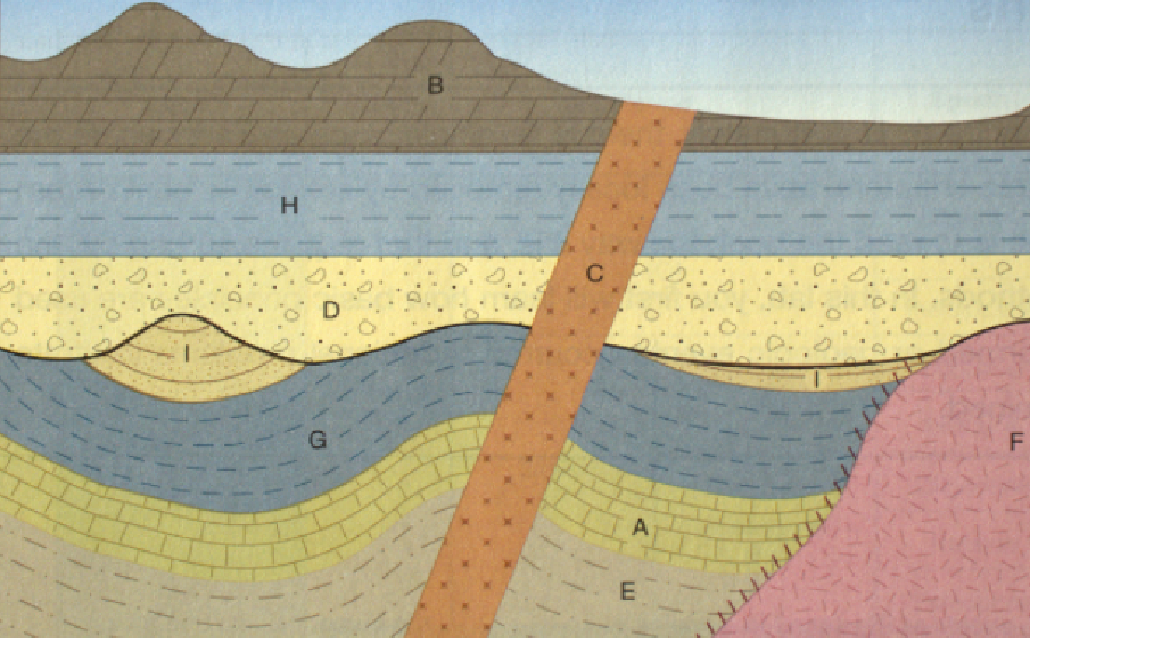
The easist way to look at this type of cross section is to start with the youngest rock, which we know is C, since it occurs in all the other levels of rock. Feature D interacts with rock C, and we can see if break though rock C, so it happend after rock C was formed. Now follow feature D down, it is interupted by feature A, for A to interfere with D, it would need to have occured after D was formed. If we keep going, we see feature E, which does not break Feature D, so it occured before D. This one is a little complicated, so it is okay for you to have gotten it wrong, it is more to help expalin how if you know one piece of informatoin (the youngest rock), you can use that to interpret a lot more from a geologic cross section.
Image, Text
02:38
keyboard_arrow_down
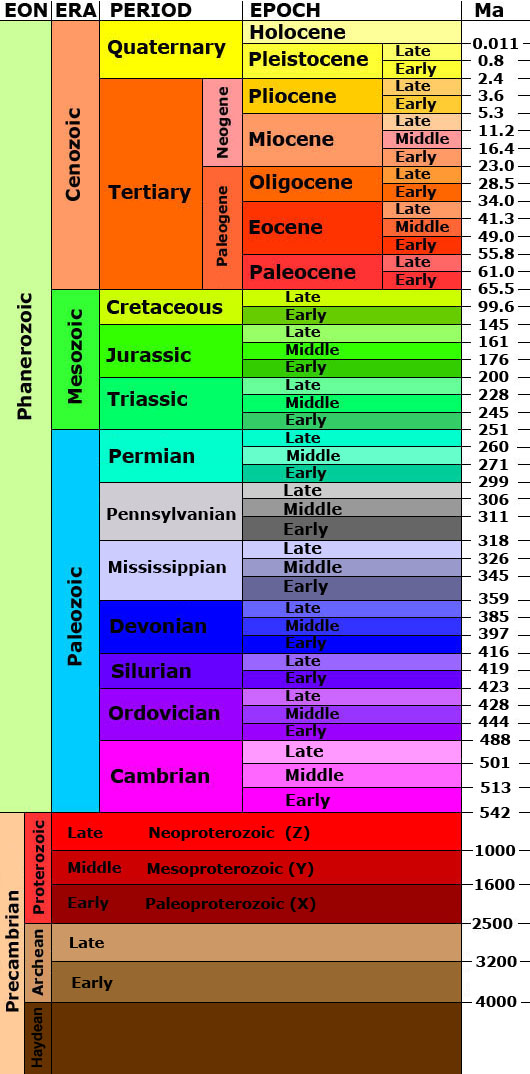
Here is an example of a Geologic Time Scale. There are a variety of types can can be more simple or more complicated than the one shown above.
Question 15
00:25
keyboard_arrow_down
1
Question 16
01:05
keyboard_arrow_down
1
Question 17
01:55
keyboard_arrow_down
1
Question 18
03:38
keyboard_arrow_down
1
Question 1
1.

Question 2
2.

Question 3
3.

Question 4
4.

Any type of rock can be impacted by weathering and erosion.
Question 5
5.

Question 6
6.

What is an example of a change that occurs within the rock cyckle?

Question 7
7.

Question 8
8.

Question 9
9.

Question 10
10.

Question 11
11.

Question 12
12.

Question 13
13.

You can stop watching this video here, and move on to the next video.
Question 14
14.

Question 15
15.

Question 16
16.

Question 17
17.

What is an example of an impact of human land use?

Question 18
18.

What two types of rock does magma cool to form?
Igneous and Sedimentary
Metamorphic and Sedimentary
Intrusive Igneous and Extrusive Igneous
Intrusive Metemorphic and extrusive Metemorphic
Extrusive Igneous rock forms when lava cools above the Earth's surface.
True
False
Is the granite in this example mafic or felsic?
Mafic
Felsic
What types of rock are impacted by weathering and erosion? Select all that apply
Metemorphic
Instrusive Igneous
Sedimentary
Extrusive Igneous
What processes create metemmorphic rock?
Heat and melting
Sedimentation
Weathering and erosion
Heat and pressure
Ice forming in cracks of a rock, expanding the crack until the rock breaks, is an example of what type of weathering?
Chemical
Mechanical
Erosion is the process of rocks breaking into smaller peices.
True
False
This is an example of....
Weathering and erosion
The formation of metemophic rock
The formation of sedimentary rock
The formation of Igneous rock
A geologist is looking at layers of rock. They want to examine the oldest layer, which layer should they look at
Top most payer
Middle Layer
Bottom Most Layer
A Scientist is using radiometric dating to determine the age of a rock sample. What is this an example of?
Relitive Dating
Absolute Dating
Historical Dating
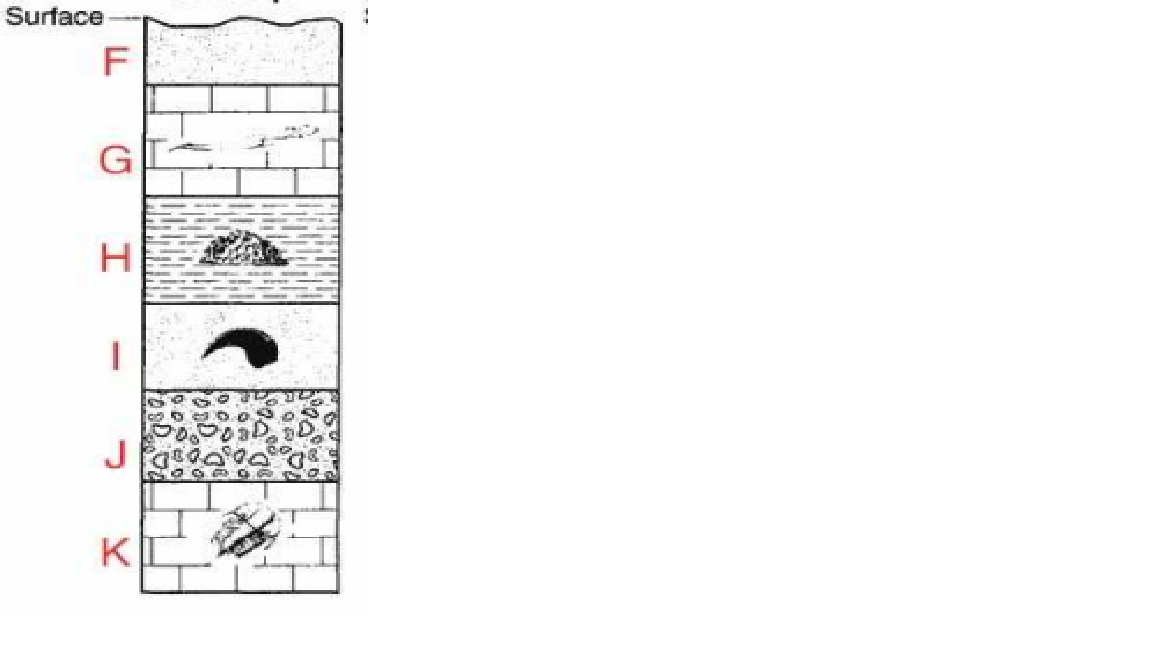
Ms. Ernst is looking at a cross section of an outcrop filled with fossils (above Image). Which layer holds the oldest fossils?
F
G
H
I
J
K
Absolute dating looks at the specific age of a rock while relitive dating looks at the cronological order of the rocks relative to eachother.
True
False
Using what you know about geologic cross sections and how different formations occur, identify which layer in the above image is youngest.
A
B
C
D
F
G
H
I
What happens to soil when vegitation is removed? (Deforestation)
It becomes hard to erode
It becomes fertile
It becomes easy to erode
It becomes infertile

How would planting trees amoung the crops help with erosion?
Stabalizing the soil
Creating nutrients
Creating shade
Are you able to relate what you learned in this video to other types of land use? For example, residentail building and mining?
Yes
No