Read the section below and answer questions 1-4
There are some regions of the Earth that experience seasons characterized by changing temperatures and amounts of precipitation, while in other regions of the earth the temperature and precipitation stay pretty constant year-round. These conditions are the result of many different factors and influences that collectively determine the global climate – which we are going to talk about today.
To understand these factors, it is important first to distinguish between weather and climate. “Weather” describes short-term, specific conditions in an area, such as temperature, wind strength and direction, and precipitation in a specific region on a particular day. “Climate” refers to the long-term, collective, cumulative effects of these conditions on the region over a long period of time.
Things that affect global climate patterns include
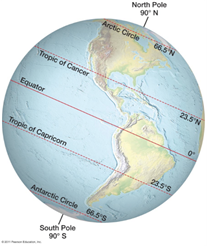
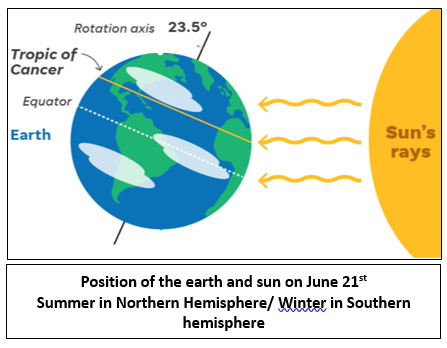
(1) the tilt of the Earth and the rotation of the Earth on its axis,
(2) uneven heating of the Earth’s surface due to uneven amounts of sun/solar energy,
(3) convection currents, and
(4) the interactions of major air, land, and water masses, including the Coriolis effect.
Using a model globe and other materials, your group will explore important aspects of these mechanisms in greater detail over the course of these laboratory activities.