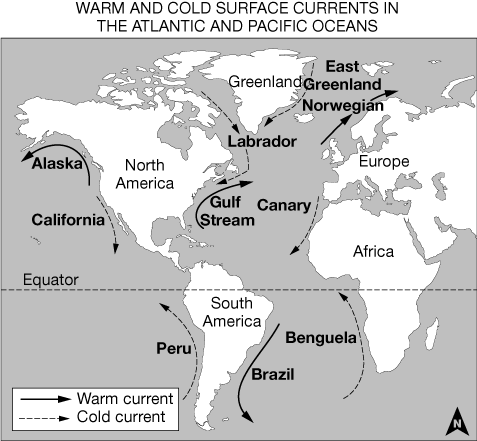
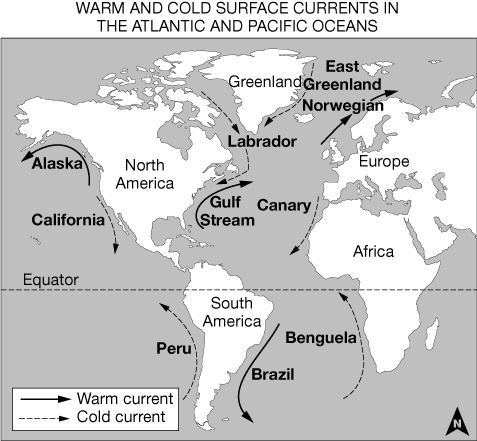
El Niño is often in the news because of the effect it has on the weather worldwide. The occurrence of an El Niño (or La Niña) is determined by an analysis of sea-surface temperatures. An El Niño occurs when there is a weakening in the trade winds off the coast of Peru. These winds typically transport warm water toward the western part of the Pacific Ocean. This water is replaced by colder, nutrient rich water from the deep ocean below. When the winds weaken, warmer waters remain off the coast of Peru and the upwelling is reduced or stopped. Without the upwelling, the productivity of these areas decreases.
In this activity, you are going to compare the sea surface temperature patterns during a major El Niño occurrence to a time more representative of long-term average conditions.
Note: The accompanying maps of the Pacific Ocean display sea-surface temperature patterns. The lines drawn on the map are constant temperature lines called isotherms. Each isothermis labeled according to the temperatureit represents, in °C. The difference from one isotherm to the next on the maps is 2° C.
1 point
1
Question 1
1.
Instructions:
1. To start, use colored pencils to fill in the color key provided.
2. Then color the entire Pacific Ocean by referring to the color key. Start by coloring inside the 30°C with the assigned color. Make sure you color LIGHTLY. You will be writing on top of the colors.
3. Using the next colorin your color key, follow the same procedure for the next lower temperature band that ranges between 30°C and 28°C.
4. Continue this process for all the temperature ranges in your color key.
5.ON YOUR MAP showing Normal Conditions, indicate where upwelling occurs near Peru.
6.ON YOUR El Niño map, indicate the weather conditions for Australia and Peru by writing “W” where wet weather will occur and a “D” where the land will be dry and result in a drought.
1 point
1
Question 2
2.
Location of low pressure system and generating rainfall
Draggable item
arrow_right_alt
Corresponding Item
Eastern Pacific
arrow_right_alt
Normal Year
Western Pacific with heavy rainfall
arrow_right_alt
El Nino Year
Western Pacific
arrow_right_alt
La Nina Year
1 point
1
Question 3
3.
Coastal wind along the west coast of South America (compass direction and relative strength)
Draggable item
arrow_right_alt
Corresponding Item
Western Pacific
arrow_right_alt
Normal Year
Eastern Pacific
arrow_right_alt
El Nino Year
Western Pacific with heavy rainfall
arrow_right_alt
La Nina Year
1 point
1
Question 4
4.
Relative strength of upwelling off the coast of South America (weak, normal, strong)
Draggable item
arrow_right_alt
Corresponding Item
Strong
arrow_right_alt
Normal Year
Normal
arrow_right_alt
El Nino Year
Weak
arrow_right_alt
La Nina Year
1 point
1
Question 5
5.
Position of thermocline
Draggable item
arrow_right_alt
Corresponding Item
Shallow
arrow_right_alt
Normal Year
Deep
arrow_right_alt
El Nino Year
Normal
arrow_right_alt
La Nina Year
1 point
1
Question 6
6.
Location of warm surface water
Draggable item
arrow_right_alt
Corresponding Item
Middle Pacific
arrow_right_alt
Normal Year
Eastern Pacific
arrow_right_alt
El Nino Year
Western Pacific
arrow_right_alt
La Nina Year
1 point
1
Question 7
7.
Wet weather conditions including flooding in some cases.
Draggable item
arrow_right_alt
Corresponding Item
Western Pacific
arrow_right_alt
Normal Year
Western coast of North and South America
arrow_right_alt
El Nino Year
Northeast coast of Australia and Indonesia
arrow_right_alt
La Nina Year
1 point
1
Question 8
8.
The fish and birds leave this area due to a lack of upwelling during an El Nino year.
1 point
1
Question 9
9.
Describetwo characteristics of an El Nino year.
1 point
1
Question 10
10.
Describetwo characteristics of an La Nina year
1 point
1
Question 11
11.
How can you tell the difference between an El Nino or La Nina year?
1 point
1
Question 12
12.
What are the economic consequences of an El Nino year?
1 point
1
Question 13
13.
What is the cause of the weather changes in an El Nino year?
1 point
1
Question 14
14.
Based on the diagram, which of the following changes are most likely to occur in the central and eastern tropical Pacific during El Niño?
1 point
1
Question 15
15.
Based on the diagram, which of the following changes are most likely to occur in the central and eastern tropical Pacific during El Niño?