Log in
Sign up for FREE
arrow_back
Library

Quarter 1 Test

star
star
star
star
star
Last updated over 1 year ago
25 questions
Note from the author:
1.1a I can explain how water’s physical properties contribute to polarity, adhesion, cohesion, thermal regulation, density and solubility
1
1.1a
1
1.1a
1
1.1a
1
1.1a
1
1.1a
1.1b I can relate the chemical and physical properties of water to life’s metabolic activities
1
1.1b
1
1.1b
1
1.1b
1
1.1b
1
1.1b
1.2a – I can recognize that living cells are composed of relatively few elements including carbon (C), hydrogen (H), nitrogen (N), oxygen (O), phosphorous (P), and sulfur (S).d Section
1
1.2a
1
1.2a
1
1.2a
1
1.2a
1
1.2a
1.2b - I can differentiate between the four major categories of macromolecules (lipids, carbohydrates, proteins, and nucleic acids) through their primary roles and functions.
1
1.2b
1
1.2b
1
1.2b
1
1.2b
1
1.2b
1.3a I can describe the structure of enzymes and explain their in role in acting as catalysts to control the rate of metabolic reactions
1
1.3a
1
1.3a
1
1.3a
1
1.3a
1
1.3a
You may complete just the sections of the test that you wish to try and improve your grade on. You do not need to answer all the questions if you are not trying to raise your grades for certain learning targets.
Question 1
1.

Question 2
2.

Question 3
3.

Question 4
4.

Question 5
5.
The diagram below shows the bonding interactions of individual water molecules with multiple other water molecules. Label the diagram below with the letters shown on the right.
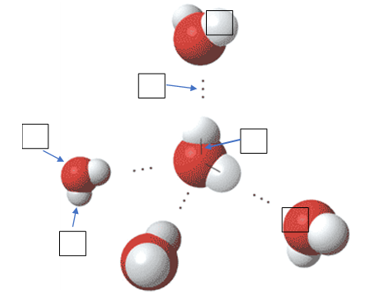
Other Answer Choices:
hydrogen
oxygen
hydrogen bond
Question 6
6.

Question 7
7.

Question 8
8.

Question 9
9.

Question 10
10.

Question 11
11.

Question 12
12.

Question 13
13.

Question 14
14.

Question 15
15.

Question 16
16.

Question 17
17.

Question 18
18.

Question 19
19.

Question 20
20.
Match the name of the molecule to its function (drag and drop)
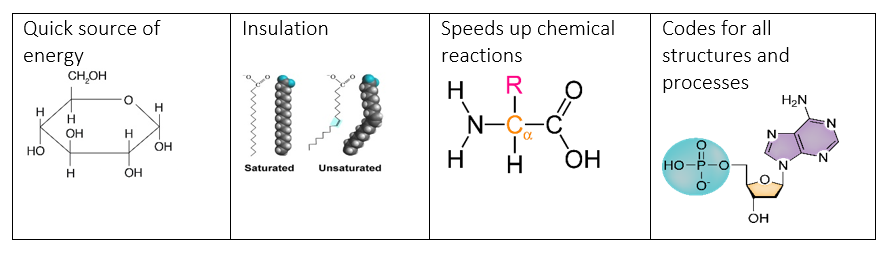
Other Answer Choices:
Lipids
Nucleic Acids
Proteins
Carobhydrates
Question 21
21.

Question 22
22.

Question 23
23.

Question 24
24.

Question 25
25.

Which best describes how hydrogen bonds are created?
The negative charge of oxygen binds with the positive charge of hydrogen on an adjacent molecule.
The positive charge of oxygen binds with the negative charge of hydrogen on an adjacent molecule.
The negative charge of oxygen binds with the positive charge of hydrogen within the same molecule.
The positive charge of oxygen binds with the negative charge of hydrogen within the same molecule.
Which of the following is not an example of Capillary action?
Mercury in a narrow glass tube
A paper towel soaking up spilled chocolate milk
A tree moving water up to its highest leaves
Water climbing higher in a straw than in the glass in which it sits
The unequal sharing of electrons between the atoms of a molecule is why water is considered a ___________ molecule.
Unevenly charged
Unequal
Polar
Universal solvent
An Arctic blast comes through town. The next day, the plumbers are busy as pipes burst all over the town. Which chemical property can explain why the pipes burst?
Hydrogen bonds between water molecules are more stable due to low temperature and the distance between water molecules is more.
Covalent bonds between water molecules are less stable due to low temperature and the distance between water molecules is more
Covalent bonds between water molecules are more stable due to low temperature and the distance between water molecules is more.
Hydrogen bonds between water molecules are broken due to low temperature and the distance between water molecules is less.
The first falling leaf of the season has tumbled from the air and landed on the top of the pond. It does not sink but yet float on top of the surface. What is happening on a molecular level that is preventing the leaf from sinking?
Both oxygen and hydrogen are negatively charged, and therefore much stronger.
The surface area of the leaf is quite large and is breaking the hydrogen bonds of the water molecules on the surface.
There is not enough weight to break the hydrogen bonds between water molecules at the surface of water.
Both oxygen and hydrogen are positively charged, and therefore much stronger.
Which of the following best describes the significance of water's high specific heat capacity in living organisms?
It enables rapid temperature changes in aquatic ecosystems.
It prevents water from evaporating in hot environments.
It allows organisms to maintain consistent internal temperatures.
It reduces the density of water when it freezes.
Which of the following is the most accurate prediction for what would happen if water did not have adhesive properties?
Important nutrients present in water would not be easily available to aquatic organisms.
Large plants would not have a way to deliver water to upper structures like leaves.
The Earth’s climate would be too hot to support life.
Insects could not walk on top of ponds to catch their prey or escape predators.
Water is the "universal solvent". Which of the following examples is correctly aligned with this property?
Water is stored in the cells to be used when the organism gets thirsty.
Water determines which proteins are translated from cellular DNA.
Water is found in the plasma membrane and cell wall of all cells.
Water provides a soluble environment for almost all of life’s chemical reactions.
In which situation is adhesion more prominent than cohesion?
When water is held together by hydrogen bonds.
When water forms a droplet on a hydrophobic surface.
When water loses density due to decreasing temperatures.
When water climbs the walls of a narrow tube.
In living cells, carbon serves as the backbone for a wide range of organic molecules. Which of the following is NOT a major role of carbon in living organisms?
Structural support
Energy storage
Serving as universal solvent
Information storage in DNA
Roger is comparing a model of a sugar molecule to a model of an amino acid. Which of the following evidence statements would be supported by the two models?
Sugars and amino acids have the same structure.
Sugars and amino acids are made of the same elements except amino acids also contain nitrogen.
Sugars and amino acids are made of exactly the same elements.
Sugars and amino acids are made of the same elements except sugars also contain phosphorus.
Scientists have found a new biological sample in the Great Salt Lake. They were testing the sample to determine its chemical composition. The sample got mixed up in the lab, with a ice core sample. Which of the following is most likely the chemical results from the new biological sample?
Carbon 14%, Hydrogen 30%, Oxygen 15%, Nitrogen 7%, Phosphorous 5%
Calcium 12%, Hydrogen 13%, Oxygen 16%, Potassium 21%
Calcium 7%, Hydrogen 23%, Nitrogen 40%, Phosphorous 17%
Carbon 14%, Helium 50%, Oxygen 17%, Nitrogen 6%
Butter, oil, wax, & cholesterol are examples of _____________, which are made up of the elements _________________.
Proteins, CHON
Carbohydrates, CHO
Lipids, CHO
Nucleic acids, CHONP
A biological macromolecule (DNA or RNA) composed of which elements?
CHO
CHNOPS
CHONP
CHON
Like complex carbohydrates, proteins are biomolecules that serve many functions and can be chemically broken down and restructured. Both proteins and complex carbohydrates are which of the following?
Monomers of polymer subunits
Polymers of smaller subunits
Sequences of simple sugars
Lipids of larger molecules
Resistance to antibiotics results from the differences in genetic information of Streptococcus pneumoniae. Which type of molecule is responsible for genetic information in Streptococcus pneumoniae?
Lipids
Proteins
Nucleic acids
Carbohydrates
Proteins have a wide range of functions in living organisms. How does the structure of a protein relate to its function, and can a change in protein structure affect its function?
All proteins have the same structure and function, with no variations.
The sequence of amino acids in a protein determines its structure, which in turn dictates its function, and any changes in structure can alter its function.
Protein structure is unrelated to its function, and changes in structure do not impact function.
Protein structure is determined by the environment and is not related to function.
In recent research there has been controversy over reduced fat diets. On the one hand, a low fat diet is meant to lead to better physical health, like reducing plaque build-up in your arteries. On the other hand, lipids provide essential building blocks for cellular structures. Which one of these would be directly affected by a reduction of fat in the diet?
Building cell membranes
Building cell walls
Building muscle
Building ribosomal RNA
Meat tenderizer contains an enzyme that interacts with meat. If meat is coated with tenderizer and then placed in a refrigerator for a short time, how would the enzyme be affected?
It would no longer act as an enzyme.
Its activity would slow down.
Its shape would change.
It would be broken down.
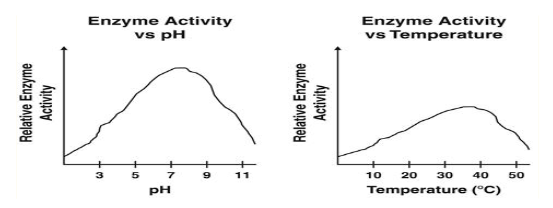
Catalase is an enzyme that speeds up the decomposition of hydrogen peroxide into water and oxygen. Students conducted two investigations to determine the ideal conditions for the function of catalase. One investigation compared catalase activity at different values of pH. The other investigation compared catalase activity at different temperatures.


According to the data in the graphs, which pH and temperature combination provides the best conditions for catalase to function?
pH 7 and 37°C
pH 5 and 4°C
pH 5 and 25°C
pH 7 and 50°C
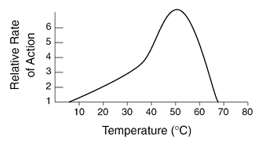
The graph below shows the effect of temperature on the relative rate of action of enzyme X on a protein. Which change would not affect the relative rate of action of enzyme X?

an increase in temperature from 70°C to 80°C
the removal of the protein when the reaction is at 30°C
a decrease in temperature from 40°C to 10°C
the addition of cold water when the reaction is at 50°C
Proteins are essential for a wide range of cellular processes. Describe the role of enzymes, a specific type of protein, in facilitating chemical reactions and explain how enzymes achieve specificity.
Enzymes lower the activation energy of chemical reactions, allowing them to proceed at a faster rate, and specificity is achieved through a unique active site shape and complementary substrate binding.
Enzymes increase the rate of chemical reactions by consuming energy, and specificity is determined by the overall protein structure.
Enzymes provide structural support to cells, and their specificity is based on the shape of the active site.
Enzymes have no role in chemical reactions, and specificity is controlled by the pH of the solution.
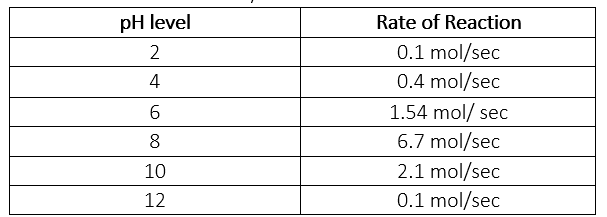
A scientist is using an enzyme to get a chemical reaction to occur within a cell sample and records the data below about the rate of reaction in different pH environments. What does the data most likely demonstrate about the enzyme?
pH affects enzyme function
enzymes lower activation energy
Enzymes are reusable
Enzyme specificity