Preskoči na glavni sadržaj
Prijava
Sign up for FREE
arrow_back
Biblioteka

Quarter 2 Unit 2 Test

star
star
star
star
star
Posljednje ažuriranje almost 2 years ago
40
LT 2.1a Hypothesis, Theory, Law
1
2.1a
1
2.1a
1
2.1a
1
2.1a
1
2.1a
LT 2.1b Cell Theory
1
2.1b
1
2.1b
1
2.1b
1
2.1b
1
2.1b
LT 2.2a Cell Organelles
1
2.2
1
2.2
1
2.2
1
2.2
1
2.2
LT 2.2b Unicellular vs Multicellular
1
2.2b
1
2.2b
1
2.2b
1
2.2b
1
2.2b
LT 2.2c Levels of Organization
1
2.2c
1
2.2c
1
2.2c
1
2.2c
1
2.2c
LT 2.3a Cell Membrane Structures
1
2.3a
1
2.3a
1
2.3a
1
2.3a
1
2.3a
LT 2.4a Cell Transport
1
2.4a
1
2.4a
1
2.4a
1
2.4a
1
2.4a
LT 2.4c Passive v Active Transport
1
2.4c
1
2.4c
1
2.4c
1
2.4c
1
2.4c
Pitanje 1
1.

Which statement best describes the term theory?

Pitanje 2
2.

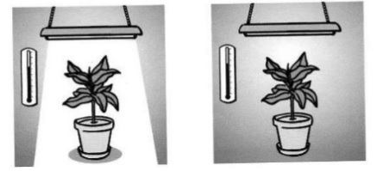
A student was doing an experiment using the scientific method. Every three days the student plans to count the green leaves. Which would be a good hypothesis for this experimen
Pitanje 3
3.

Which statement best describes the difference between a scientific theory and a scientific law?

Pitanje 4
4.
Pitanje 5
5.
Pitanje 6
6.

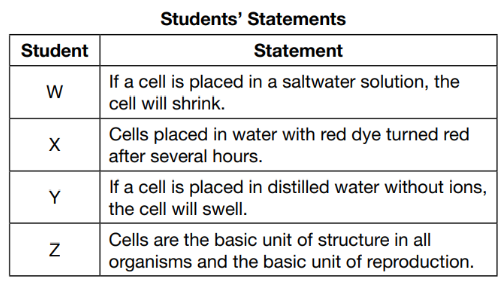
Students presented the statements shown in the chart. Which student’s statement would best be characterized as a scientific theory?

Pitanje 7
7.

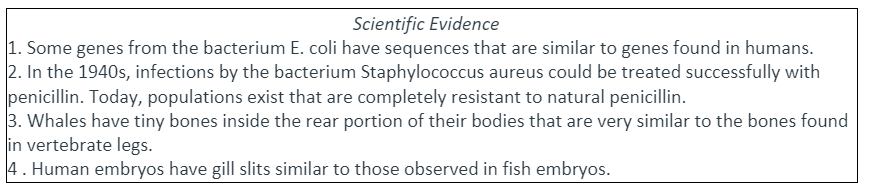
Four pieces of evidence collected by scientists are listed above. How did the scientists most likely use these pieces of evidence?

Pitanje 8
8.

A big debate in the scientific community revolves around how to classify viruses.  A virus is described as having genetic material enclosed inside protein crystal.  Many do not classify viruses as living specimens.  When inside a living host, they will reproduce to create more viruses.  Which aspect of the cell theory are viruses not meeting?

Pitanje 9
9.

Which tenet of modern cell theory does this represent?

Pitanje 10
10.

The cell theory has advanced from the original three tenets to the addition of the 3 modern tenets with the advancement of technology.  The nature of science allows for changes in scientific understanding as new evidence is collected.  What technology development was critical for the advancement in the understanding of cells?

Pitanje 11
11.

Which statement best describes the role of the Golgi apparatus within the cell?

Pitanje 12
12.

Plant cells use sunlight to make their own food. Which structure allows plant cells to perform this function?

Pitanje 13
13.

Antibiotics are medicines that slow the growth of disease-causing bacteria. One of the ways that antibiotics work is by interfering with the normal functioning of bacterial ribosomes. How does this interference reduce the rate of bacterial reproduction?

Pitanje 14
14.

A molecule is produced within a ribosome in a cell. What most likely happens to the newly formed molecule once it is inside the Golgi apparatus of the cell?

Pitanje 15
15.

Cells possess structures that perform specific jobs. Which statement correctly pairs a cell structure with a function it performs in the cells?

Pitanje 16
16.

Which reaction helps maintain homeostasis when the body becomes dehydrated?

Pitanje 17
17.

Which conclusion is best supported by the presence of ribosomes in prokaryotes and eukaryotes?

Pitanje 18
18.

Lungs and capillaries both have porous linings that allow certain substances to move into or out of the structures. Which function do these porous linings most likely serve in living organisms?

Pitanje 19
19.

An example of an activity that best contributes to maintaining homeostasis in an organism is

Pitanje 20
20.

The shivering mechanism in bumblebees often serves the same purpose as it does in mammals. During which condition will the action of shivering most help a bumblebee to maintain homeostasis?

Pitanje 21
21.

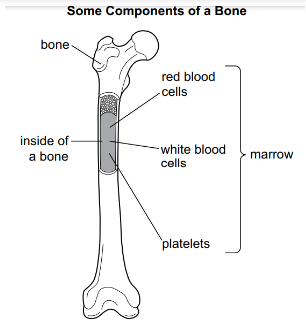
The diagram shows a bone and some of its components. Which statement best describes a relationship among some of these components?

Pitanje 22
22.

Life functions are performed at many levels of biological organization. Which level of biological organization is the simplest level at which a structure can support life functions?

Pitanje 23
23.

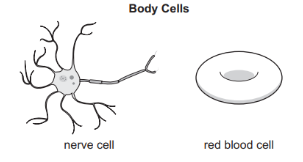
Which statement best explains why these cells have structural differences?

Pitanje 24
24.

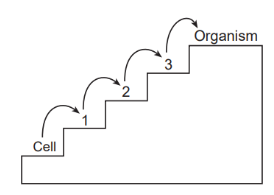
The numbers 1, 2, and 3 in the diagram below represent the different levels of organization in a multicellular organism.

Which chart correctly identifies the levels of organization of 1, 2, and 3?

Pitanje 25
25.

After meiosis II, a spermatid cell changes and develops into a mature sperm cell.  What process causes this change in structure to optimize the function of the cell?

Pitanje 26
26.

Which of the following is most involved in providing structure for a plasma membrane?

Pitanje 27
27.

Which statement best describes a function of the proteins embedded in the plasma membrane of cells?

Pitanje 28
28.

Which action is prevented by the plasma membrane?

Pitanje 29
29.

The presence of cholesterol in the plasma membranes of some animals

Pitanje 30
30.

Which of these often serve as receptors or cell recognition molecules on cell surfaces?

Pitanje 31
31.

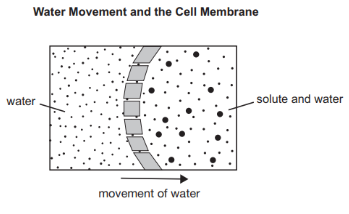
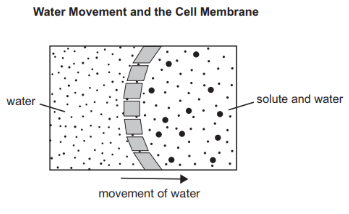
The relative concentration of solute inside and outside a cell can cause water molecules to move across the membrane. Which phrase would be an alternate title to the diagram?

Pitanje 32
32.

In the diagram, the cell will __________________ because the solution is _____________________ compared to the contents of the cell.

Pitanje 33
33.

Which transport mechanisms require the formation of a vesicle to transport material into or out of a cell?

Pitanje 34
34.

A semi permeable membrane is stretched across a chamber filled with water. The membrane is only permeable to water. 60 mg of salt is added to the left side of the chamber. Which of the following will happen?

Pitanje 35
35.

Which of the following statements is correct about diffusion?

Pitanje 36
36.

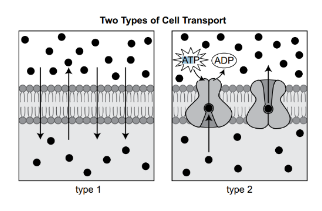
The diagram shows two types of cell transport . Which pair of statements best compares the two types of cell transport?

Pitanje 37
37.

Which statement best describes how channel and carrier proteins in the plasma membrane are similar?

Pitanje 38
38.

Cell membranes inside the cells that line the stomach pump hydrogen ions from areas of low concentration inside the cells to areas of higher concentration outside the cells. Which activity produces the ATP that makes this pumping possible?

Pitanje 39
39.

Which statement best describes how active transport differs from passive transport?

Pitanje 40
40.

How does a mitochondrion facilitate the movement of some materials between cells?