Log in
Sign up for FREE
arrow_back
Library

Quarter 2 Unit 2.4

star
star
star
star
star
Last updated over 1 year ago
10 questions
LT 2.4a Cell Transport
1
2.4a
1
2.4a
1
2.4a
1
2.4a
1
2.4a
LT 2.4c Passive v Active Transport
1
2.4c
1
2.4c
1
2.4c
1
2.4c
1
2.4c
Question 1
1.

Question 2
2.

Question 3
3.

Question 4
4.

Question 5
5.

Question 6
6.

Question 7
7.

Question 8
8.

Question 9
9.

Question 10
10.

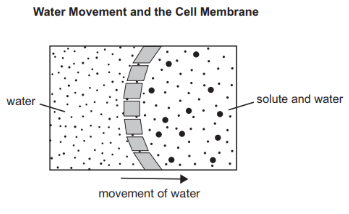
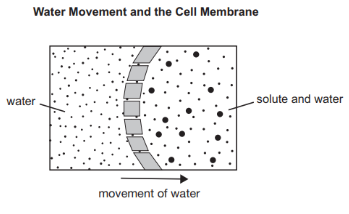
The relative concentration of solute inside and outside a cell can cause water molecules to move across the membrane. Which phrase would be an alternate title to the diagram?
Active Transport in a Cell
Osmosis Across a Membrane
Facilitated Diffusion Across a Membrane
Exocytosis in a Cell
In the above diagram, the cell will __________________ because the solution is _____________________ compared to the contents of the cell.

Shrink ; hypotonic
Stay the same; isotonic
Swell; hypotonic
Swell; hypertonic
Which transport mechanisms require the formation of a vesicle to transport material into or out of a cell?
diffusion and osmosis
exocytosis and endocytosis
diffusion and facilitated diffusion
exocytosis and calcium pumps
A semi permeable membrane is stretched across a chamber filled with water. The membrane is only permeable to water. 60 mg of salt is added to the left side of the chamber. Which of the following will happen?
salt will move toward the right side
water will move toward the left side
salt will move toward the left side
water will move toward the right side
Which of the following statements is correct about diffusion?
It is a passive process in which molecules move from a region of higher concentration to a region of lower concentration.
It is very rapid over long distances.
It is an active process in which molecules move from a region of lower concentration to one of higher concentration.
It requires an expenditure of energy by the cell.
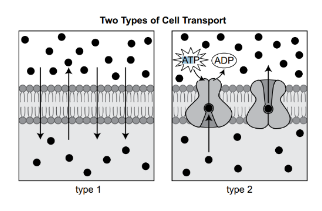
The diagram shows two types of cell transport . Which pair of statements best compares the two types of cell transport?

Type 1 requires energy and molecules move with their concentration gradient. Type 2 requires energy and molecules can move against their concentration gradient.
Type 1 does not require energy and molecules move with their concentration gradient. Type 2 does not require energy and molecules can move against their concentration gradient
Type 1 does not require energy and molecules move with their concentration gradient. Type 2 requires energy and molecules can move against their concentration gradient.
Type 1 does not require energy and molecules can move against their concentration gradient. Type 2 requires energy and molecules move with their concentration gradient.
Which statement best describes how channel and carrier proteins in the plasma membrane are similar?
Both allow for the flow of molecules into and out of a cell.
Both use energy to continuously move water molecules out of a cell.
Both cause the phospholipid bilayer to form a rigid membrane for a cell.
Both directly connect the membrane to the nucleus of a cell.
Cell membranes inside the cells that line the stomach pump hydrogen ions from areas of low concentration inside the cells to areas of higher concentration outside the cells. Which activity produces the ATP that makes this pumping possible?
active transport
cellular respiration
enzyme synthesis
carbohydrate digestion
Which statement best describes how active transport differs from passive transport?
Only active transport allows substances to leave a cell.
Only active transport requires ATP.
Only active transport moves small particles.
Only active transport relies on a plasma membrane.
How does a mitochondrion facilitate the movement of some materials between cells?
It supplies the energy needed for moving molecules through membranes.
It supplies digestive substances that break large molecules into smaller units.
It produces fibers that attach to molecules and move them through the cytoplasm.
It manufactures the proteins needed to form channels in cell membranes.