Natural Selection and Speciation Quiz
star
star
star
star
star
Last updated about 2 years ago
17 questions
Answer each question using your understanding and big ideas from our work together. The questions will ask you to APPLY your learning from our exploration to new situations and scenarios.

Required
1
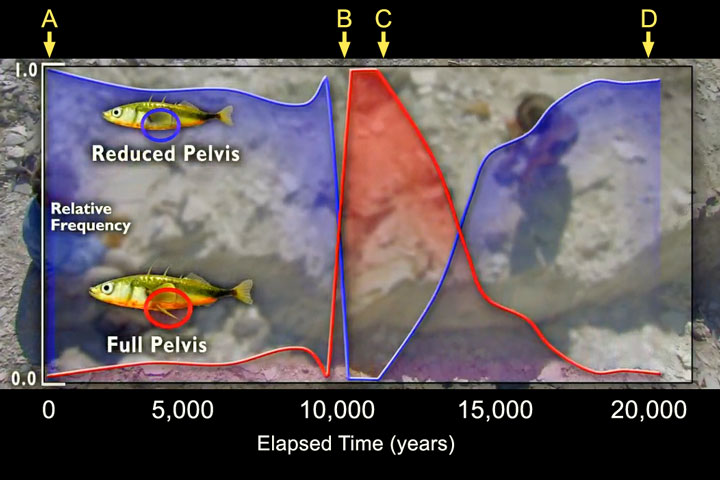
Which traits were favored at 5,000 years? (9L.2.1.1.2 - standard 1)
Required
1
What would likely happen if variation for the full pelvis trait did not exist in the population of stickleback fish at point B on the graph? (9L.2.1.1.2 - standard 1)
Required
3
Create a scenario to explain HOW the reduced pelvis and full pelvis sticklebacks could become two different species? (9L.4.1.1.3 - standard 5)
Required
1
Which description could be a possible reason for the loss of the pelvic spine in the stickleback fish population over many generations (between points C and D on the graph)? (9L.2.1.1.2 standard 1)
Required
2
Researchers have found stickleback fish in fresh and saltwater habitats. Describe the observations or tests you would perform to determine if the these fish are the same species or not. (9L4.1.1.3 - standard 5)
Required
1
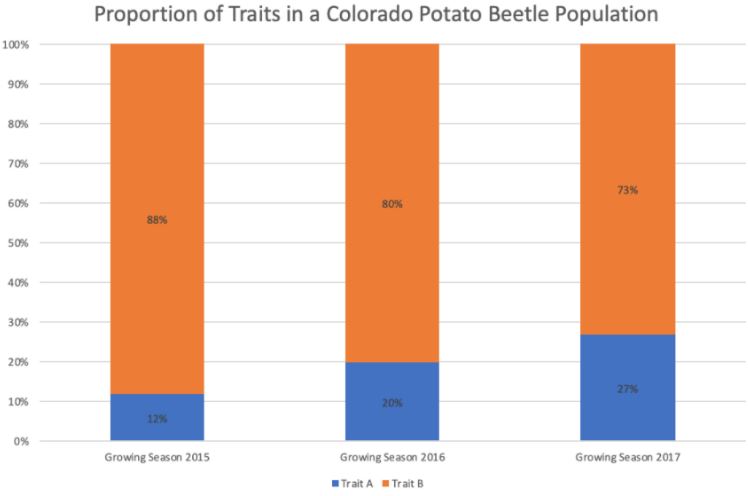
What pattern do you see in the data for trait A (blue) over time? (Cross Cutting Concept 1)
Required
1
Which trait (A or B) is more likely to make the Colorado potato beetles resistant to the pesticide that is applied in future growing seasons? ( 9L.3.2.1.5 - standard 3)
Required
3
Using the 3 "ingredients" for the "recipe" of Natural Selection, explain your answer to the previous question. (9L.3.2.1.4 - standard 2)
Required
1
Which answer(s) could explain why the population of beetles with Trait A (blue) changed between 2015 and 2017? (9L.3.2.1.4 - standard 2)
Required
1
Which method is the most likely explanation for the formation of another trait in the population of the Colorado potato beetle? ( 9L.2.1.1.2 - standard 1)

Required
1
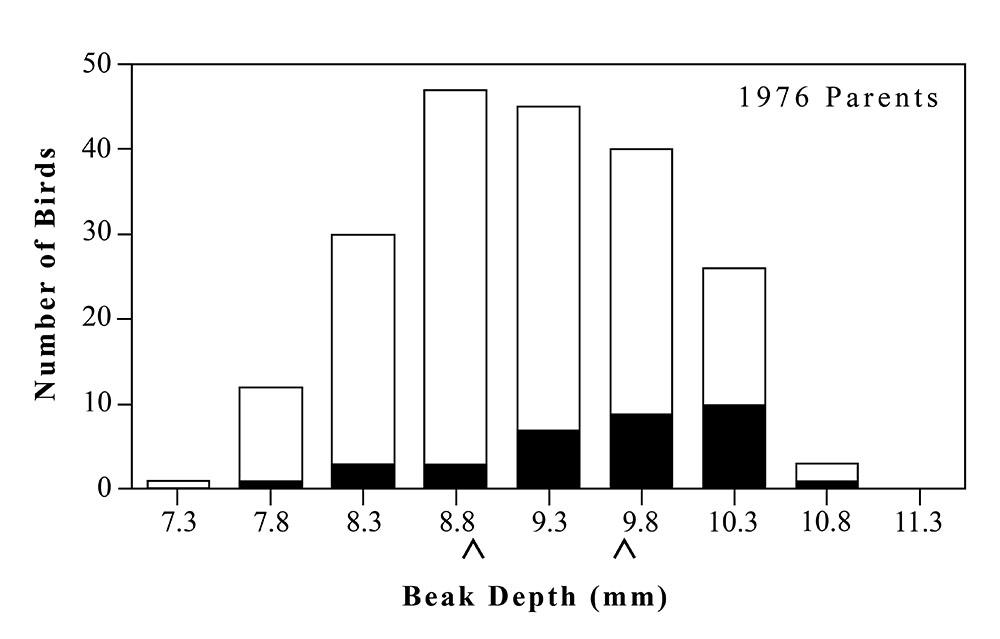
What type of selection has occurred in the finch population? (9L.3.2.1.5 standard 3)
Required
1
Suppose new data was collected and the beak depth now includes some birds with beak depth of 11.3 mm. What caused this new larger beak depth? (9L.2.1.1.2 standard 1)
Required
3
Using the data from the GRAPH explain how natural selection led to the adaptation of the population. (9L.3.2.1.5 standard 3)
Required
1
Which of these are in the correct order to model natural selection? (9L3.2.1.5 - standard 3)
Required
1
15. Which of the following is NOT an example of artificial selection? (9L.4.2.1.1 standard 6)
Required
1
Which of the following does NOT provide evidence that living things have been evolving for millions of years? (9L.4.2.1.1 standard 6)
Required
1
Which of the following is NOT an example of reproductive isolation. ( 9L.4.1.1.3 - standard 5)