S2w1 FC Graphing and inverting trig functions
star
star
star
star
star
Last updated 11 months ago
31 Nsɛmmisa
1
1
Ɛhia
1
Ɛhia
1
1
Ɛhia
1
1
Ɛhia
1
Ɛhia
1
Ɛhia
1
Ɛhia
1
1
1
1
1
1
1
1
1
1
1
1
Ɛhia
1
Review: if y=f(x), and g(x)=4f(x), what transformation takes place?
Review: if y=f(x), and g(x)=f(4x), what transformation takes place?
watch the following video on graphing trig fuctions. Do you have any questions?
according to the video, what does the amplitude of a sine function refer to?
the line of equilibrium is frequently at 0. When it is not at zero, what function transformation must have happened?
watch the following animation showing the connection between a wheel turning and two different sinusoidal waves being drawn. pay attention to where the sine wave is when the point is at its highest, notice what part of the graph is shown after one revolution.
What do you notice?
Consider a graph where the x-axis signifies the degree, and the graph is showing the y-component of a spot on a wheel as the wheel is turning. The dot starts at (0,1) if you were to plot the same dot, but instead of using theta as the x axis, you are using time as the x axis, where do you think the graph would hit the x axis?
If you want to talk about how fast a wheel is moving, what units do you use?
if a wheel is moving at 1 revolution per second, how many degrees has that wheel moved in 0.5 seconds?
sin and cosine are functions that take angle measurement as inputs. Cos(t) where the units of t are seconds doesn't make a lot of sense. So consider cos(g(t)) if g(x) =2t, where 2 is the rate of speed of the wheel and has the units revolutions/sec, what is the unit of g(x)?
About how long would you say you have worked on this formative so far? Note that there are two very different sections of this homework - graphing and inversing. It may be helpful to spend some time doing homework questions (roughly the first half of the assignment) or work of practicing using your module. Come back to the second half later.
Ok, have you rested your working memory?
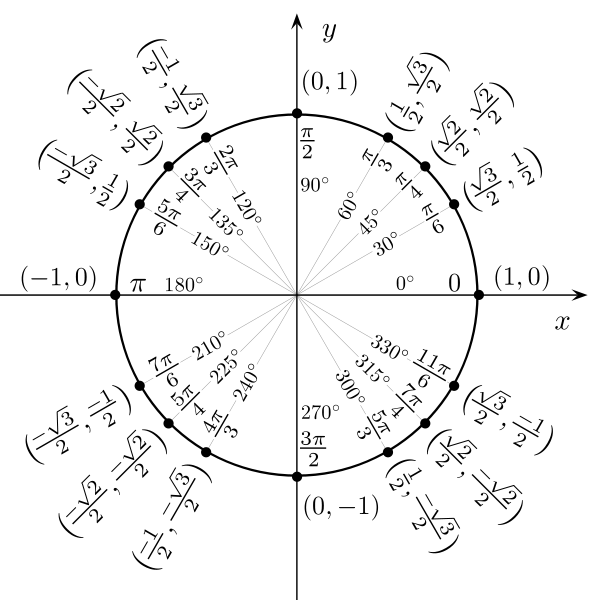
Match degrees to the appropriate unit circle radian measure.
| Draggable item | arrow_right_alt | Corresponding Item |
|---|---|---|
60 | arrow_right_alt | 0 |
120 | arrow_right_alt | |
45 | arrow_right_alt | |
30 | arrow_right_alt | |
135 | arrow_right_alt | |
270 | arrow_right_alt | |
315 | arrow_right_alt | |
300 | arrow_right_alt | |
210 | arrow_right_alt | |
360 | arrow_right_alt | |
0 | arrow_right_alt |
What is the relationship between the domain and range of the exponential parent function and the logarithmic parent function?
What is the domain of the sinusoidal function cos(x)?
What is the range of the sinusoidal function cos(x)?
what do you think the domain of the inverse of sine (written as arcsine, also sin^-1) should be?
y=x^2 is not a one to one function, but we have a sortof inverse for that function anyway - what do we do to "undo" the squaring function.
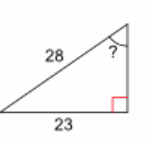
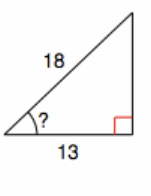
Find the measure of the indicated angle (?) round to the nearest tenth, use a calculator.
Solve for the missing angle
looking at the unit circle above: what is
Why can the answer above definately not be
Categorize the different parts of the lesson.
how to transform sinusoidal functions
what the amplitude of a sine wave is
what the period of a sine wave is
how to graph sine waves
What the equilibrium line of a function represents
how to have a rate of change as part of the function inside a sin function
the relationship of
to arcsin x
the lack of relationship of
to
how to deal with tan, cot, sec and csc by just turning them into sin and cos
the domain and range of an inverse trig function
how to graph the tan, cot, sec and csc functions
finding sides of right triangles given a side and an angle
finding the angle of a right triangle given two sides
Im good
im fuzzy
so confused
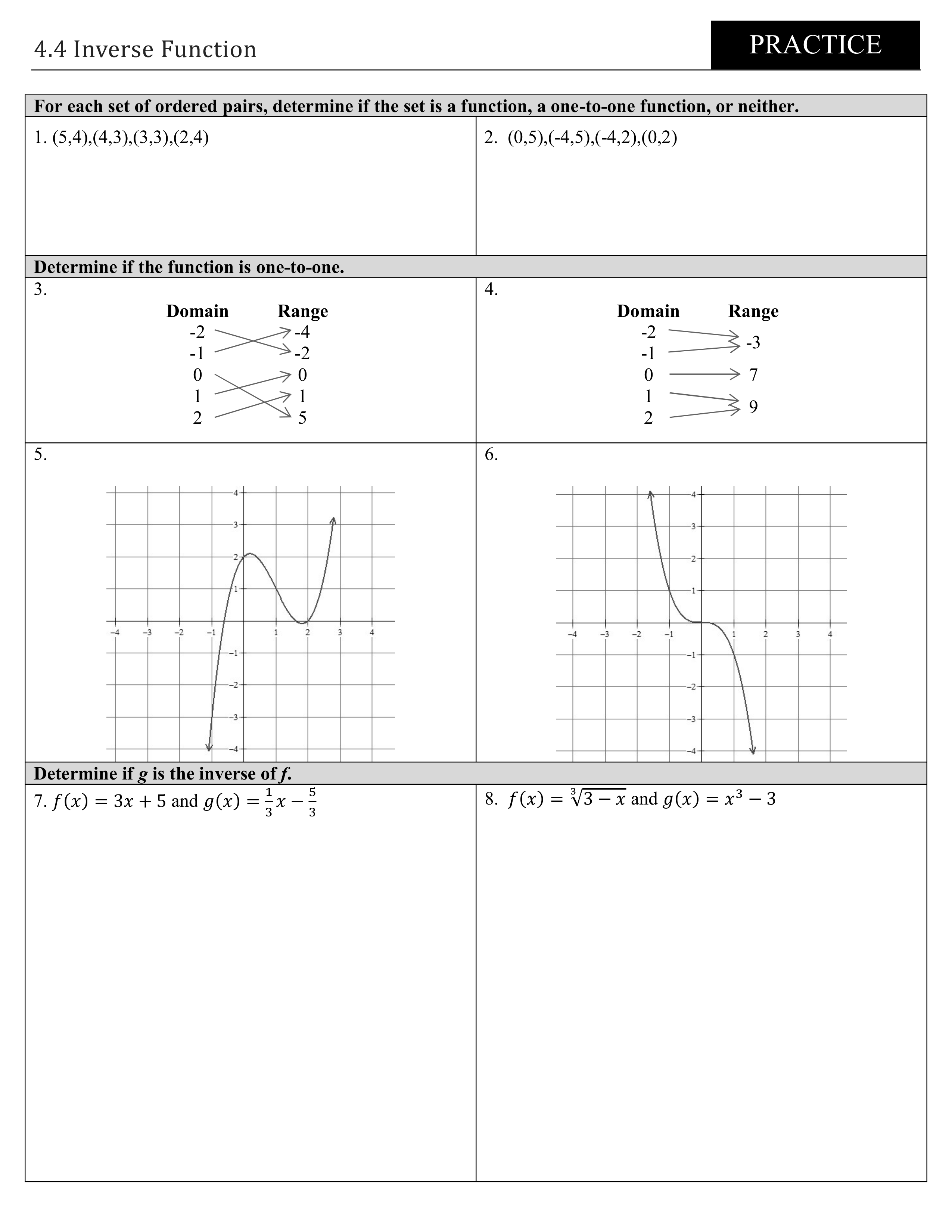
Which of the following describes the set of ordered pairs?
Which of the following describes the set of ordered pairs?
Which of the following describes the relation shown?
Which of the following describes the relation?
Which of the following describes the graph?
Which of the following describes the graph?
g is the inverse of f.
g is the inverse of f.