s2w2 FC Trig identities
star
star
star
star
star
Last updated 11 months ago
29 Nsɛmmisa
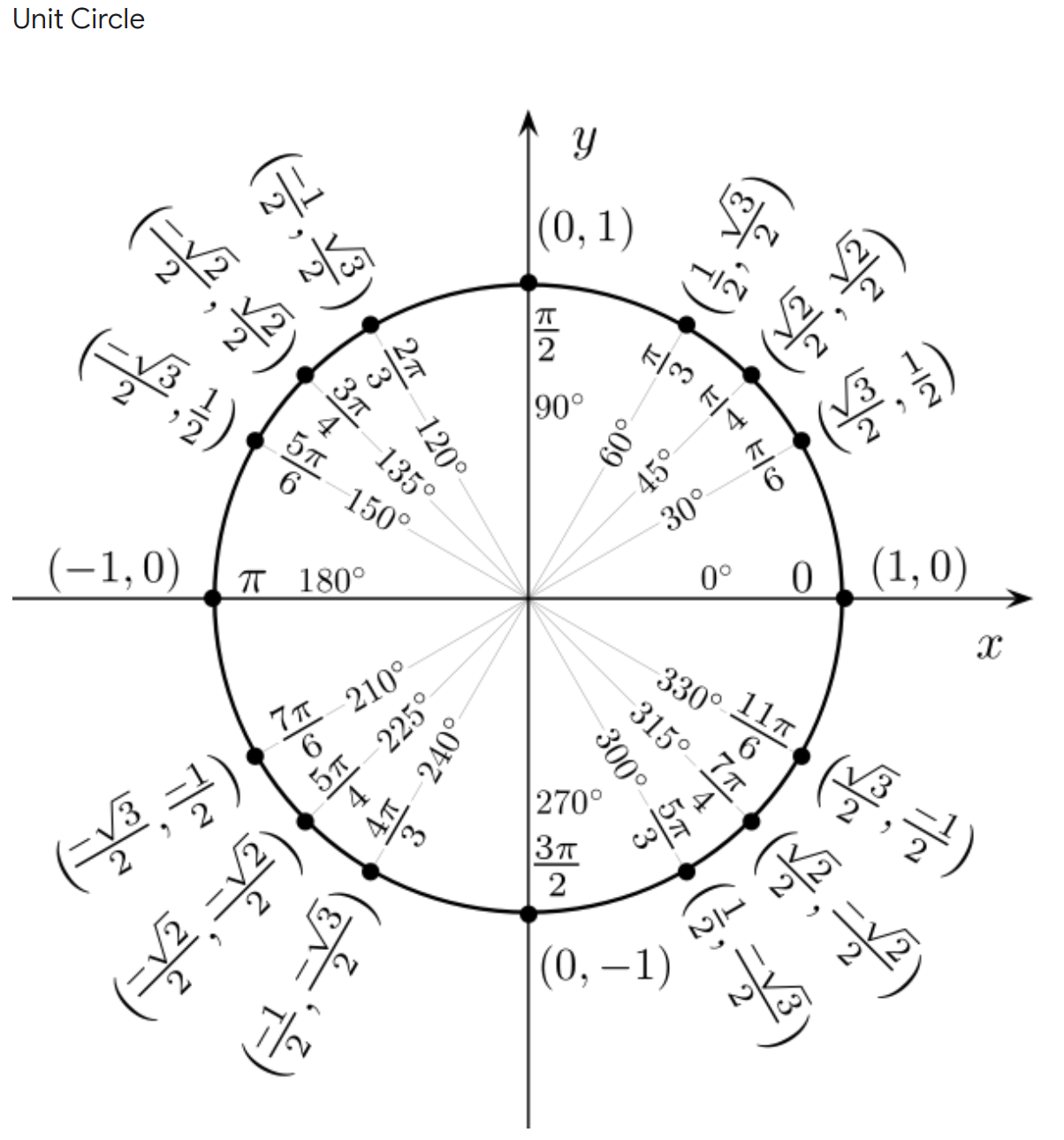
1
1
1
1
1
1
1
0
1
Ɛhia
1
Ɛhia
1
1
1
1
1
1
1
1
1
1
1
1
1
We talked in class last week about how the inverse sin, inverse cos, and inverse tan functions have very specific domains and ranges, but that they are functions that only return one output for each input. How can any of the above questions have multiple answers if that is the case?
so far, the only equations you have been asked to solve have involved only one trig function. Do you know how to solve something that looks like this yet?
Now this one can be solved without using the tools I am about to give you, but some more complicated ones will not be so easy. What might be your first step in solving this equation?
There are two identity properties you are already familiar with. The first is
for any value of x. We use this in completing the square
the second is
for any value of x. We use this for working with fractions
What do you consider the purpose of an identity property? what do these two examples have in common?
Watch the following video: Do you have any questions?
After algebra I just stopped subtracting, and turned every subtraction problem into adding a negative, Similarly I immediately turn every tan, cot, sec, csc into sine and cosine. It makes life easier. Use the trig identities to simplify the following expression into nothing but sine and cosine. if you can make it all just either sin or cos, that would be better. do that, and then simplify the following.
Complete the trig identity:
Complete the trig identity:
quick review: the equation for a unit circle is
and if draw a line from any point on the circle to the origin and the down to the x-axis, I make a right triangle with legs of length x and y, with a hypotenuse 1.
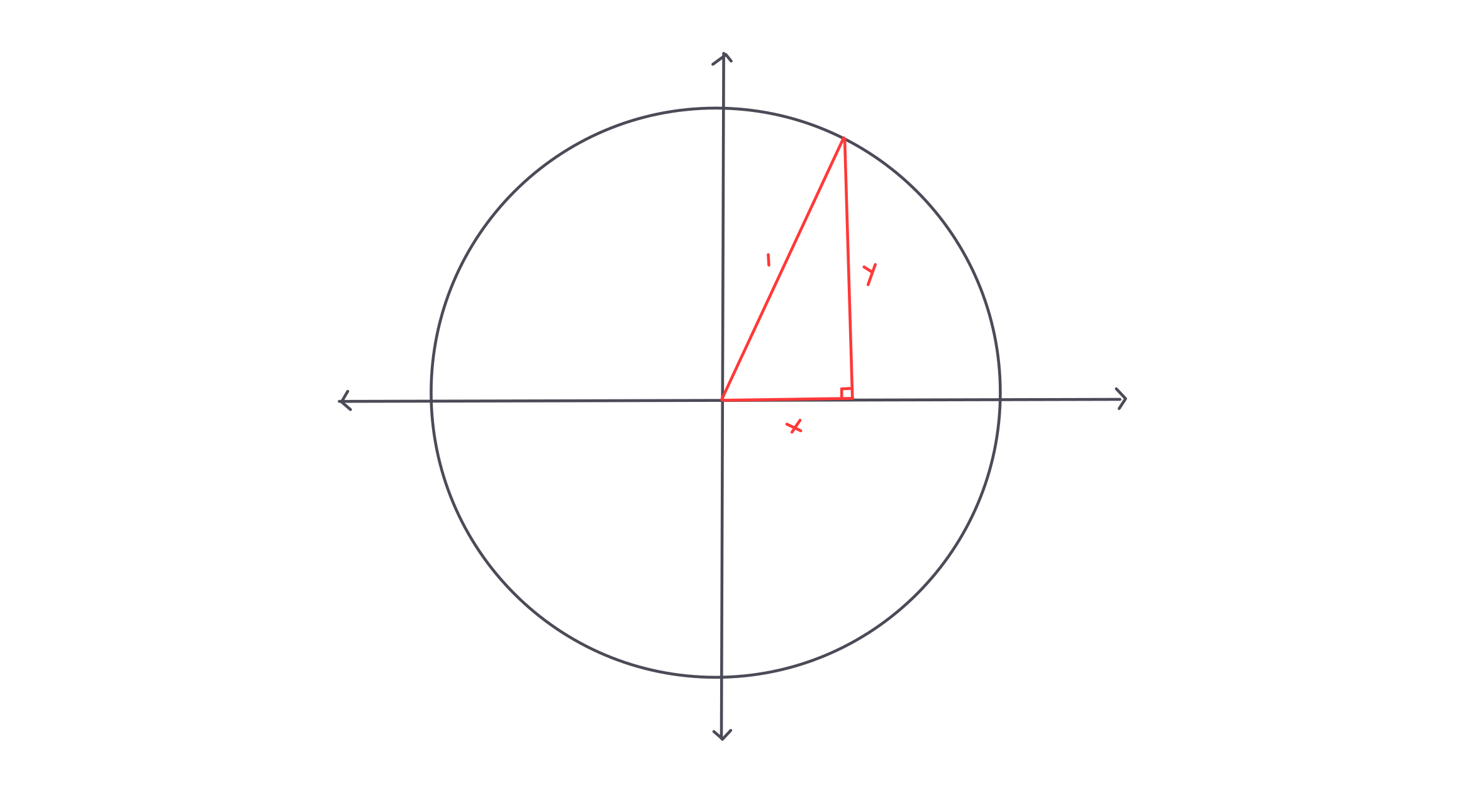
and if I name the angle of that triangle at the origin
Care to guess what the pythagorean identity is?
Pythagorean identities: after you have watched the video, do you have any questions?
Take the following expression to simplify:
which of the following might you do next?
Which would be the best step to show that
You'll notice that he put up three equations as pythagorean trig identities. Some people go further and use all of the following.
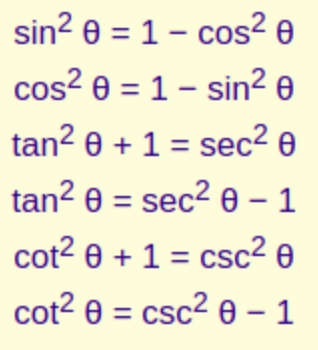
I reject this. I only use
that has its pros and cons. I can look at
Do you consider yourself a memorizer, or a work everything out with the one identity I memorized type?
First - I'm about to change subjects to another type of trig identity. It may be a good idea to spend some time on a module, and save the rest of this formative for later. let things sink in a bit. You aren't trying to finish this formative all in one fell swoop, right?
right?
ok. you are back. New way to categorize functions- But first a true or false - all numbers are either even or odd?
We have talked about polynomials being even degreed functions or odd degreed functions, but other Functions can also be categorized as even or odd. It is sortof related, but slightly different. Even functions are functions where
if
would g(x) be even?
An odd function is one where
if
if g(x) odd?
Is the following function
even or odd?
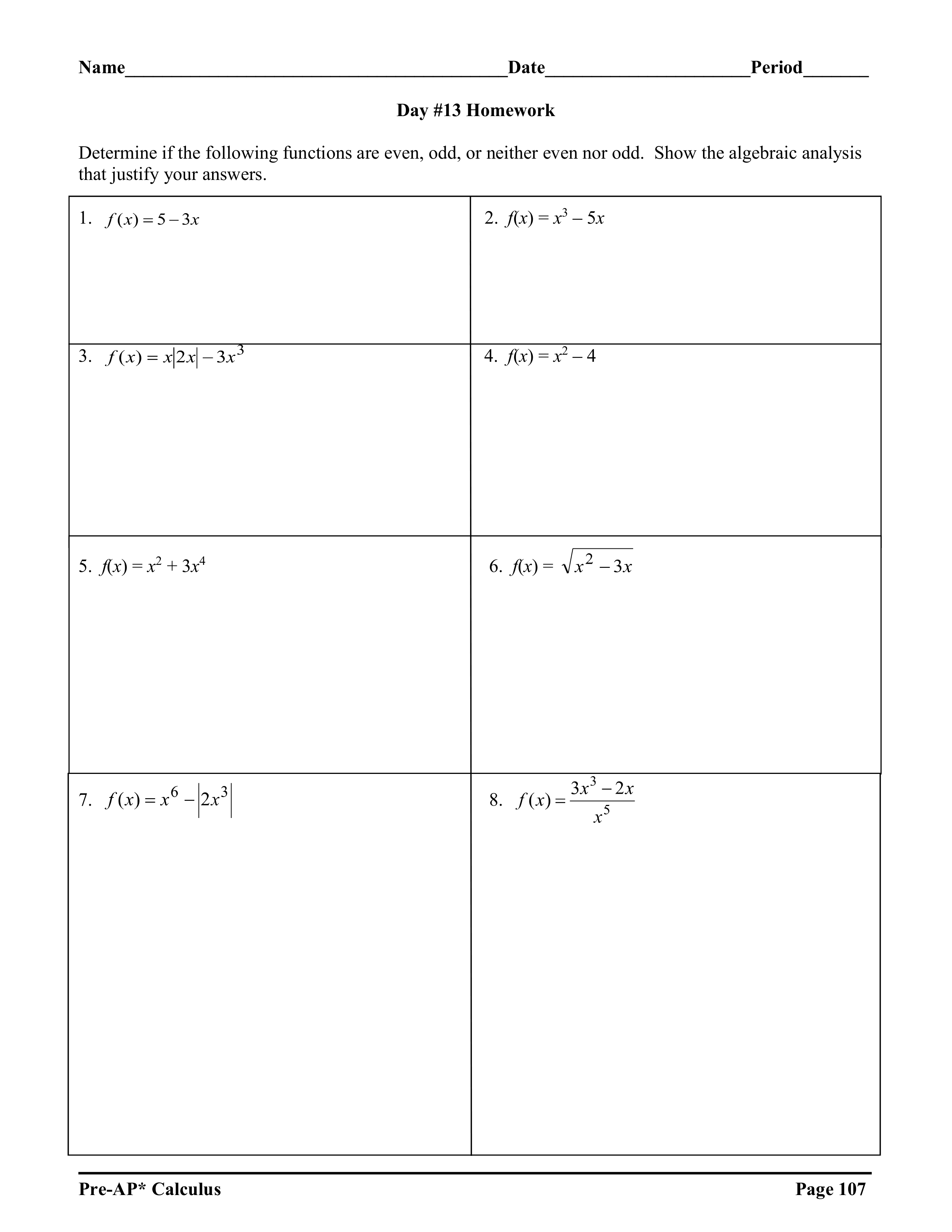
Click and drag each problem number to the correct category.
1
2
3
4
5
6
7
8
Even
Odd
Neither
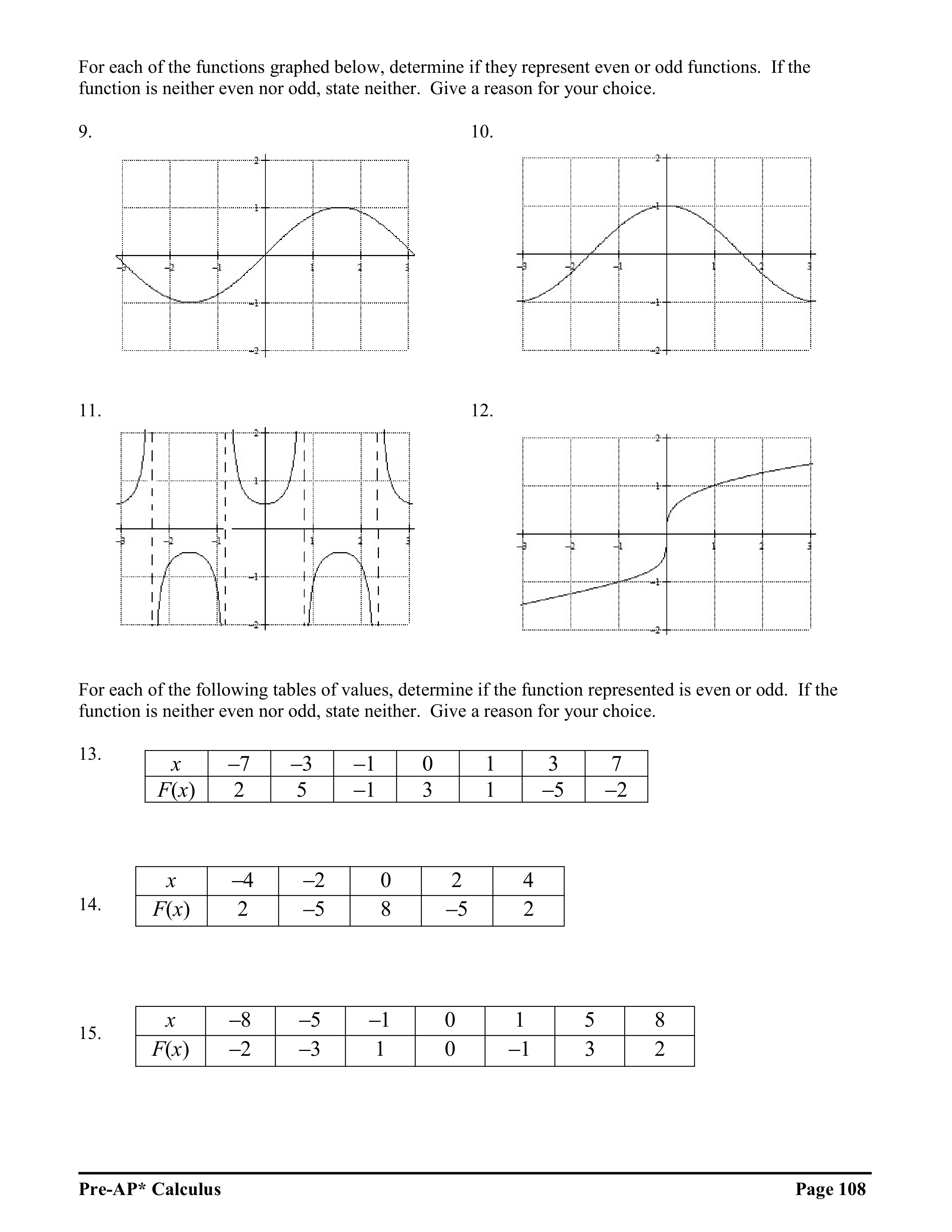
Click and drag each problem number to the correct category.
9
10
11
12
Even
Odd
Neither
Click and drag each problem number to the correct category.
13
14
15
Even
Odd
Neither
given this, look at your unit circle, or look above at the different graphs.
f(x)=sin x
f(x)=cos x
f(x)=tan x
f(x)=sec x
f(x)=cos x
even function
odd function
neither
Up until now all the identities you have done are messing with expressions that are all sin, cos and tan of the same angle. we are moving past that now. We have two new identities, this time setting things equal when the angle inside the function is not always the same.
and
Once you have these, you shouldn't have to refer to your classification above, what would the tan version of this identity be?
Which of the following is a true identity?
How are you feeling on
Using the unit circle to solve trig equations
rewriting trig equations using identities
What is the purpose of an identity property
what is the pythagorean identity
how do you use the pythagorean identity?
whats the deal with the tan form of the pythagorean identity?
why do I need to take a break and work on my aleks homework and modules when what I really want to do is just finish this thing?
what is an even function
what is an odd function
what does a function that is neither even or odd look like
what are the even/odd identities in trig
im fine
im fuzzy
so confused
You don't have to watch this whole video, we are just covering the first problem. What do you think his first step in working this problem should be