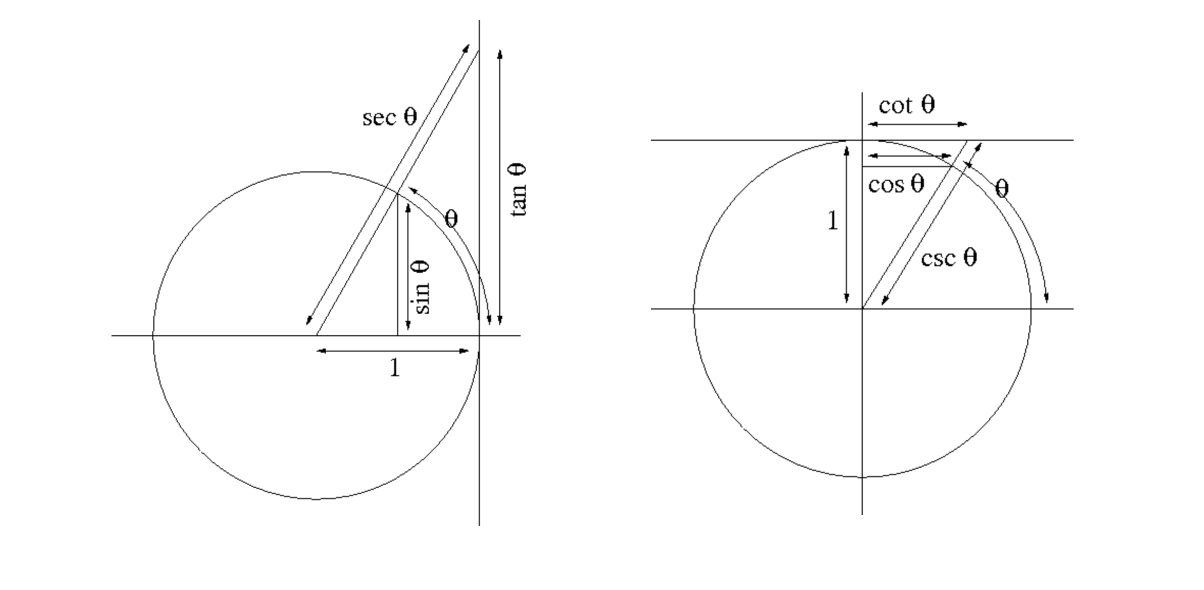
1
which word needs to be changed?
which word needs to be changed?
When we proved that tan x= sin x/cos x we used
1
what should it be changed to?
what should it be changed to?
0
Review questions: Categorize each parent function by dragging them to the different lables
logarithmic
Linear
polynomial
secant
tangent
sine
cotangent
quadratic
rational
radical
exponential
cosecant
cosine
unrestricted Domain--> x= all real numbers
restricted domain, x cannot be all real numbers.
An identity is true no matter what value is chosen for its variable. so lets do some true-false questions: each of these is either an identity or not an identity. categorize them.
identity
not an identity
which word needs to be changed?
When we proved that tan x= sin x/cos x we used
what should it be changed to?
To put it all together
do you have any questions?
Review: the co in cosine, cotangent and cosecant stands for complementary, which refers to the relationship to each other when their . The sine function is an function, because the graph of one side of the y axis is . Another list of trig identities to know are the cofunction identities -
Cos x= Sin
= tan (90°-x)
=
=
=
So far we have a set of basic trig identities, pythagorean identities and the cofunction identities, and odd/even identities. See if you can match identities,
| Draggable item | arrow_right_alt | Corresponding Item |
|---|---|---|
| arrow_right_alt | cos (90°-x) | |
| arrow_right_alt | cot(90°-x) | |
cot x | arrow_right_alt | csc (90°-x) |
sec x | arrow_right_alt | 1/sin x |
tan x | arrow_right_alt | cos x/sin x |
csc x | arrow_right_alt | 1 |
cos(x) | arrow_right_alt | |
| arrow_right_alt | ||
sin x | arrow_right_alt | cos(-x) |
Can you solve the following equation?
Prove the following identity: it easiest to just use a bunch of equation tool doohickies.
This is another section. I suggest you practice some of these in your modules and homework, and come back for the rest after you have let your mind brain absorb stuff.
Ok, our first set of identities was just relating all the trig functions together. Which is the reciprocal of what, what is the quotient of who, etc.
Then with odd/even function and co-functions, we had "what happens when we change the angle inside in specific ways, those ways being negating and phase shifting."
this next one is more general - what happens when we have two different angles being added together?
are there particular parts of this previous section you need more practice with?
Pause here and remember what I said about never subtracting. Replace b with negative b. Which identity will you need to use this equation to figure out sin (a-b)
Use the identities you picked before, change up sin(a+b) to sin(a+-b), and write down what you think it will be.
See if you can work out cos(x+y) on this version of the same proof.
OK, you should have gotten
here I want you to rewrite sin(a+b) where b=a. What do you get?
One more time, look at that equation, use the same identities you used before, and translate cos(a+-b)
Prove the following identity.
It is easy to put
do you want to go through the proof for these, or no?
prove one of the cofunction identities using the angle addition identities?
Last set of identities. These are just formulas you can use when they come up, they aren't ones you usually need to remember exist when being asked to prove an identity.
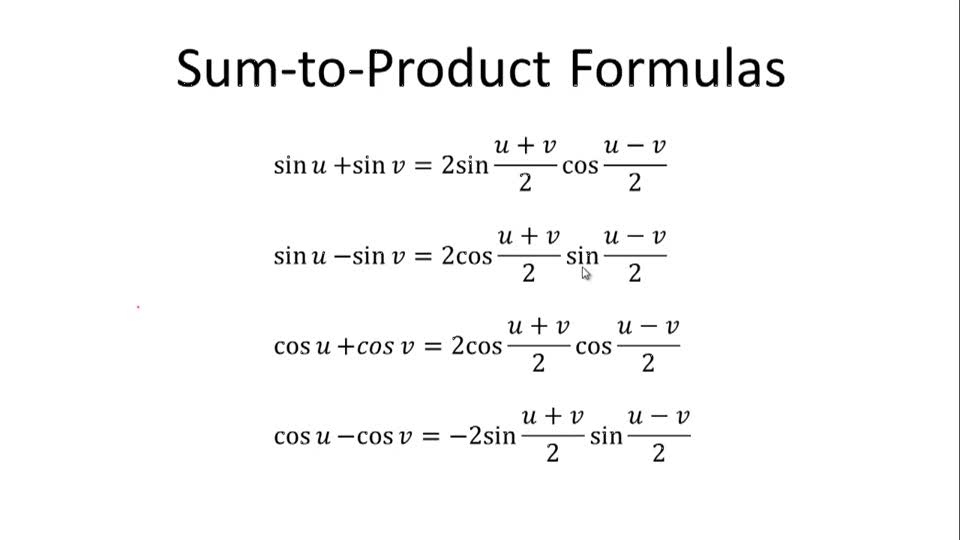
any questions?
Using the above list and only using the unit circle, give an exact answer to
First use the two angles above to find u and v.
how are you feeling?
what qualifies as an identity
cofunction identities
the geometry of the proof for angle addition
the angle addition identities
the angle subtraction identities
double angle identities
half angle identities
working the identities on Aleks
Sum to product formulas
Ive got this
im fuzzy
so confused
Does the way these two pictures show the geometric forms of the six functions reconcile you a little to the fact that csc is the reciprocal of sin, not cosine?
ok, lots of geometry. Which of the following is the same as angle y because of alternate interior angles
Which of the following is equal to (90°-y) Mark all that apply.
Since the hypotenuse of the red triangle is 1, we can assume that is the radius of a unit circle. which means,