Watch this video on vectors, do you have any questions?
match the description to the best representation
| Stavka koja se može prevući | arrow_right_alt | Odgovarajuća stavka |
|---|---|---|
The unit vector in the y direction | arrow_right_alt | (3,4) |
a vector that goes 3 in the y direction and 4 in the x direction | arrow_right_alt | <3,4> |
an initial point at =3, y=4 | arrow_right_alt | |
a vector that goes from (0,0) to (3,4) | arrow_right_alt | |
standard position | arrow_right_alt | |
the unit vector in the x direction | arrow_right_alt | Initial position is (0,0) |
A vector has magnitude and direction. A number that is NOT a vector is called a scalar. velocity is a vector because the direction matters to your velocity. Speed is scalar because you don't need to specify direction for your speed.
which of the following is not a way to express the direction of a vector
A vector has a magnitude and a direction, but does not have set initial position. that means that if someone gives you a vector that starts at (3,5) and has a terminal position of (7,12), it is considered the same vector as one that starts at (0,0) and ends at (4,7), and can be written as <4,7> or
If you move the initial point to the origin, you are puting the vector in
One of the things I don't love about the video is that it doesn't show the notation difference between a vector and a unit vector. Consider the following vector
Notice that vector d has an arrow on top, but i and j have little carets, or hats, on them. you would read this line as vector d equals three i hat + four j hat
Notice that the vector and the linear combination makes a right triangle where the vector is the hypotenuse, and the i and j components are the legs. Use the pythagorean theorem to find the magnitude of d, round to the nearest tenth
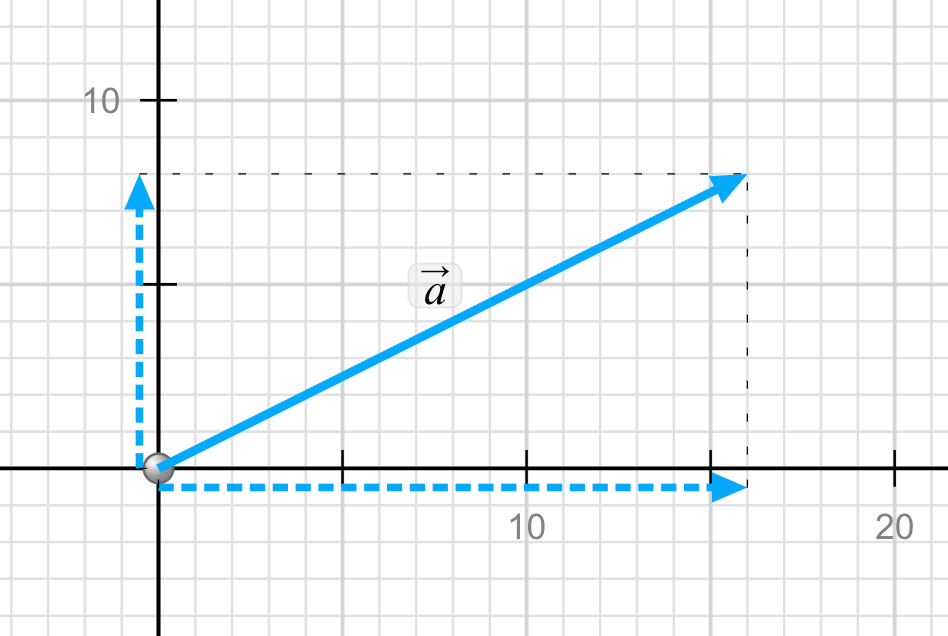
Given the following graph of vector

write the vector in its linear combination form (with i-hat and j-hat, and don't worry about adding the hats, it isn't simple online. if you want to try though, you can type \vec{a} into the numeric to get
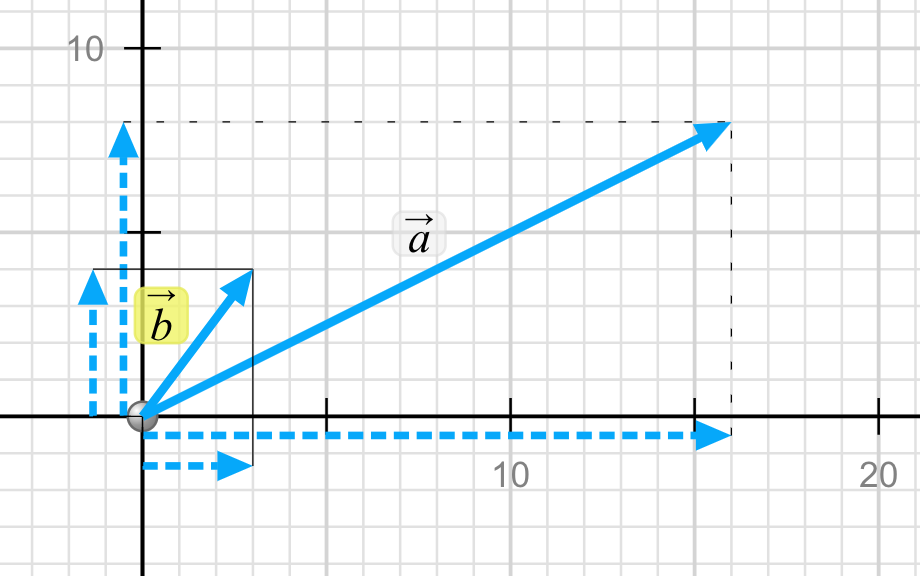
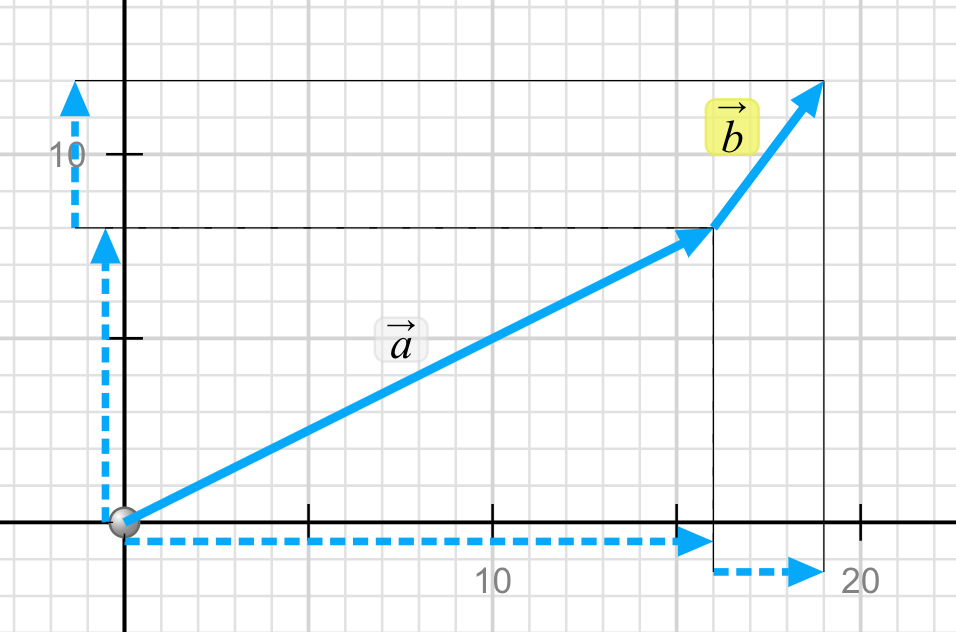
Lets add another vector to the graph, what is the component form of

Notice that we can move b so that it starts at the end of a. As long as it is in the same direction and has the exact same length, it doesn't matter where it starts.

This is called the tail to tip method of vector addition. give the terminal position of
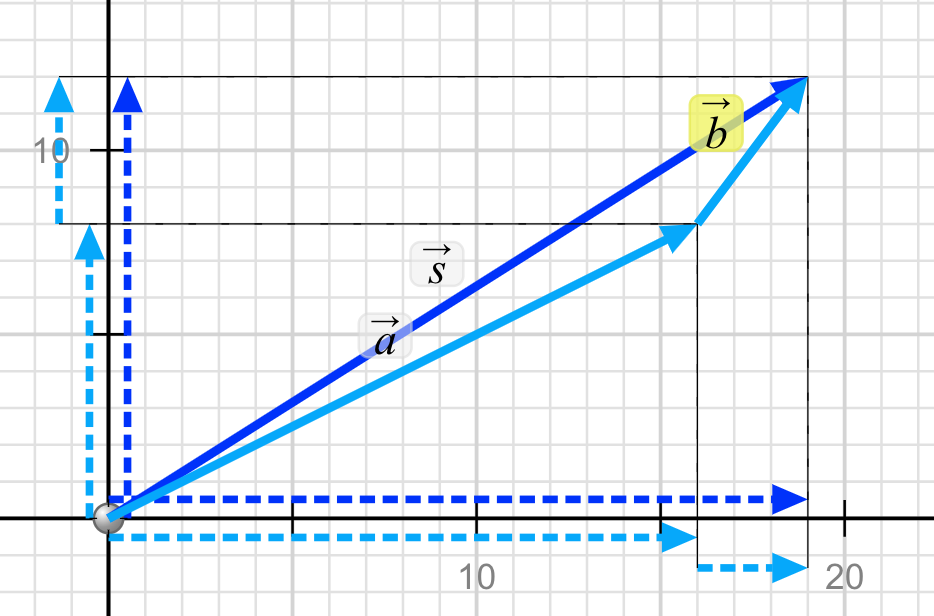
Notice that both
Once you put the tail of the second vector onto the tip of the first vector, you can add the vectors by drawing a vector from . this is called the

In the question above the component form of
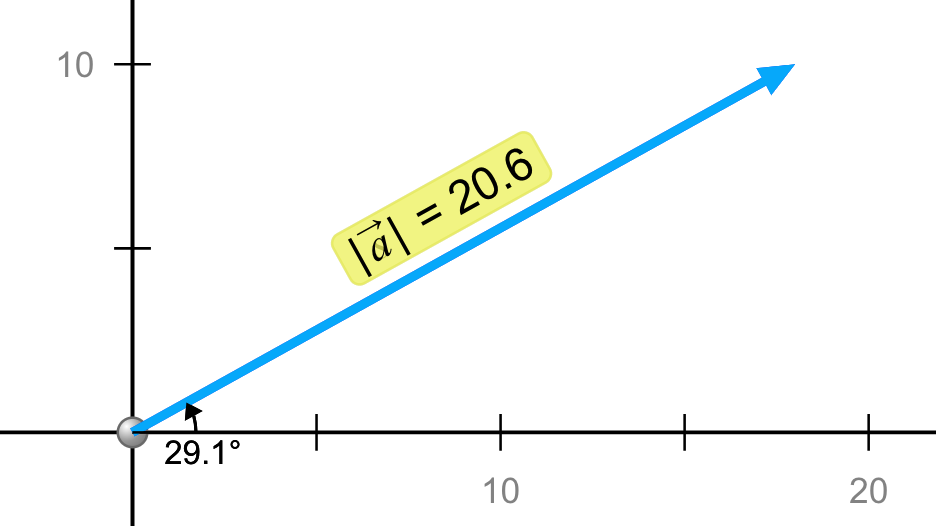
ok, What if you have a magnitude and a direction, how do you find the coefficient for the

You have to multiply the cos(
given just the components of the vector, how might you use trig to find the angle between the vector and the x axis?
Consider the following equation
What does it mean to subtract a vector?
recall that I dislike subtraction, and try to never do it. let me rephrase - given the following equation
What does it mean to make a vector negative?
spend some time on the following phet simulation https://phet.colorado.edu/sims/html/vector-addition/latest/vector-addition_all.html
what does it mean to multiply a vector by the number 3?
do you have any question about vector terminology, vector addition, and scalar multiplication?
Which of the following is the vector dot product of
Watch this video on vectors. its more of the same, but prettier. It tends to write vectors as matrices, which will come in handy later. What questions do you have about this one?
Below I am listing the objectives for the week. Please note the ones you are feeling good about, those that you are shaky on, and those that you are really struggling with.
what is a vector
graphing a vector
component form <a,b>
initial and terminal positions
linear combination form
finding the magnitude and angle given the components
finding the components, given the magnitude and the angle
adding vectors
negative vectors
subtracting vectors
scalar multiplication
how to calculate the dot product using component form
how to calculate the dot product using linear combination form
how to calculate the dot product using the lengths of the vectors and the angle between them
how to calculate the angle between vectors using component form
I've got this.
I'm fuzzy
so confused.
So far we have only every used vectors with two components. If there are three components, then the third shows
Notice that he has not been using arrows to show vectors. looking at this screen - what shows what is a vector and what is a scalar?
Notice that the form of the pythagorean theorem just extends with the third dimension. You can have vectors with more than 3 dimensions. What do you think the magnitude of vector <1,1,1,1> would be?
Orthogonal is another word for