Review: A vector \vec{A} is given as 4\hat{i}+2\hat{j}. match the description of the vector to the proper calculation
Draggable item
arrow_right_alt
Corresponding Item
initial position
arrow_right_alt
\sqrt{4^2+2^2}
The magnitude of the vector
arrow_right_alt
The length of the component of the vector in the positive x direction
arrow_right_alt
4
terminal position if it's initial position is (1,1)
arrow_right_alt
2
the length of the component of the vector in the positive y direction
arrow_right_alt
trick question - it doesn't have one
The angle between the vector and the x axis
arrow_right_alt
(1+4,1+2)
1 point
1
Question 2
2.
At the end of last week there was a section of the video that was explaining how to take the dot product. We have not yet explained what the dot product _IS_. First, lets discuss the basic algorithm of the dot product.
First - there is the trig way:
where \theta is the angle between the two vectors. What do the lines around |\vec{A}| mean?
1 point
1
Question 3
3.
Usually you use this form when given a vector in some way that is NOT the standard form (a\hat{i}+b\hat{j}) or component form <a,b>. See below - the vectors \vec{M} and \vec{N} are given as scalar extension of vectors.
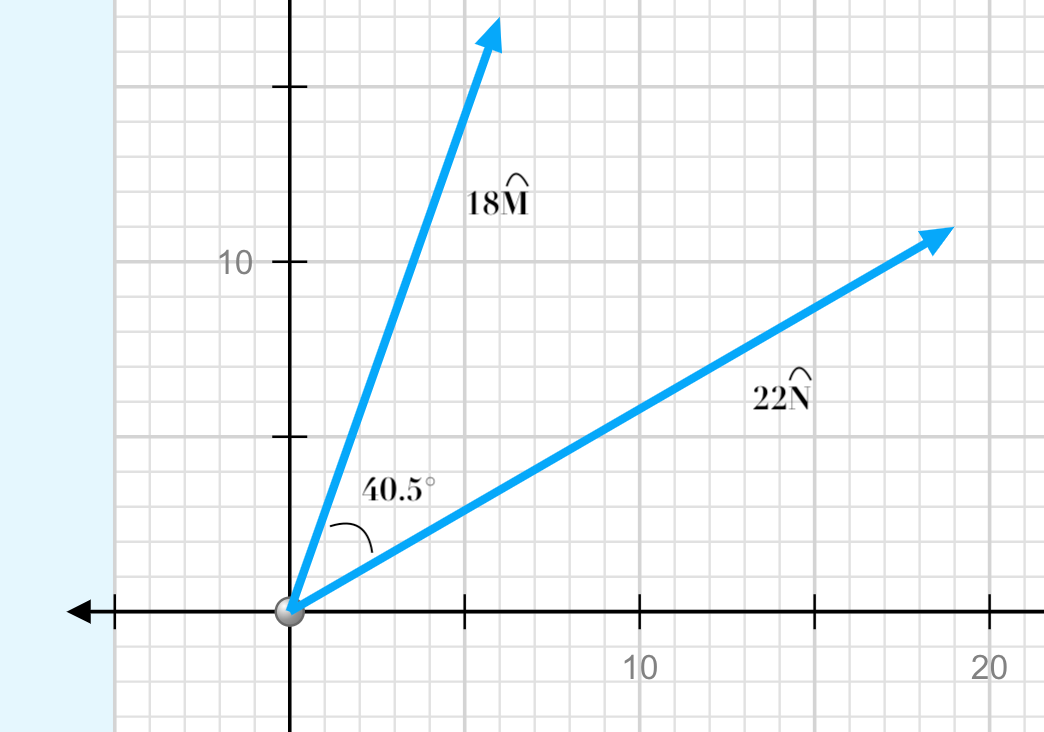
What does the hat over M and N mean?
1 point
1
Question 4
4.
what is the magnitude of \vec{M} above (NOT \hat{M})
1 point
1
Question 5
5.
What is \vec{M}\cdot\vec{N}? round to the nearest 10th. notice that the answer is NOT a vector.
1 point
1
Question 6
6.
The other is used when given a vector in standard or component form
or
give \vec{M} above in component form.
1 point
1
Question 7
7.
Find the component form of \vec{N} above and calculate \vec{M}\cdot\vec{N}. round to the nearest 10th. It won't be exactly the same, because the lengths of the vectors given above are rounded.
1 point
1
Question 8
8.
ok, thats the algorithm, what does this mean?
Watch this and write any questions you have.
1 point
1
Question 9
9.
What is the dot product of two orthogonal vectors?
1 point
1
Question 10
10.
What is dot product also known as?
1 point
1
Question 11
11.
If the dot product of two vectors is negative, what does it indicate about the angle between them?
1 point
1
Question 12
12.
Which of the following expressions represents the subtraction of vector B from vector A: A - B?
1 point
1
Question 13
13.
Which expression represents adding the opposite of vector A to vector B?
1 point
1
Question 14
14.
Ok, the rest of this flipped classroom is review of a couple bits from alg 2. Let's start with complex numbers. What is i? If you have hard time with this, maybe review using yay math's videos on complex numbers.
1 point
1
Question 15
15.
Simplify the expression. Write your answer as a imaginary number. No spaces.
\sqrt{-25}
1 point
1
Question 16
16.
Simplify the expression. Write your answer as a imaginary number. No spaces. Simplify any radicals.
\sqrt{8}\cdot\sqrt{-24}
1 point
1
Question 17
17.
Simplify the expression. Write your answer as an imaginary number.
(2i)^{5} \cdot (i\sqrt{6})^{2}
1 point
1
Question 18
18.
Simplify the expression. Write your answer as a complex number, a+bi, no spaces.
(9+5i)(4-2i)
1 point
1
Question 19
19.
In what ways are complex numbers and vectors similar? In what way are they different?
Ok, we have reviewed a little complex numbers, this next section is less 'Math you need to know' and more "what is this used for" as such, this is filled with some concerningly advanced level math, and it seems pretty long, but you won't be watching all of both videos if you don't want to. Just around 11 minutes of one and two minutes of the other.
1 point
1
Question 20
20.
Watch this video on spans of vectors -
1 point
1
Question 21
21.
We can use the dot product to change the basis vectors of a space. Can you think of reasons that might be practical?
1 point
1
Question 22
22.
Categorize
How do you find the dot product from component form?
how do you find the dot product from magnitudes and angles?