Given the following graph of a piecewise function, for what x does the limit not exist?
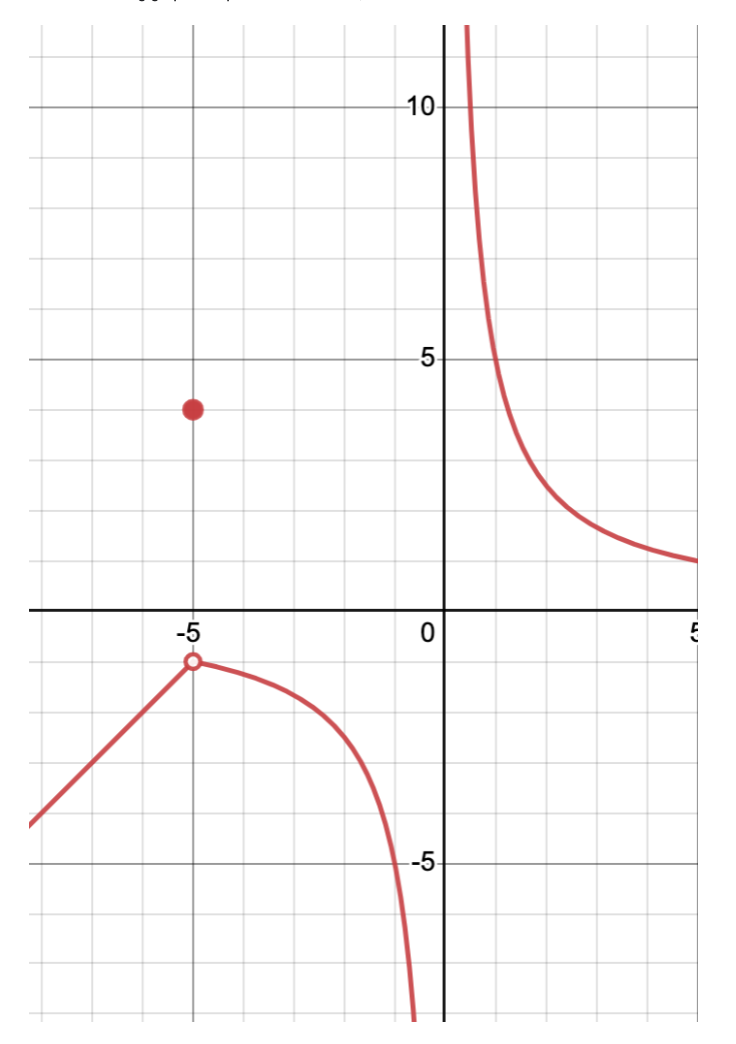
Given the following graph of a piecewise function, for what x does the limit not exist?
Algebra 2 review - use polynomial long division to divide the following
give in the form of
Given the following graph of a piecewise function, for what x does the limit not exist?
For the above piecewise function, what kinds of discontinuities are on the graph, from left to right
Watch the following video on composition of functions
Do you have any questions?
If
If
If
if
If
f(x)=
g(x)=
how would you prove that decomposing (like you did above) a function is not a function? (ie. there are always multiple correct ways to decompose a function)
watch this video on calculating inverses. Do you have any questions?
Find the inverse of
He says he can only find the inverse for a one-to-one function. What does that mean?
Watch the following video on asymptotes for radical functions
do you have any questions?
We discussed in class that you have to find numbers that must be excluded from the domain before you simplify a function. So the following function has a domain where x can't equal 1, even though (x-1) on top cancels with the one on bottom. what is this kind of scenario called
honors: if f(g(x))=g(f(x)) does it follow that f(x) and g(x) are either inverses or the same operation? why or why not?
The video said if the degree of the numerator was greater than the degree of the denominator there is no horizontal asymptote. Which is true. Go to desmos and plug in the following two equations. The linear equation is not a horizontal line, but it does look like an asymptote, why do you think that is?
What is the relationship of the domain and range of a function and the domain and range of its inverse?
Pair the term with the correct concept.
| Draggable item | arrow_right_alt | Corresponding Item |
|---|---|---|
Asymptote | arrow_right_alt | Combines two functions. |
Rational function | arrow_right_alt | A line that a curve approaches. |
Composite function | arrow_right_alt | Ratio of polynomials. |
Identify the appropriate pairings of function properties.
| Draggable item | arrow_right_alt | Corresponding Item |
|---|---|---|
One-to-one function | arrow_right_alt | Includes a root. |
Inverse function | arrow_right_alt | one output per input, Each output has only one input. |
Radical function | arrow_right_alt | Reverses another function. |
how are you tracking with the major topics from this week
What is a composite function
how to composite two functions
how to decompose a function
what an inverse function does
when, graphically, you cannot create an inverse function
when, verbally, you cannot create an inverse function
how to find an inverse function graphically
how to find an inverse function algebraically
how to determine vertical asymptotes
how to determine horizontal asymptotes